The Guardian has edited a controversial article about Gail’s bakery after it was accused of using anti-Semitic tropes.
The opinion piece, published on Saturday, described the opening of a Gail’s near an independent Palestinian cafe as an ‘act of heavy-handed high-street aggression’.
It prompted a furious backlash from critics who said the newspaper had published ‘centuries-old stereotypes’ about Jews.
But the article was edited on Tuesday evening to clarify the phrase ‘meant to refer to the described fears about the chain’s impact on small traders’.
Originally, the piece suggested the presence of a new Gail’s near the Palestinian cafe was ‘symbolic’ of the war in Gaza.
It claimed the parent firm of the Israeli-founded brand has invested ‘heavily in military technology, including Israeli security companies’.
‘Campaigners point out that [Gail’s] parent company, Bain Capital, invests heavily in military technology, including Israeli security companies,’ columnist Jonathan Liew wrote.
‘So even though Gail’s describes itself as ‘a British business with no specific connections to any country or government outside the UK’, its very presence 20m away from a small independent Palestinian cafe feels quietly symbolic, an act of heavy-handed high-street aggression.’
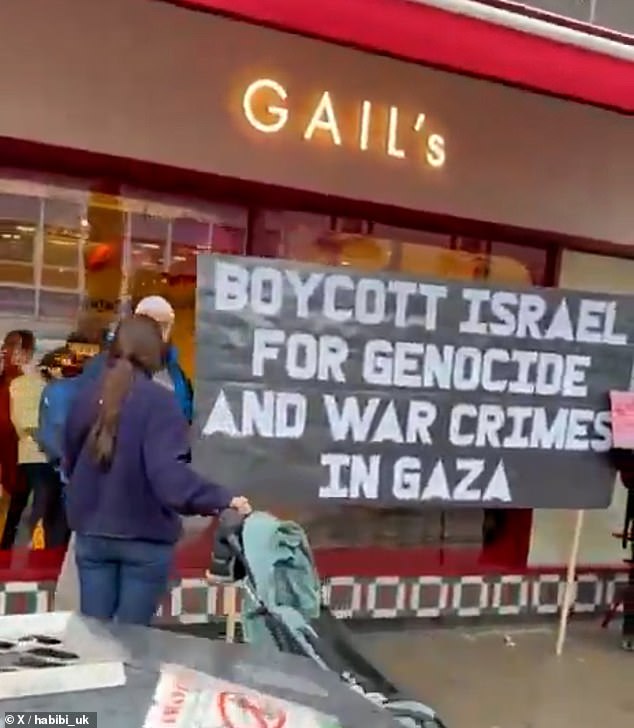
A Gail’s in Archway, north London, pictured after it was attacked by vandals. A Guardian opinion piece prompted outrage after it described the opening of the shop as an ‘act of heavy-handed high-street aggression’ against a Palestinian
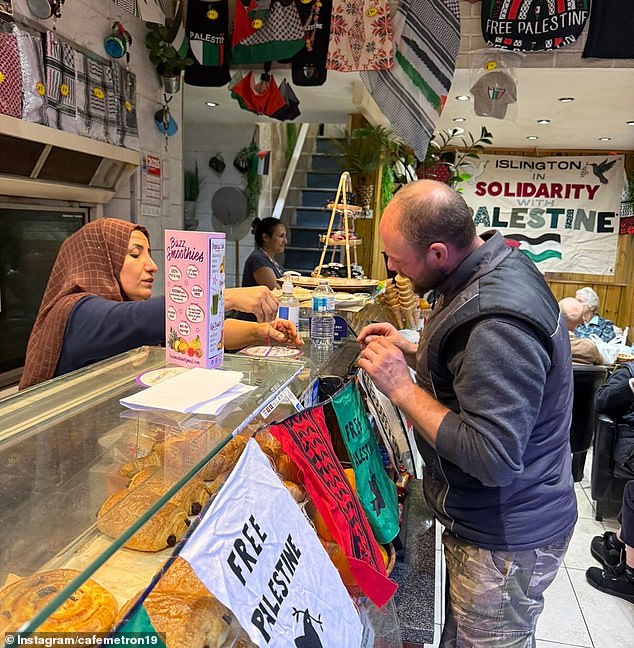
The article features an interview with Palestinian cafe owners in Archway, north London, pictured, where a new branch of Gail’s was recently established
But the claim of ‘aggression’ has been moved to follow a reference to the bakery ‘accelerating gentrification and squeezing out smaller outlets’.
It now states: ‘And so like the multinationals that landed before it, the very presence of this chain 20 metres away from a small independent cafe feels quietly symbolic, an act of heavy-handed high-street aggression.’
A note below the article also clarified it did not condone previous attacks on branches of Gail’s.
‘A comment contrasting activism that is capable of influencing global events with ‘small acts of petty symbolism’, which was not intended to minimise local vandalism but rather to suggest its misdirected futility, has been removed to avoid misunderstanding,’ it read.
But the edit has not been universally welcomed with some Jewish staff still ‘shocked and angry’ that it was published in the first place.
Around 40 protesters made their feelings clear about the article outside The Guardian’s office in King’s Cross today.
Signs being held warned that ‘extremists target Jewish and Israeli businesses’ and Gail’s products were being handed out.
The publication faced accusations that ‘the simple establishment of a Jewish businesses is now seen as a hostile act’.
Alex Gandler, the Israeli embassy’s UK spokesman, branded the article an ‘astonishing exercise in bigotry disguised as moral commentary’ and a ‘re-packaging of anti-Semitic prejudice in fashionable political language’.
The piece features an interview with Faten and Mahmoud, Palestinian owners of Cafe Metro in Archway, north London.
The nearby Gail’s was last month targeted for a second time by vandals who smashed windows and painted anti-Zionist graffiti.
Mahmoud said ‘we compete with [Gail’s] legally’, adding they had nothing to do with the attack.
Gail’s was founded by Israeli baker Gail Mejia in the 1990s and expanded by Israeli entrepreneur Ran Avidan from 2005 – both are no longer linked to the company.
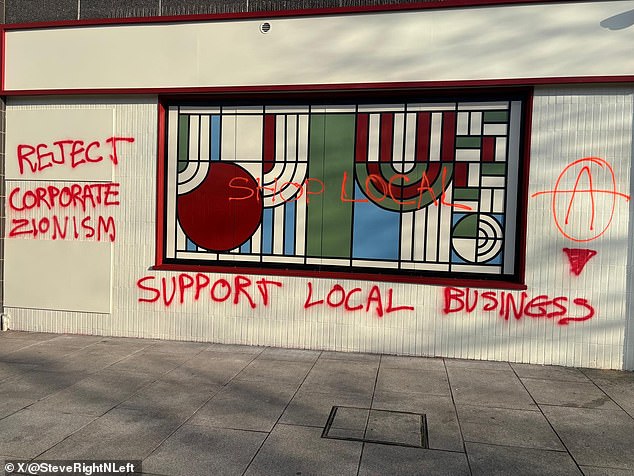
The Archway Gail’s pictured after it was daubed in graffiti last month
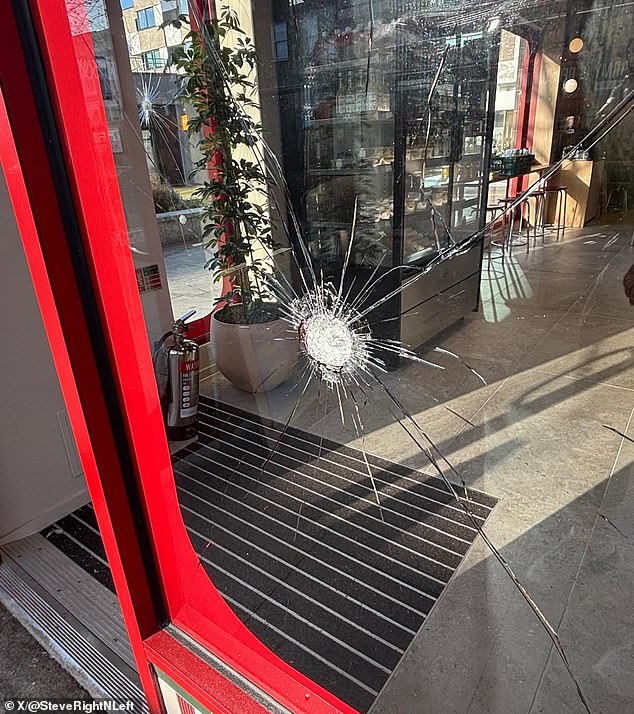
The previous attack on the Archway branch took place just hours before it opened to the public
In 2021, US investment fund Bain Capital acquired a majority stake in the business, which says it has ‘no links with any country or government outside the UK’.
Mr Liew said Cafe Metro has also been targeted with ‘Stop killing people’ stickers.
He added: ‘Somehow these two… cafes, from two entirely separate worlds, with what we have to assume are two almost entirely separate clienteles, have found themselves on the frontline of a war.
‘A deeply asymmetric war, defined by gross imbalances in power and resources and platforms… one that simultaneously feels more distant and more local than ever.’
In response, Mr Gandler said: ‘It is a very old prejudice wearing new clothes. [Mr] Liew… attempts to turn north London cafes into a symbolic battlefield of the Israeli Palestinian conflict. In doing so, he falls into a trope that has echoed through centuries of European discourse: the insinuation that Jewish success or presence represents some form of encroachment by powerful ‘global’ forces.’
‘Perhaps this writer is not qualified to write on this topic if he keeps accidentally stumbling into antisemitic tropes when he tries to tackle it,’ a Guardian journalist told The Times.
‘He seems to be extremely unlucky with these misunderstandings.’
The Campaign Against Antisemitism said the article gave a ‘warped view of the Palestinian-Israeli conflict’ and encourages ‘anti-Israeli sentiment’.
A Guardian spokesman said: ‘Complaints about Guardian journalism are considered by the internally independent readers’ editor under the Guardian’s editorial code and guidance.’