Battle lines were drawn this week in a conflict unlike any in U.S. history: not with America’s rivals or enemies, but with its closest allies.
For now, both sides have stepped back from the brink.
They appear to have found a formula by which U.S. President Donald Trump will drop his demand that the United States be allowed to “acquire” Greenland, which is a part of Denmark. That was an ultimatum that Denmark and other European NATO members had unanimously rejected.
Why We Wrote This
The dispute over Greenland may have been resolved at Davos. But it generated so much ill will and mistrust between Washington and its European allies that NATO might not recover.
Still, the escalating tension, especially after Mr. Trump slapped tariffs on Denmark’s European supporters, has sorely tested trust within the Western alliance – to the point where some fear that NATO is in danger of becoming a dead letter.
By the time a compromise was worked out late Wednesday, one NATO leader – Canadian Prime Minister Mark Carney – had urged fellow “middle powers” to recognize a new reality.
Mr. Trump had abandoned the old rules of engagement with America’s partners, Mr. Carney suggested, in favor of a “great power” world in which the strong could simply take what they wanted. “The rules-based order is fading,” he said. “We are in the midst of a rupture, not a transition.”
This week’s tensions came against an unlikely backdrop: the snow-carpeted resort town of Davos in the Swiss Alps, site of the annual World Economic Forum.
For years, the Davos forum has been a meeting point for political leaders and policy wonks, entrepreneurs and investors, championing cooperative solutions to international challenges.
This year, however, it became the stage for a war of worldviews, between the Davos vision and the “America First” unilateralism of the week’s most anticipated speaker, President Trump.
Since his return to the White House, Western allies have grown increasingly concerned over Mr. Trump’s readiness to deploy America’s power not just against foes, but to wrest concessions from friends, especially on trade.

Yet his insistence that America must “own” Greenland, implying that he might use force to ensure that outcome, curdled concern into outright alarm.
European leaders warned that such a U.S. takeover would mean the end of NATO.
When European NATO countries joined Denmark in sending a small military contingent to the island last week, they intended to reassure Mr. Trump of their readiness to help beef up its defenses. The president, though, appeared to see it as a move to oppose any U.S. takeover, and responded with new tariffs on the countries concerned.
That prompted criticism not only from European governments, but even pro-Trump opposition parties, such as Nigel Farage’s Reform UK and the far-right Alternative for Germany.
By the time the president’s helicopter touched down in Davos on Wednesday, European leaders were more hopeful than confident of finding a way to scale back hostilities.
Even British Prime Minister Keir Starmer, who has consistently avoided publicly clashing with Mr. Trump, told Parliament that the U.S. tariffs would not weaken his insistence that Denmark and Greenland must decide the island’s future themselves.
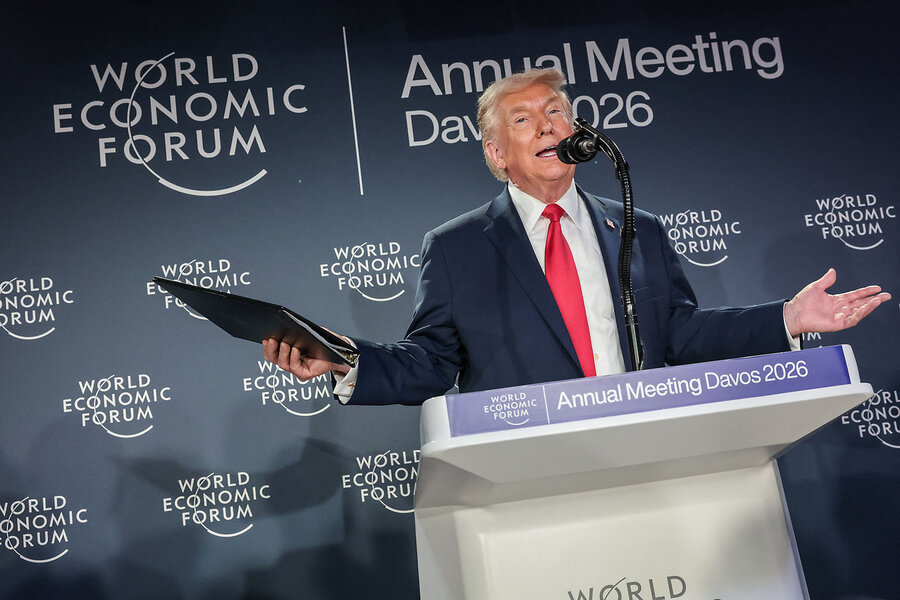
When Mr. Trump strode to the Davos microphone, he said little at first to suggest he was in the mood for compromise.

Sean Kilpatrick/The Canadian Press/AP
Appearing very much the “great power” president whom Mr. Carney described, Mr. Trump extolled American wealth and power. He said allies’ sole hope was to ride on America’s coattails, and that those who did deals in response to his tariff pressure would thrive. He lambasted European leaders for their policies on immigration and green energy.
He dismissed the value of NATO, suggesting that only America’s allies had benefited from it.
On Greenland, he doubled down on the need for the United States to take control, proposing that his NATO partners, after freeloading off Washington for decades, should grant this one request.
“You can say yes, and we will be very appreciative,” he told them.
“Or you can say no. And we will remember.”
Yet he did retreat from indications he might use force against a fellow NATO state. Though that force would be “unstoppable,” he said, “I don’t have to use force. I don’t want to use force. I won’t use force.”
That, it appears, helped pave the way for NATO’s secretary general, Mark Rutte, to work out a “framework” security deal with Mr. Trump covering Greenland and the wider Arctic region.

The president gave no details, and the understanding stopped far short of a formal agreement.
But the arrangements appear likely to involve a greatly increased U.S. military presence in Greenland and effective security control. Those provisions have been possible all along, under a 1951 agreement between Copenhagen and Washington – with the Europeans’ caveat that Danish sovereignty and the views of Greenland’s autonomous local government be respected.
And, crucially for the Europeans, Mr. Trump announced he was canceling his tariffs.
The key question now is how badly European trust in Washington – the bedrock of the transatlantic alliance – has been damaged by Mr. Trump’s explicit insistence that allies should make his policy priorities their own.
Europe knows it still needs America, especially to ensure that Ukraine can withstand Russia’s invasion force.
Yet transatlantic trust has plummeted over the Greenland crisis. The sense that the old bonds were fracturing, maybe forever, was evident among the audience in Davos.
They listened to Mr. Trump’s broadsides, aimed at European leaders, in near silence.
But the Canadian prime minister’s blunt message, that America had changed and other countries must build new avenues of cooperation and defend international “legitimacy and integrity,” was greeted with a quite different response, rare at these meetings.
He received a standing ovation.