By RUTH WALKER, U.S. BOOKS EDITOR
For years, Gisele Pelicot had been plagued by terrifying bouts of memory loss.
Their increasing regularity could only mean one thing, she thought: that she was dying of a brain tumor – just as her mother had done when Pelicot was nine years old.
The loss had resulted in what Pelicot described as a ‘descent into hell’ – a trauma that sucked her childhood and teenage years into a black hole.
Now she was facing the same symptoms and it felt like a curse – that destiny was finally catching up with her.
It was only when her husband of nearly 50 years, Dominique, was arrested and later convicted of systematically drugging and raping her – and inviting more than 50 men to abuse her unconscious body – that the horrifying, unimaginable truth became clear.
In her new memoir, A Hymn To Life: Shame has to Change Sides, she wrote that it was her daughter, Caroline, who first suggested that her memory lapses might have something to do with the drugs she had been plied with for the past decade.
‘I hadn’t made the connection,’ she wrote. ‘Dominique had always been there to witness my memory losses. He was the one who reassured me and took me to the doctor; he was the one to whom my hairdresser had confided her concerns that time I’d completely forgotten I’d been in for an appointment.
‘I went back the next day to try to piece together what had happened. She told me how relieved she was when I walked in again, and described my blank expression in the mirror the day before, my mechanical responses to her questions, how she had been afraid I might be having a stroke, how she’d suggested to Dominique I get some tests done as a matter of urgency.

Gisele Pelicot was plagued by memory loss in the 10 years before her husband was brought to justice
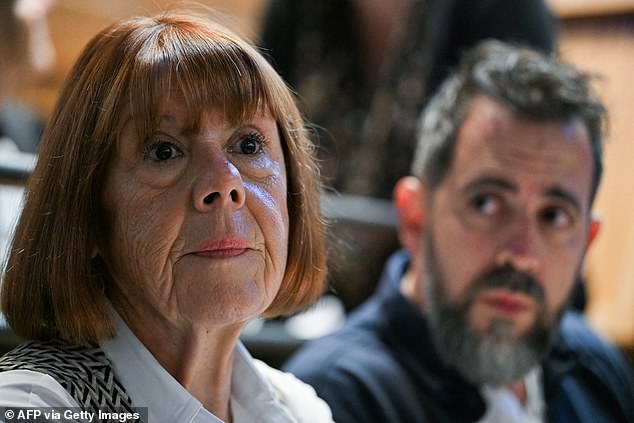
Pelicot in court with her youngest son Florian

During the trial of her husband, murals of Pelicot’s face appeared across France in solidarity. This one reads: ‘Gisèle, women thank you’
‘He was my ally.’
On another occasion, her children later told her, she’d been on the phone to her grandson and kept repeating the same thing, ‘like a broken record.’ He was so embarrassed that he’d hung up.
One friend of the family suggested it might be Alzheimer’s. Another whispered that perhaps it was time to consider putting Pelicot in a home.
Pelicot remained convinced she had a brain tumor – despite the fact that a 2017 scan had come back clear.
And throughout all the doctor’s visits, concerned conversations, and Pelicot’s own deep trauma, her husband played the part of loving, supportive partner to hide the truth of his vile lies.
‘When the children called, it was not unusual for their father to tell them I was too tired to speak,’ she wrote in the memoir.
‘Whenever they came to visit, though, I was fine. There was never anything wrong, except for one time when everyone was leaving to go back to Paris.
‘I had spent lunch slumped in my chair, my arm falling continually as if I couldn’t control it. Florian [her youngest son] was clearly upset, he didn’t want to leave, but his father frogmarched him to the car and said, “Don’t worry, she’s just tired, I’m going to put her to bed.”
‘He was going to put me to bed, yes. To rape me and invite other men to rape me a few hours after my son had left.’
Now aged 73, Pelicot became a global symbol of strength for abuse survivors everywhere, after defiantly waiving her legal right to anonymity at a rape trial the likes of which the world had never seen.
In a courthouse in Avignon, France, in 2024, her husband admitted to drugging and raping her – inviting dozens of men he met on the internet to sexually assault her while unconscious in her bed – for almost a decade.
Pelicot attended the entire four-month trial and the appeal, a tiny figure with a neat bob and tailored jackets, whose quiet strength and dignity against the unfolding horrors of the case prompted thousands to march in support, with murals of her face appearing across the country.

Pelicot’s memoir recounts how she fell in love with Dominique (right) when both were virgins

Pelicot leaves court surrounded by press – she waived her right to anonymity

Pelicot became a global symbol of strength for abuse survivors
Her memoir describes how she fell in love with Dominique as a young virgin, and how they grew together as a couple before retiring to the French town of Mazan in south-eastern France.
When police first informed her that photographs and video revealed her being raped at least 92 times by 72 different men – all facilitated by the man she lovingly called Doume, an affectionate nickname for her Dom – she was in denial. How could that be her in those images? She looked like a rag doll.
But as she pieced together their past – and as she faced her abuser in court – the full extent of his perversion became impossible to deny.
That he had allowed her to believe she was dying was just one more layer of his violation of her body and spirit.
‘I spent a decade having endless medical examinations,’ she wrote. ‘Blood tests. Scans. Multiple courses of vaginal pessaries. Neurological tests. Ten years of going to see doctors who looked at me as if to say that at my age, a woman can’t expect much any more… never wondering what might be going on. Never attempting a diagnosis.
‘And Dominique, always there by my side. He knew.’
On one occasion, she said, she unwittingly came close to uncovering the truth.
She described being shrouded by a brain fog all day, unable to remember anything at all – what time she got up, what she’d been wearing.
‘I joked to Dominique, who was busy fixing something, “Doume, you haven’t been drugging me, have you?”’
Her husband burst into tears, feigning distress.

In a recent exclusive interview with You Magazine, Pelicot revealed that she has unexpectedly found love again

‘Dominique, always there by my side. He knew,’ wrote Pelicot in her memor

Pelicot’s daughter Caroline Dorian – who was first to make the connection between her memory lapses and the drugs she’d been given by her husband
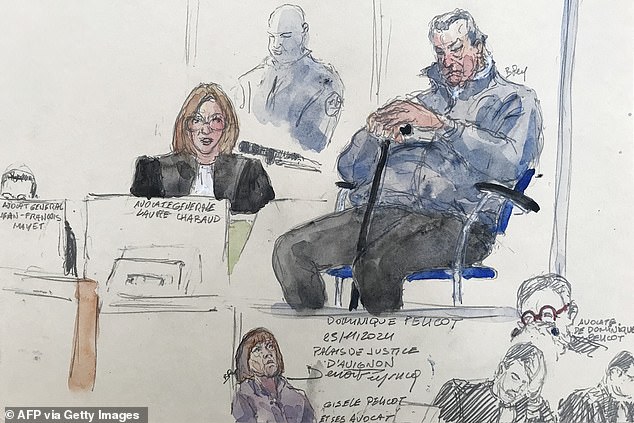
A court sketch of Dominique during his trial – he is currently serving 20 years for aggravated rape
‘How could you possibly say such a thing?’ he told her, weeping.
In December 2024, Dominique Pelicot was convicted of aggravated rape and given a 20-year sentence.
All of the 50 co-defendants were found guilty of committing aggravated rape, attempted rape or sexual assault against Pelicot, and were sentenced to between three and 15 years’ imprisonment. Only one ended up appealing and lost in court last year.
In a recent exclusive interview with You Magazine, Pelicot revealed that she has unexpectedly found love again, with a former Air France steward called Jean-Loup.
‘It happened almost by accident, because I never thought I’d fall in love again or would even want to,’ she said.
‘Neither of us expected it at all. And we thought, “Why not? Why not allow ourselves to be happy?”’
A Hymn To Life: Shame has to Change Sides by Gisèle Pelicot is published by Penguin Press