Gerry Adams was ‘directly responsible for and complicit in’ IRA decisions to bomb England across almost a quarter of a century and was the terror group’s ‘de facto leader’, a landmark civil trial has heard.
The former Sinn Fein president is being sued by three victims of IRA bombings on the British mainland who allege that Mr Adams was one of the key orchestrators of attacks in England between 1973 and 1996.
He attended the High Court in London today for the first day of his trial in what appeared to be a protective vest.
The claimants are seeking symbolic damages of just £1, with the trial examining Mr Adams’ long-standing denial that he was ever a member of the IRA.
The court has heard the claimants’ focus is ‘to prove on balance of probabilities that [Mr Adams] was so intrinsically involved in the Provisional IRA organisation that he is as culpable for the assaults giving rise to these claims as the individuals who planted and detonated the bombs.’
Opening the claimants’ case, Anne Studd KC, said that a former Army intelligence officer, who will give evidence this week, was privy to information that communicated ‘both explicitly and implicitly’, that Mr Adams was a senior member of the IRA’s ruling Army Council and the ‘de facto leader of the IRA.’
The trial marks the first time Mr Adams has been questioned over his alleged role in the IRA in an English courtroom.
He has never been convicted of IRA membership and continues to deny he had any role in the Provisional IRA.
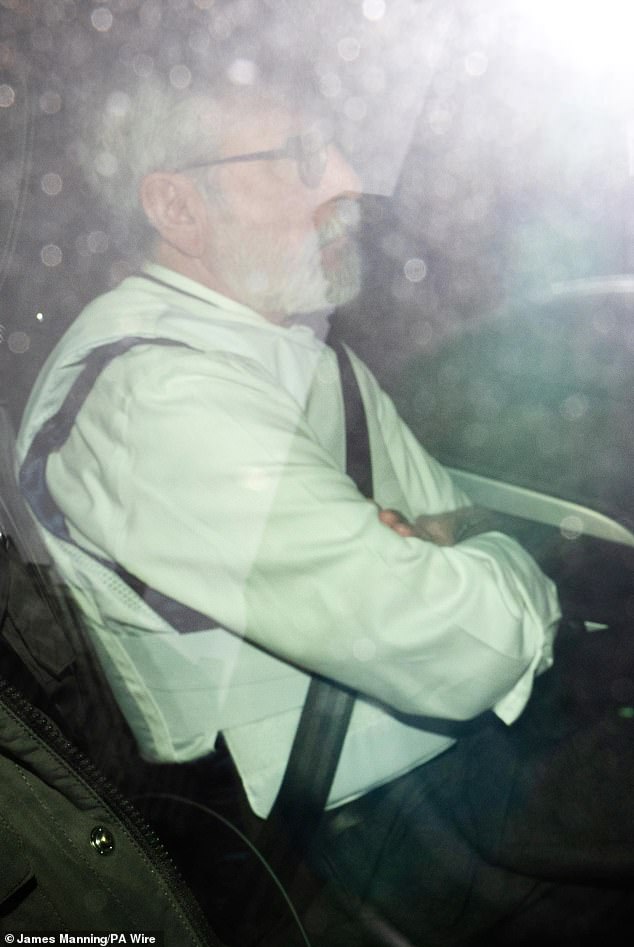
Mr Adams, 77, appeared to attend court today in a protective vest. He is vigorously defending the claims made against him
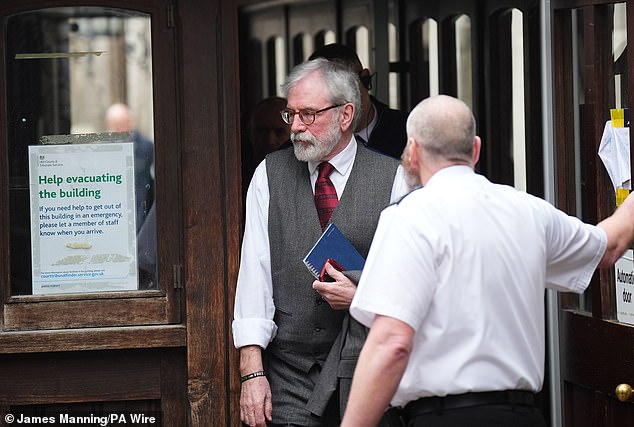
The former Sinn Fein president – seen here arriving at the Royal Courts of Justice – is being sued by three victims of IRA bombings on the British mainland
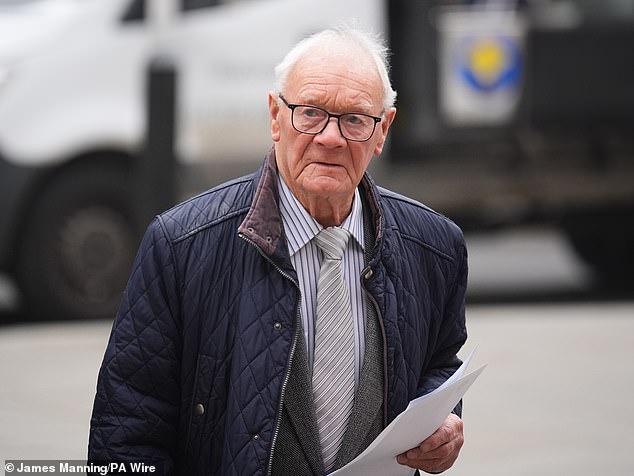
Barry Laycock, who was injured in the 1996 IRA attack on Manchester’s Arndale shopping centre, is one of three survivors of IRA bombings suing Mr Adams
He claims his attendance at high-level meetings with members of the British government were in his role at Sinn Fein, rather than the IRA.
Mrs Studd added that the ‘evidence of those who associated with him over the relevant time, and the structure of the [IRA]’ will show Mr Adams was ‘directly responsible for and complicit in the decisions made by that organisation to detonate bombs on the British mainland in 1973 and 1996.’
She continued: ‘The Army Council set the strategy for the Provisional IRA through all the years of the Troubles.
‘It did not really change in its basic information, which was that the defendant was an instrumental force in the organisation of the Provisional IRA and building of the two-strand attack – Armalite and the ballot box.’
He is being sued for symbolic damages of £1 by John Clark, a victim of the IRA’s Old Bailey attack in 1973; Jonathan Ganesh, who was injured in the 1996 attack at London’s Docklands and Barry Laycock, who was injured in the attack at Manchester’s Arndale Shopping Centre in the same year.
The High Court has been told that former IRA volunteer Dolours Price, who was jailed for her role in the Old Bailey bombing, named Mr Adams in 2010 as ‘the person who had agreed that volunteers should be sent to the UK mainland to commence bombing, one of which was the bomb at the Old Bailey.’
Peter Rogers, another former IRA volunteer, said that in 1980 he met with Mr Adams who allegedly asked him about the moving of explosives to the British mainland.
He had expressed surprise that Mr Adams had any knowledge of the operation if he was solely a member of Sinn Fein and not the IRA.
The court also heard that in 1993, when discussing whether Mr Adams should be granted a visa to visit the United States, President Bill Clinton told the Mayor of New York that ‘credible evidence exists that Adams remains involved at the highest level in devising PIRA [Provisional IRA] strategy.’
The following year, however, Mr Adams was granted a 48-hour visa to visit the US.
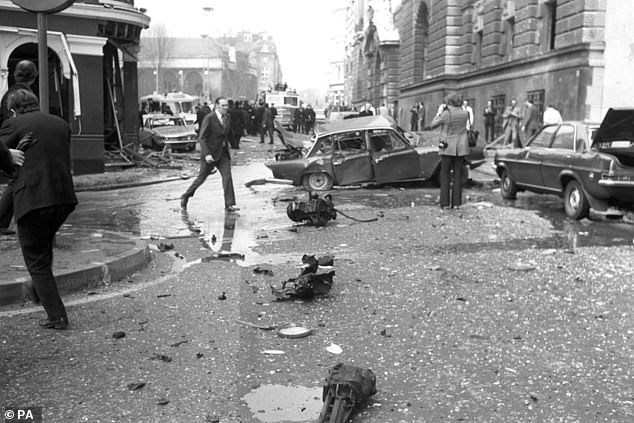
The aftermatch of the 1973 Old Bailey bombing in London in which at least 200 people were injured. The claimants contend Mr Adams was responsible owing to his IRA role
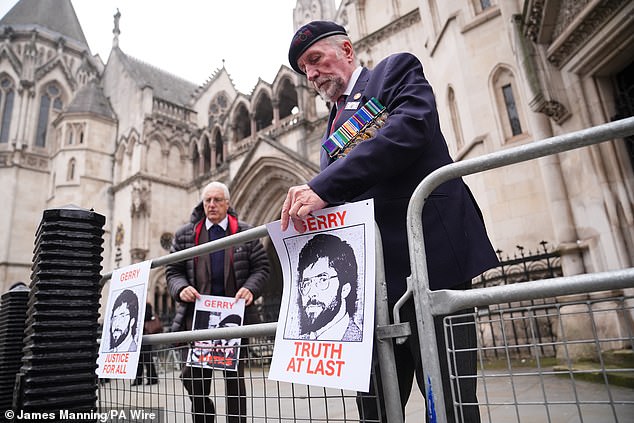
There were a number of veterans outside London’s Royal Courts of Justice on Monday, the first day of Mr Adams’ civil trial
The court was also told that Mr Adams wrote for the Republican News newspaper – also known as An Phoblacht – under the pen name, ‘Brownie’.
One ‘Brownie’ article in 1976 included the line: ‘Rightly or wrongly, I’m an I.R.A. Volunteer.’
Mr Adams will say that this was actually written by his assistant, Richard McAuley, and he did not pen all the articles under the pseudonym.
Mrs Studd, for the claimants, pointed out that Mr McAuley is not being called by Mr Adams to corroborate this.
Mr Adams is also alleging that Gerry Kelly, a Sinn Fein politician who was also convicted of the Old Bailey attack, was in charge of the Belfast IRA in the 1990s. However he is not being called as a witness.
Mrs Studd alleges that these are people ‘who will not seemingly publicly support the defendant’s version of history.’
It has even been claimed that, in 1982, one former IRA volunteer, Sean O’Callaghan, said Mr Adams ‘suggested assassinating John Hume’, the former SDLP leader.
Mr Edward Craven KC, for Mr Adams, said the allegation had been made in a book written by a ‘serial fantasist.’
The court heard that Mr Clark was a police officer and sent to the Old Bailey in 1973 when the bomb was detonated and shrapnel was lodged in his hand. At least 200 people were injured.
Mr Ganesh was a part-time security guard when the Docklands bomb was detonated in 1996. Two of his friends were killed and he has suffered from PTSD.
Mr Laycock was said to have been ‘blown across the room’ when a bomb was detonated at Manchester’s Arndale shopping centre. He suffered back and leg injuries and has also been diagnosed with PTSD.
Mrs Studd added: ‘There is no doubt that the defendant contributed to the peace in Northern Ireland, but the claimants say that on the evidence he also contributed to the war.’
On behalf of Mr Adams, Mr Craven said he ’emphatically, unequivocally and categorically denies any involvement in the bombings.’
‘And he emphatically, unequivocally and categorically denies that he was ever a member of the IRA,’ he added.
He said that Mr Adams had ‘never been formally questioned, let alone prosecuted or convicted’, in relation to the three bombings in question – while others had.
Mr Adams was facing ‘extraordinarily serious’ allegations that he was ‘involved in some of the worst terrorist atrocities imaginable over 30 years,’ he said.
On Ms Price’s allegation that he had directed the Old Bailey bombers, Mr Craven said she was ‘about as unreliable as it is possible to be’ as she had a ‘virulent hatred’ of Mr Adams and ‘loathed’ his role in the 1998 Good Friday Agreement.
The trial continues.