In a hall at Nasser Hospital in Khan Yunis, mothers and fathers sit in white and brown plastic chairs, their faces carved with worry.
At the front of the room, a staff member from the hospital’s forensic department, dressed in a black vest, stands beside a large screen. He swipes images one after another, pausing briefly after each one, scanning the room for a flicker of recognition.
None comes. In the audience, all are silent as they study the screen. Each of them has a loved one who disappeared without explanation during the Israel-Hamas war. These images might be their only remaining path to answers.
Why We Wrote This
The fragile peace in Gaza affords an opportunity for Palestinian families whose relatives have gone missing to search for them. Thousands of people disappeared without trace during the war; their parents and siblings are torn between wanting to learn their fate, and fearing they have died.
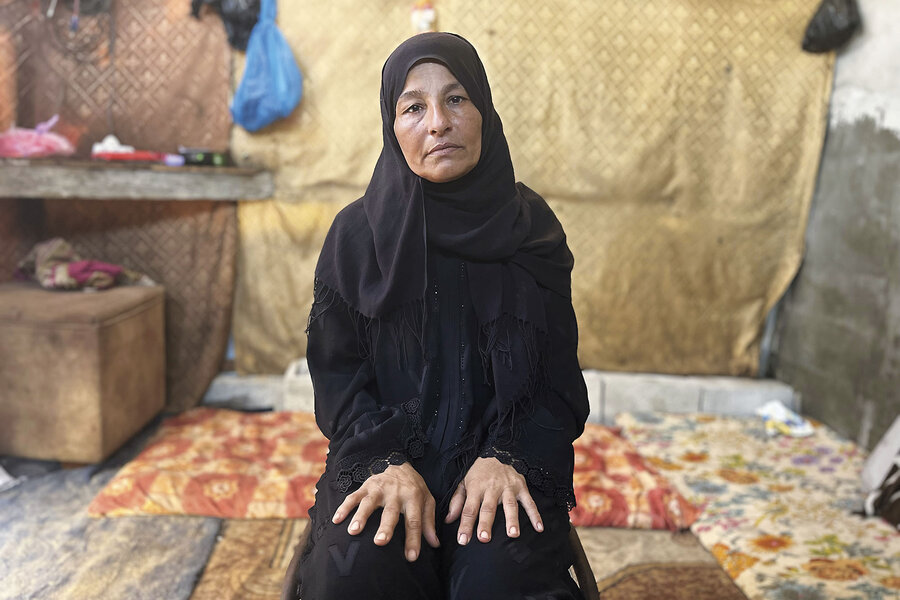
Among those silently studying the screen is Rida Ash-shahry and her daughter, Mahasin. The women are regulars.
The photos are of deceased Palestinians whose bodies have been returned by Israel. They were handed over by the Israeli military through the International Committee of the Red Cross (ICRC) to the Palestinian Ministry of Health. The Israeli army has provided little biographical information about the returned remains, leaving these families in limbo.
Mrs. Ash-shahry searches for anything that might belong to her youngest son, Hussam – a familiar jawline, the curve of a brow, a hint of the face she last saw on the morning he disappeared on June 23, 2025. She whispers prayers under her breath. She wants closure, no matter how painful.
None of the images belong to Mr. Ash-shahry. Relief and despair rush through his mother all at once.
“I was happy to know he is not there,” she said softly. “But I also want an answer. Is he alive or is he dead?”
Though a ceasefire reached in October means the bombing of Gaza has slowed, the search for the missing – and the funerals – are only just beginning.
A search for answers
Thousands of Palestinians are unaccounted for in Gaza. These include people detained by Israeli soldiers, lost in the chaos of displacement, buried under destroyed buildings, or killed in the pandemonium at aid distribution sites – some by Israeli military fire.
The search for answers comes as Hamas and Islamic Jihad return the remains of the last of the 28 Israeli and Thai hostages killed in Gaza to their grieving families in Israel, as part of the fraught and fragile ceasefire.
The confirmation in October of which hostages died in captivity brought devastating clarity for Israeli families which had held out hope their loved ones were still alive. Yet this step toward resolution has been delayed for many Gazans, who have not been able to confirm their loved ones’ status.

“To date, there is no final or official number of missing and forcibly disappeared persons, but we are talking about thousands of cases based on the reports we receive daily,” says Ghazi Al-Majdalawi, coordinator of the Palestinian Center for the Missing and Forcibly Disappeared.
He points out that Gaza lacks DNA testing capabilities. And Israeli authorities rarely inform families which Gazans are held in their jails.
“Families live in a state of constant and agonizing anticipation, searching [and] hoping to find their loved ones,” Mr. Majdalawi says.
Like Mrs. Ash-shahry, many are afraid of what the truth will mean.
In pursuit of food
On the June morning that Mrs. Ash-shahry lost her son, he had woken unusually early, startling his then-pregnant wife, Afnan.
By then, people were experiencing severe hunger as Israel blocked food and medical supplies into Gaza. The shelves in displaced people’s shelters were bare; children cried themselves hoarse from hunger.
“We’re having a baby,” he told his wife. “Let me go. We need food. Otherwise you and our coming child will starve.”
He was joined by five young men from their makeshift camp. Together, they headed toward Al Shakosh, a food-distribution point run by the now-defunct Gaza Humanitarian Foundation, an Israeli-backed American organization. Al Shakosh was one of four such sites, which, because of disorder and the Israeli military’s use of live fire, locals had come to fear, calling them death traps.
That evening, the five men from the camp returned. Mr. Ash-shahry did not.
His friends told the family they last saw him inside the Al Shakosh compound, not long before the gates opened, allowing aid seekers to rush towards cartons of food. Then, he was gone.
Mrs. Ash-shahry and her daughter have made a regular pilgrimage to Al Shakosh on foot, asking anyone they could find whether they had seen him.
The family began an exhaustive search of every medical facility they could reach: Nasser Hospital, European Gaza Hospital, Al-Aqsa Martyrs Hospital, field clinics, and the ICRC’s medical station.
At Nasser Hospital, Mrs. Ash-shahry approached a nurse, her voice shaking. “Please, I’m looking for my son, Hussam Ash-shahry.” The nurse checked the intake logs for that day. “No one with that name has come,” he said gently, promising to call her if anything changed. That call never came. She returned again and again. In this time, Afnan gave birth to their first child, Mohammed. She wonders whether he will ever meet his father.
Mr. Ash-shahry’s sister took her search online. To reach more people, she asked a local journalist to share Mr. Ash-shahry’s photo on social media.
Unwelcome images
On one morning in early November, Nasser Hospital announced that it had received 15 bodies from Israel. As soon as the news spread, Mrs. Ash-shahry and Mahasin rushed back to the hall.

Next to them sat another woman, Ahlam Sultan, who had been searching for her husband, Ashraf, for 17 months.
She joined the others seated before a screen displaying objects belonging to the dead: belts, trousers, bits of fabric, scraps of clothing scorched and torn. Anything that might have belonged to the people they loved. They stayed until 2 p.m., scanning, waiting, bracing themselves.
A father keeping his family warm
When Mrs. Sultan returned to her tent in Al-Mawasi, on Gaza’s coast, her children, ranging from 8 to 17 years old, were sitting outside, waiting for news about their father. Mr. Sultan had disappeared two days after the family fled Rafah on May 13, 2024, following Israel’s order that civilians should evacuate the city ahead of an Israeli offensive.
The Sultans sought refuge in a tent in Al-Mawasi, where the children slept on sand. Her husband could not bear watching them shiver from the cold. He returned to their abandoned home in Rafah to retrieve blankets and mattresses and made it back to their tent safely. When he said he was going to make the trip a second time, his wife begged him not to. “He insisted,” she said. “He wanted to bring bedding for the children.”
He never returned.
Her five children watch their mother navigate the labyrinth of hospitals, checkpoints, and whispered rumors. “It feels like living between two worlds,” she says. “One where he is dead, and one where he is alive. And I’m trapped in the middle.”
Disappeared on way to mosque
Sawsan Fathy Mady has also been living in suspended time since the earliest days of the war. Two days after the first strikes on Gaza City in October 2023, following the Hamas attack that drew Israel into the war, her husband, Fathy Hamdy Mady, left their home in Qizan an Najjar at 1 p.m, riding his bicycle to the neighborhood mosque for afternoon prayer.
It was a routine he had followed for years. He often lingered afterward – visiting friends, exchanging greetings, checking the market – so when evening came and he still hadn’t returned, Mrs. Mady tried to steady her breath. But something inside her tightened. Something felt wrong.

That night, she went to her brother-in-law’s house. They called his phone again and again. At first, it rang once, twice, three times. Then the ringing stopped.
There had been no reported airstrikes in the area that day. No clashes. No explosions. Mr. Mady used to avoid confrontation of any kind; he disliked Hamas and kept far from anything that could bring trouble, according to his family. “Nothing about his disappearance made sense,” his wife says.
She reported him missing to the ICRC. He was last seen wearing a navy-blue checkered shirt and jeans. Meanwhile, their youngest daughter, Lamiaa, a student at the University College of Applied Sciences, became the family’s lead investigator. Instead of attending lectures, she spends her days sending forms, filling out online missing-person affidavits, calling prisoner committees, and reaching out to lawyers in the West Bank. “One lawyer said he would update us in three weeks,” she says. “The weeks are still passing.”
She keeps going. “I fill out every form I find. The date he disappeared, his clothes, his ID number – everything. If I see a link, I stop whatever I am doing and fill it out.” But she can’t bring herself to do more. Not after what happened to her eldest son, Hamza. He had gone to inspect their neighborhood one day and never returned. She later found his body at Nasser Hospital.
“I don’t have the heart for that again,” she says quietly.
One family reunited
Surprises came with each batch of Palestinian prisoners released by Israel as part of the Israel-Hamas ceasefire in October and November.
Ahmed Abu Ishtiwi, who is in his 20s, had been believed killed. And then he stepped off the bus in front of Nasser Hospital as part of the release on Oct. 13. His family cheered and embraced him.

After he had gone missing, the ICRC sent Mr. Ishtiwi’s father a form via WhatsApp, instructing him to submit paperwork to designate Ahmed as officially missing. They told him to follow up in three months. Nearly a month later, news arrived: His son was alive, held in an Israeli prison.
The quest continues
Mrs. Ash-shahry rushes to the buses of prisoners. Faces stream past, one after another. She scans each bus, searching for her son. When released detainees walk down from the fourth bus, she freezes. A young man has stepped down. “He is exactly like Hussam,” she whispers. She rushed forward. “My son!” she cries, embracing the young man. But as she looks closer at his face, her heart drops. It isn’t Hussam.
Rumors only compound the difficulty. One of the released detainees tells her he had seen another prisoner resembling Mr. Ash-shahry, but no one could confirm whether it was him. The family’s search goes on.
Some days, Mrs. Ash-shahry uses artificial intelligence to generate photos of Mr. Ash-shahry holding his infant son, whom he has never met, trying to picture a future that the war stole from them. She remembers the way he joked constantly, the way he tried to make her laugh even on the worst days. “He never let me stay sad,” she says. “Even during the war.”