Relief, joy, and rare hope washed across Israel, the Gaza Strip, and the West Bank Thursday as Israel and Hamas finalized a hostages-for-prisoners release and ceasefire deal.
The dramatic breakthrough signaled the potential end of a conflict that reverberated around the world and set the region on a knife-edge, drawing in combatants from Lebanon, Iran, and Yemen.
The prospect that the harrowing two-year war was finally coming to an end arrived almost as suddenly as the surprise Oct. 7, 2023, Hamas attack that triggered it. Some 1,200 people were killed and another 251 taken hostage in that attack.
Why We Wrote This
As Israel and Hamas finalize the first phase of President Donald Trump’s Gaza plan, many in the region are focused on what can go wrong after two years of war. Even so, joy is enveloping many Israelis and Palestinians eager for emotional and physical relief.
It was followed by a relentless Israeli military campaign that killed tens of thousands of Palestinian civilians, leveled Gaza’s cities, and opened the deadliest chapter of the decades-old Israeli-Palestinian conflict and occupation.
The agreed-upon first phase of the deal – Hamas’ release of the remaining Israeli hostages and a staged Israeli military withdrawal – may not be a permanent peace, but for many, it marks an end to suffering, both emotional and physical.
“I feel like I’m walking on clouds,” says Israeli Dani Miran, whose son Omri, a father of two young daughters, was taken hostage from his home on Oct. 7 and is believed to still be alive and held by Hamas.
Mr. Miran stood in Tel Aviv’s Hostages Square Thursday as he was engulfed by well-wishers reaching out to hug and congratulate him on the agreement.
“We will never forget the terrible things that happened. History will be the judge. But I am focused on looking forward to the good things that await,” he says. Omri Miran “will return, and we will rebuild the country anew.”

In Gaza, displaced, hunger-stricken, and grieving Palestinians see the deal as tentative relief from an Israeli military offensive, deemed by some international experts to have become a genocide. Israel has killed 67,194 people in Gaza, including more than 18,000 children, according to Gaza health records.
“With the ceasefire, I hope my children get back to a sense of a normal life. I wish for a home and proper shelter,” says Nimah al-Qutosh, a displaced mother of three in Deir al-Balah, whose home in the Maghazi refugee camp was bulldozed by Israeli forces. “I miss a dignified life.”
But, she says, “I will not feel happy until things are real; words and pen on paper are not enough.”
“Able to breathe again”
The agreement was signed by Hamas and Israel in Egypt early Thursday, with the presence of mediators from Turkey, Egypt, Qatar, and the United States. It was expected to be ratified by an Israeli Cabinet vote Thursday night.
Mediators now expect Hamas to release hostages by Monday, according to U.S. President Donald Trump, who says he is planning to visit the region to oversee the deal.
As part of the agreement, Israel announced that a ceasefire and halting of its military operations in Gaza will go into effect Friday, 24 hours after it ratifies the deal. This will be the first suspension of its military offensive since it ended a previous ceasefire in March.

Under the deal’s first phase, in return for Hamas’ release of the estimated 20 surviving Israeli hostages and the bodies of 28 who died, Israel is to release 250 Palestinians serving life sentences in Israeli prisons and 1,700 Gazans detained during the war.
Israel is to withdraw its forces from Gaza’s population centers to an agreed-upon perimeter in the coming days.
Also as part of the agreement, Israel will begin letting 400 trucks a day of food and aid into Gaza – a number that is to later climb to 600 trucks daily.
“There are still details that we don’t know, but what is important is that this agreement is a declaration of the end of the war – not a temporary ceasefire,” says Gershon Baskin, an Israeli peace activist who helped broker a 2011 prisoner-release deal with Hamas for the release of an Israeli soldier. “There are guarantees that the war will not be renewed once Hamas releases all of the hostages.”
“This is definitely a morning for celebration. The war is ending. The killing and destruction will stop. The Israeli hostages will be coming home,” Mr. Baskin says. “Israelis and Palestinians will be able to breathe again.”
In Tel Aviv’s Hostages Square, which activists hope to rename as “the Square of the Returned,” some people broke into dance and song celebrating the hostages’ impending release. Others handed out stacks of stickers bearing different hostages’ photos.
Among the cheering was Rachel Zigdon, a hospital patient still wearing hospital garb who insisted to her doctors she be briefly let out: “I had to be with my people today.”

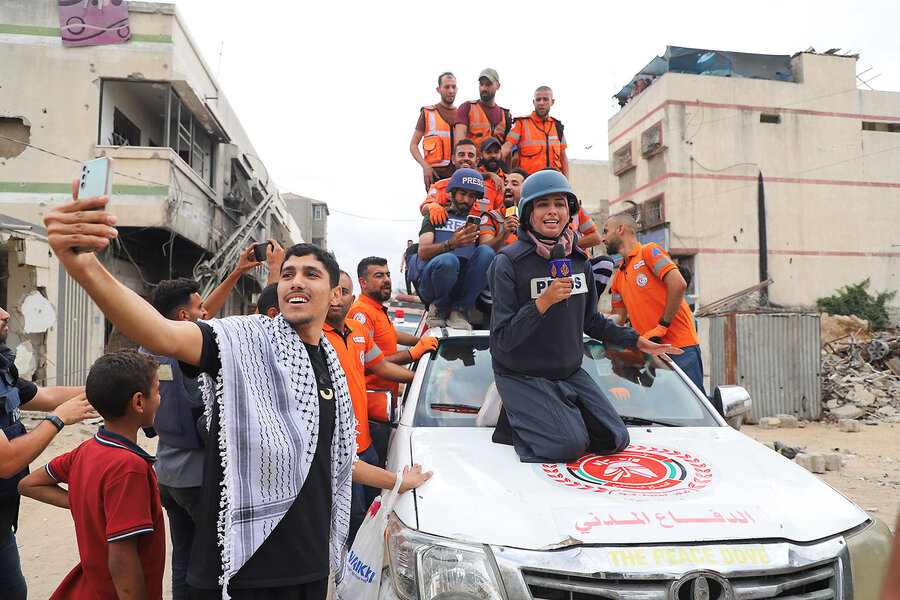
In Gaza, while small-scale celebrations erupted in multiple regions, many Palestinians remained guarded, with few daring to hope that the deal holds.
“They said ‘ceasefire’ many times and then it failed, so why care now?” says Suad al-Mamlouk, a mother-of-seven recently displaced from Gaza City to Deir al-Balah. She lost a son in July.
“The first time they declared a ceasefire [in January] I cheered and celebrated. My son was then alive. Now my son is killed and I cannot feel happy. I can no longer feel comfort.”
Stars aligned
A constellation of developments made the deal possible.
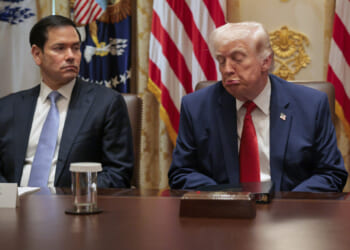
First was pressure exerted by President Trump on Israeli Prime Minister Benjamin Netanyahu to reach a ceasefire deal.
A weakened Hamas, degraded militarily and facing a Gazan population desperate to end the war, was pressured by Israel and the Arab and Islamic world to take the Trump deal. The deal itself was, essentially, a repackaging of previous proposals by Arab states, France, and the Biden administration.
“Hamas received advice from friends like Turkey and Qatar and Egypt to find partial deals to begin the Trump deal, starting with a hostages-prisoners swap,” says Mohammed Daraghmeh, an analyst and Palestine Bureau Chief for Asharq news network in the West Bank, who has contacts with Hamas.
“Hamas has reached the point where weapons cannot help them, but they needed a face-saving deal.”

Another new element to the two years of faltering talks was the involvement of Turkey, one of the few countries with open channels to Hamas and a potential destination, observers say, for exiled Hamas leaders.
As part of the deal, Turkey, along with Egypt, Qatar, and the U.S. will oversee the hostage-prisoner release.
Future, peace uncertain
The agreement has deferred for now the thorniest issues of the Trump plan, such as Hamas’ disarmament, future Gaza governance, the dispatch of an Arab-international security force, reconstruction, and a further withdrawal of Israeli forces.
Contentious talks over the list of Palestinian prisoners to be released – including the status of high-profile detainees like popular Fatah leader Marwan Barghouti – continued late Thursday.
Another major sticking point is the proposed international board that would temporarily oversee Gaza’s governance. At issue is administratively splitting Gaza from the West Bank – both seen as critical to a unified Palestinian state – and putting Gazans’ fate in the hands of foreigners. Hamas and its rival Palestinian Authority both refuse this.
Observers say the vast gulf between Israel and Hamas on these contentious issues may see the deal collapse in the weeks to come, leading many Palestinian analysts and faction heads to describe the agreement as a “one-phase deal.”
Hinting at the disagreements to come, Hamas spokesperson Hazem Qassem denied Thursday that the movement would give up its arms. In an interview with Al Jazeera, he said talks were progressing over a lasting ceasefire, “but not on the basis of [us] handing over weapons.”
“Resistance weapons are legitimate to defend our people and ensure the independence of Palestinian decision-making,” he added.
Amos Yadlin, a former head of Israel’s Military Intelligence Directorate, said at a briefing Thursday that while this first phase is clear cut, the rest of President Trump’s 20-point-plan, including Israel’s withdrawal lines and Gaza’s transitional government, are “more vague and can be interpreted differently by the two sides.”
“There is a lot to discuss,” he cautioned. “It can take weeks and months and could end up in a crisis.”