Fuel duty will remain frozen for a 16th consecutive year and the ‘temporary’ 5p cut to the tax on petrol and diesel will be extended, the Chancellor will confirm in her Autumn Budget statement.
Rachel Reeves will spare million of drivers more financial pain at the pumps for now by ruling out an immediate increase to fuel duty – but a sting in the tail comes from rises planned from September.
It comes amid increasing pressure from back benchers to end the 5p cut introduced by former Chancellor Rishi Sunak in 2022 to temper rising petrol prices on the outbreak of war between Russia and Ukraine.
Edmund King, AA president, said continuing the freeze nullifies ‘one of the big concerns for millions of drivers, their families, and businesses’.
But Reeves is likely to neutralise an estimated £3billion loss to the Treasury incurred from freezing duty by bringing in ‘staged increases’ to the tax from September.
At today’s petrol prices, fuel duty accounts for almost two fifths (39 per cent) of the price paid at the pump and with VAT added, tax amounts to 56 per cent of the price.
RAC head of policy Simon Williams said drivers will be ‘relieved’ the Chancellor has decided to keep the 5p duty cut in place for now as it saves them more than £3 a tank but says this relief will be ‘very short-lived’ given the staggered increase from next September.
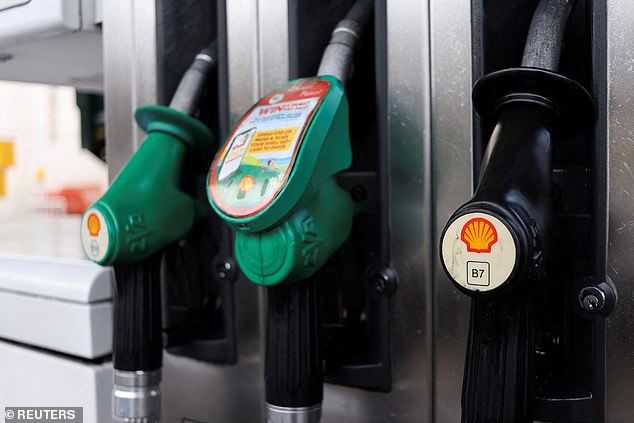
Rachel Reeves will confirm that fuel duty will remain frozen – and the 5p ‘temporary cut retained – until September. However, ‘staged increases’ thereafter will be imposed
Freezing fuel duty: what it means for YOU
What does the freeze and retention of the 5p cut really mean for you and your outgoings when you fill up at forecourts?
Had Rachel Reeves scrapped the 5p cut with immediate effect on Wednesday, the cost of a litre of both petrol and diesel would have increased by 6p, inclusive of an extra penny in VAT.
Based on Tuesday’s (26 November) average unleaded price of 137.2p, this would have seen a theoretical jump to 143.2p.
Diesel would have risen from 146.2p to 152.2p with the 6p hike.
This would have meant an average family car with a 55-litre fuel tank would have cost an additional £3.30 to fill up.
Over the course of a year, based on average annual mileage of 7,000 miles and the average petrol car returning 36mpg, drivers are set to save in the region of £53 on their fuel receipts.
The AA’s Edmund King said: ‘With fuel still accounting for a significant share of household spending, maintaining the 5p freeze will save drivers £3.30 a tank.
‘For workers, who are dependent on their cars to commute and fill up twice a month, this keeps £6 to £7 in their pocket to battle other costs.’
The RAC’s Simon Williams said: ‘Without the discount drivers would still be paying more for a litre of petrol than they were prior to Russia’s invasion of Ukraine in February 2022 which sent pump prices rocketing to record levels.’
Steve Gooding, director of the RAC Foundation, said: ‘For all the furore over the pence per mile charge for electric vehicles it is the defrosting of the freeze on fuel duty and the promise of further index-linked increases to come that will have been greeted with concern by the drivers of the 30 million cars on the UK’s roads that run on petrol or diesel, and for whom the pump price of fuel remains a significant element of their hard-pressed household budgets.’
Freezing fuel duty: what it means for the Exchequer
The freeze on fuel duty rates until September 2026 is estimated to cut tax receipts by £2.4billion next year and £0.9billion in the medium term, the OBR said in its report leaked in error ahead of the Budget statement.
Fuel duty has remained frozen for 15 consecutive years and is now a third lower in real terms than it was in 2010.
Independent think tank Resolution Foundation says the cumulative cost to the exchequer of the long-running freeze and 2022 cut to fuel duty is £130billion.
It described this as a ‘colossal sum given the struggle governments have had to balance the books during that time’.
How much of what we pay at the pumps is tax?
Based on today’s petrol price at 137.2p, fuel duty at 52.95p accounts for almost two fifths (39 per cent) of what drivers pay at the pump.
With VAT at 20 per cent also charged on road fuels, total taxation on petrol amounts to a whopping 56 per cent of the retail price.
For diesel, currently at an average of 146.2p across the UK, fuel duty accounts for 36 per cent of every litre bought, while VAT bumps the tax total to 53 per cent.
Therefore, despite no increase to fuel duty in the next 10 months, well over half of what drivers are paying at the pumps goes direct to the Treasury.
In cash terms, that’s around £42 of the £76 total bill every time the tank of an average petrol-powered family car (with a 55-litre tank) is filled up in Britain.
For diesel owners, £42 of an average £80 visit to a forecourt will go to the Exchequer.
Britons pay some of the highest tax on fuel
Despite the fuel duty freeze and extension of the 5p-a-litre cut, UK drivers are still paying some of the highest taxes on road fuels against other European nations.
Taxation of fuel across Europe is calculated differently to how it is in the UK.
The European Union’s (EU) Energy Taxation Directive requires Member States to levy a minimum excise duty of €0.36 (approximately 31p) per litre on petrol. However, many have much higher rates than this.
A recent report published by Tax Foundation Europe found that it’s only motorists in Malta who are charged the minimum excise duty rate, though drivers in Bulgaria and Hungary currently benefit from low levies on unleaded.
At the opposite end of the spectrum, the Netherlands has the highest petrol taxation at €0.79 a litre (approx 69p), followed by Italy and Denmark at €0.71 (approx 62p).
With fuel duty remaining at 52.95p (converting to approx €0.62), the UK still has the tenth highest levy on petrol.
| Country | Petrol price per litre (Euro) |
|---|---|
| Netherlands (NL) | €0.79 |
| Italy (IT) | €0.71 |
| Denmark (DK) | €0.71 |
| Greece (GR) | €0.70 |
| Ireland (IE) | €0.69 |
| Finland (FI) | €0.69 |
| France (FR) | €0.68 |
| Germany (DE) | €0.66 |
| Portugal (PT) | €0.63 |
| United Kingdom (GB) | €0.62 (52.95p) |
| Belgium (BE) | €0.60 |
| Slovenia (SI) | €0.60 |
| Estonia (EE) | €0.59 |
| Luxembourg (LU) | €0.56 |
| Average | €0.56 |
| Latvia (LV) | €0.53 |
| Slovakia (SK) | €0.51 |
| Lithuania (LT) | €0.51 |
| Croatia (HR) | €0.51 |
| Czech Republic (CZ) | €0.51 |
| Romania (RO) | €0.51 |
| Spain (ES) | €0.50 |
| Austria (AT) | €0.48 |
| Cyprus (CY) | €0.43 |
| Poland (PL) | €0.42 |
| Sweden (SE) | €0.42 |
| Hungary (HU)** | €0.40 |
| Bulgaria (BG) | €0.36 |
| Malta (MT) | €0.36 |
| Average | €0.56 |
| Minimum Rate | €0.36 |
| Source: Tax Foundation Europe **Hungary’s excise duty increases to €0.41 per litre for petrol if the world market price of crude oil is at or below 50 USD/barrel |
|
As for diesel – which is far less popular on the continent – the EU sets a slightly lower minimum excise duty of €0.33 a litre (approx 29p).
Even with the fuel duty cut, the UK’s taxation on diesel fuel is almost the highest against European neighbours, with the 52.95p levy translating to €0.62.
The most expensive country is Italy at €0.63 per litre (approx 55p) and Belgium at €0.60 (approx 52p).
While most EU countries levy a lower excise duty on diesel than on petrol, only the UK and Belgium levy the same rate of tax on the two fuels.
| Country | Diesel price per litre (Euro) |
|---|---|
| Italy (IT) | €0.63 |
| United Kingdom (GB) | €0.62 (52.95p) |
| Belgium (BE) | €0.60 |
| Ireland (IE) | €0.60 |
| France (FR) | €0.59 |
| Denmark (DK) | €0.56 |
| Slovenia (SI) | €0.55 |
| Lithuania (LT) | €0.52 |
| Netherlands (NL) | €0.52 |
| Portugal (PT) | €0.50 |
| Finland (FI) | €0.50 |
| Germany (DE) | €0.47 |
| Romania (RO) | €0.47 |
| Luxembourg (LU) | €0.45 |
| Latvia (LV) | €0.44 |
| Estonia (EE) | €0.43 |
| Greece (GR) | €0.41 |
| Croatia (HR) | €0.41 |
| Cyprus (CY) | €0.40 |
| Austria (AT) | €0.40 |
| Czech Republic (CZ) | €0.39 |
| Poland (PL) | €0.39 |
| Spain (ES) | €0.38 |
| Hungary (HU)** | €0.37 |
| Slovakia (SK) | €0.37 |
| Sweden (SE) | €0.35 |
| Malta (MT) | €0.33 |
| Bulgaria (BG) | €0.33 |
| Average | €0.46 |
| Minimum Rate | €0.33 |
| Source: Tax Foundation Europe **Hungary’s excise duty increases to €0.40 per litre for diesel if the world market price of crude oil is at or below 50 USD/barrel | |
What’s next? All eyes on Fuel Finder scheme in February to tackle rip-off fuel retailers
In February 2026, the Government is due to launch its Fuel Finder scheme that will force all fuel stations to log changes to their pump prices with an official database.
Operators have to notify the scheme within 30 minutes, almost in real-time.
It will mirror what has been introduced in other European countries for years, leading not only to pump-price transparency but greater competition and lower prices.
This comes against a background of the fuel trade apparently ignoring criticism from the Competition and Markets Authority that margins on the price of petrol and diesel are ‘consistently bloated’.
The AA pointed to this being a case in point with average fuel prices ‘surging’ ahead of the Autumn Budget.
The motoring group said the fuel trade had ‘beaten the Chancellor to a fuel duty hike’ by hiking pump prices in the days in the lead-up to her statement.
Average petrol prices jumped by half a penny over the weekend and diesel went up a penny also.
Petrol started November at 135.4p a litre with diesel at 143.1p though have risen to 137.2p and 146.2p on average respectively.
‘As drivers trembled at the prospect of a pump price surge, coming from a fuel duty increase in today’s Budget, the fuel trade has beaten the Chancellor to it with its own hike in road fuel costs,’ said Luke Bosdet, the AA’s spokesman on pump prices.
‘The Chancellor won’t be thanking the fuel trade for ramping up the political jeopardy of a fuel duty increase.’
Fuel Finder is expected to reveal to drivers the location of competitive and much cheaper forecourts. This in turn will pressure the expensive ones to bring down their prices or risk losing customers.
The scheme also boosts the profile and appeal of those fuel stations looking to use lower pump prices to draw customers to their shops. In effect, it offers free marketing.
The RAC’s Simon Williams said: ‘The introduction of the long-awaited Fuel Finder in early 2026 will also be a big moment – for the first time, all petrol stations will need to report their prices allowing customers to find the cheapest fuel wherever they are.’