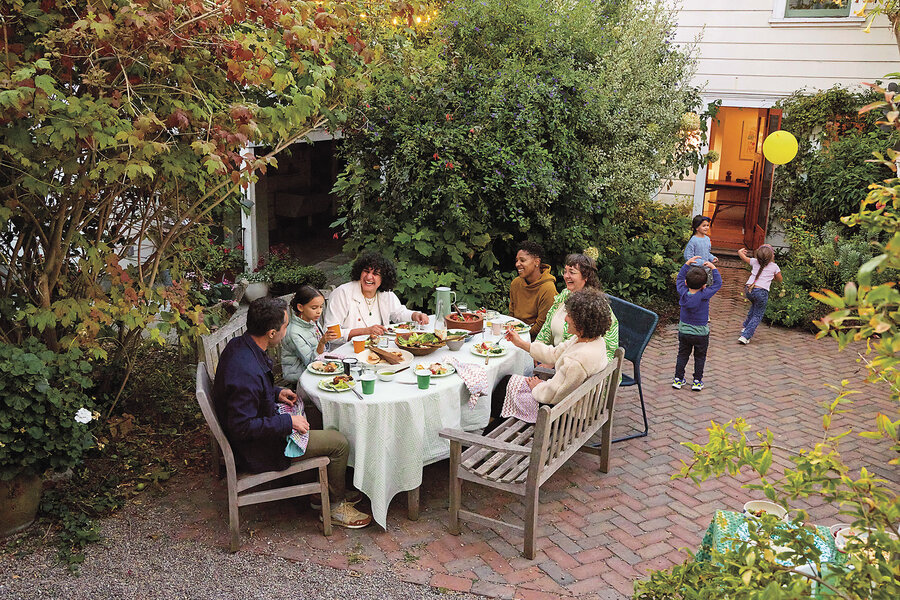
Gathering with family, friends, and even strangers for a meal provides a space to listen and learn. Often, those exchanges can be more nourishing than an appetizing spread, displacing feelings of isolation and discord. In this roundup of recent cookbooks, authors share how their personal creative processes in the kitchen – whether that’s keeping things simple, contemplating the history of a recipe, or being inspired by the beauty of one’s surroundings – can have a harmonizing, restorative effect.
Samin Nosrat made her first splash in the cookbook world with the bestselling “Salt, Fat, Acid, Heat: Mastering the Elements of Good Cooking” in 2017 and a 2018 Netflix docuseries of the same name. She returns with Good Things: Recipes and Rituals to Share with People You Love. Similar to her first cookbook, the author supplies a bounty of foundational tips, such as how to choose and store the best ingredients and how to work efficiently with kitchen tools. But more importantly, “Good Things” offers recipes to support the communal experience of dinnertime.
Nosrat emphasizes that the effort spent on a dish shouldn’t take precedence over spending time with those who have gathered to eat. The fuss and mess aren’t worth it. It’s a lesson she learned when cooking a birthday party meal for her friend’s young son. After biting into a delicious taco, he said the only thing missing from his party was Nosrat, who was busy in the kitchen frying up perfect fish. “I’ve been trying to put what I learned from Orion that day into practice,” Nosrat writes. “I spend less energy trying to do everything for everyone. Instead, I rely on a handful of recipes I think of as small, welcoming gestures and focus on spending quality time outside the kitchen with the people I love.”
Why We Wrote This
In this roundup of cookbooks, authors like Jacques Pépin and Samin Nosrat share how their personal creative processes in the kitchen can have a harmonizing, restorative effect.
“Good Things” is a meditation on those gestures that feed the soul as much as it is a cookbook for readers wanting to create a solid dinner ritual with friends and family.

Braided Heritage: Recipes and Stories on the Origin of American Cuisine is the latest book from culinary historian Jessica B. Harris. Harris’ previous work, “High on the Hog: A Culinary History from Africa to America” (2011), inspired the acclaimed four-episode docuseries on Netflix in 2020. In “Braided Heritage,” the historian takes an expansive look at early American cooking. She traces three foodways in sections titled Native Peoples, Europeans, and African Americans to show how those civilizations mixed and melded their culinary traditions to create what she calls the “American braid.”
“Our American food, perhaps more than any other aspect of our contentious conjoined cultures, shows us who we are at heart,” writes Harris. “This American cookbook is not a work of history, but rather an attempt to remind us of just how magnificently mixed we are on the plate, and have been from the very beginning of our national story.”
Harris admits that reducing the American braid to just three cultures, leading up to the nation’s founding in 1776, is an oversimplification. But given the vastness of the geographical United States and the breadth of time in which people have cooked and consumed food here, the generality is a reader service. Harris introduces each section with profiles of cultural practitioners of different parts of the “braid” who describe how culinary traditions were passed down through their family. The recipe ingredients include clues to their origins. Native Peoples hunted and gathered local ingredients such as mollusks, cranberries, and venison. Europeans brought pigs, sheep, and apples as well as shortbread, waffles, and doughnuts. African Americans carried with them agricultural and cooking techniques as their cultures were subjected to enslavement, migration, innovation, and regionalism.
The historical framework Harris provides for so many familiar “American” recipes illustrates how they shifted and changed as they were disseminated across the nation in its early centuries.
It’s hard to imagine what the prolific French cooking author has left to share with readers, but The Art of Jacques Pépin: The Cookbook offers a retrospective on his time spent not only in front of the stove but also at the easel. “The Art of Jacques Pépin,” through nearly 100 of his all-time favorite recipes paired with his favorite artworks, covers all the bases for a meal: soups, pastas, fish, poultry, meat, and dessert.
“Cooking can be both solitary and communal – and like painting, the results are shared with many others. When I cook, I always think about the people who will eat what I cook,” writes Pépin. “I don’t know whether my painting has helped my cooking or whether my cooking has benefited my painting. All I know is that they live in harmony.”
While Pépin admits his paintings and drawings are the work of a dedicated amateur, his mastery and intuitive cooking shine through his recipes. His colorful art, a mix of impressionism and still lifes in vibrant hues, is a visual treat throughout. There are, of course, classic French recipes such as bread and onion soup, pork roast with ratatouille, as well as flan and crème au chocolat. Some recipes are as simple as a list of familiar ingredients with uncluttered instructions. For instance, the dessert section emphasizes clever ways to dress up fresh fruit in minutes, settle it atop slices of pound cake or English muffins, and top with a drizzle of jam or a dollop of cream.
Pépin, the author of more than 30 cookbooks, reminds readers that time in the kitchen can be an art and a muse for creative expression.

In Coastal: 130 Recipes From a California Road Trip, Scott Clark takes readers along the storied California Central Coast to meet the region’s organic farmers, regenerative ranchers, sustainable foragers, hunters, and fishers. This is the first cookbook for Clark, an East Coaster who found his home and calling making lunch in a rented caboose along California’s Route 1 in Half Moon Bay. The author combines the techniques he learned from working in fine restaurants with the Central Coast’s freshest ingredients. The result is a collection of recipes for elevated yet casual meals.
“I thought I wanted Michelin glory. It turned out what I wanted was a life,” writes Clark, who dropped out of high-pressure kitchens to spend more time with his family. “The Central Coast gave me that. Its abundance, its beauty, its precariousness, its chill. Surfing, sailing, ocean kayaking, gathering your salad ingredients from the tide pools and the woods.”
Clark’s recipes are the kind you want after a day of adventuring. Among the appealing items served at the popular Dad’s Luncheonette diner are his hamburger sandwich, the “heart and soul of Dad’s.” It zings with pickled onions and mustardy sauce, cheese, and one fried egg. Pair it with potato chips fried by the handful in a Dutch oven pot, and finish it with a sprinkling of kosher salt and nutritional yeast. His creativity shines in a recipe for Earl Grey ice box pie – a custard infused with tea on a graham cracker crust.
Illustrated with many colorful photos from the Central Coast, “Coastal” is a delightful read for armchair travelers and a true love letter to Clark’s chosen home.