Animal welfare experts have revealed the 10 extreme body traits in dogs that they’re urging prospective owners to avoid.
From flat faces to stubby legs, many of these ‘extreme conformations’ are highly prized by breeders and pet owners who see them as ‘cute’.
However, these seemingly adorable traits are actually condemning tens of thousands of pets to a life of suffering.
Vets and pet experts are now calling on the public to spot the signs of extreme conformation and make sure they don’t fuel the demand for these trendy pets.
Experts say demand for these pets has been fuelled by social media trends and celebrity pooches like Megan Thee Stallion‘s French bulldog and Kendall Jenner‘s Doberman.
Dr Rowena Packer, a leading expert on extreme conformation from the Royal Veterinary College, told the Daily Mail: ‘Dogs with extreme conformation are commonly denied the ability to live long, healthy and happy lives due to the inherent body shapes we are trapping them in, due to our aesthetic preferences as humans.
‘This often includes extremely high risks of inherited disorders that can prevent dogs from performing the most basic biological functions, including breathing, blinking, walking and wagging their tails.’
So, are you unknowingly supporting the market for dogs that are born to suffer? These are the 10 things you should look for to find out.
To help breeders and buyers spot the signs of extreme conformation, scientists and members of the All Party Parliamentary Group for Animal Welfare (APGAW) have created a checklist known as the Innate Health Assessment (IHA).
Dr Dan O’Neil, an animal health expert from The Royal Veterinary College who helped develop the IHA, says: ‘Extreme conformation means that we have crossed a boundary, and that the conformation is preventing the animal from living its life as a dog.
‘This is so basic, but dogs that are incapable of doing this are suffering.’
1. Stubby legs
One of the most common forms of extreme conformation is having very short legs relative to the body.
According to the IHA, the distance between a healthy dog’s chest and ground should be at least a third of its full height.
Any smaller than this, and the dog won’t be able to move and play without causing excessive strain on their joints.
Dr O’Neil says: ‘Caring owners of dogs with short legs and long backs try to stop these dogs jumping up and carefree playing in these dogs to protect them from slipping their discs, causing the dogs huge frustration.’
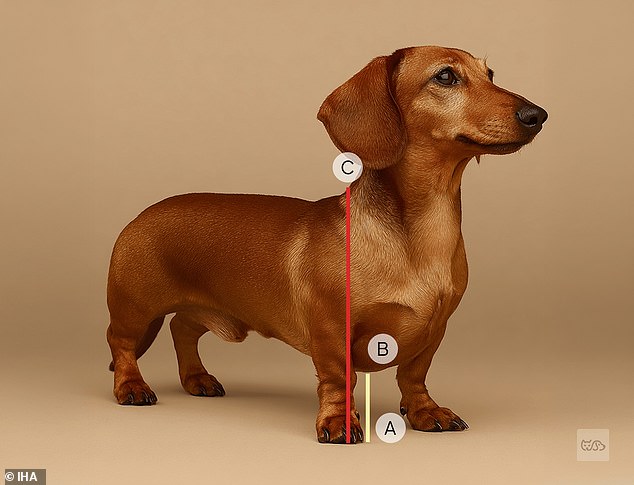
A healthy dog should have enough ground clearance to move freely, which means the distance from its chest to the ground should be at least one–third of its height, unlike some Dachshunds
He adds: ‘The problem has become more critical in recent years because of rising public desire to own dogs with novel body shapes.’
Recently, Dachshunds overtook French Bulldogs as the UK’s most popular breed, according to data from Pets at Home.
However, many caring owners have not been informed that their beloved pet might be unable to have a happy life.
Marisa Heath, Director of APGAW, told the Daily Mail: ‘It is not just about the dogs, it is about the public often being misled into thinking this is what a good dog looks like and then being saddled with high vet bills, insurance premiums and heartbreak when the dog suffers as a result of its extreme conformation.’
2. Flat faces
Bulldogs, Pugs, Boston Terriers, Cavalier King Charles Spaniels, and Shih Tzus are often examples of one of the most common extreme conformations – a flat face.
According to the IHA, a healthy dog’s muzzle should be at least one–third the length of its skull.
Dogs with shorter muzzles than this are known as ‘brachycephalic’, and are at risk of an array of devastating health conditions.
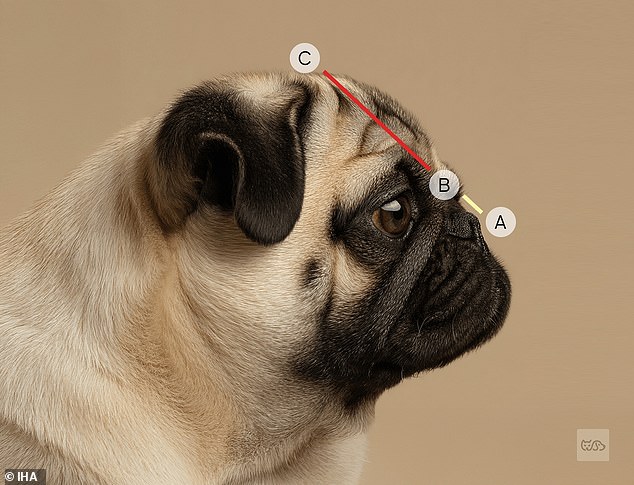
Flat–faced dogs, like Pugs, suffer from debilitating health conditions. A dog’s nose should be at least one–third the length of its skull in order for it to breathe normally
Extreme brachycephalic dogs lose much of their natural nasal function and so have a greatly reduced ability to breathe freely, sleep deeply, and even cool down.
An often overlooked consequence of this is that flat–faced dogs lose their primary way of understanding the world, as they can no longer use their nose to smell.
Flat–faced dogs may have a condition called Brachycephalic Obstructive Airway Syndrome (BOAS), which is where their breathing problems are so severe that veterinary care is required.
Dr O’Neil says: ‘BOAS is such an issue because the compressed and narrowed airway requires the dog to work much harder just to breathe, even at rest.
‘These dogs may show exercise intolerance, tire quickly, collapse after play, and often seem “lazy” simply because breathing is difficult.’
Dogs with BOAS also suffer from frequent gagging, regurgitation, and vomiting due to the pressure changes and stress of laboured breathing.
The big problem is that many of these signs of suffering are mistakenly seen by owners as cute or desirable.
Dr Packer says: ‘Brachycephalic dog face shapes have been demonstrated to adhere to the so–called “baby schema” – baby–like features such as disproportionately large and round eyes, small noses and large heads.
‘Of high concern is that signs of disease in brachycephalic dogs, such as abnormal breathing sounds – snoring and snorting – are perceived by some owners as cute “piggy” noises, despite being a sign that their airway is obstructed.’
3. Bulging eyes
Another extreme conformation that unfortunately fits within the ‘baby schema’ is large bulging eyes.
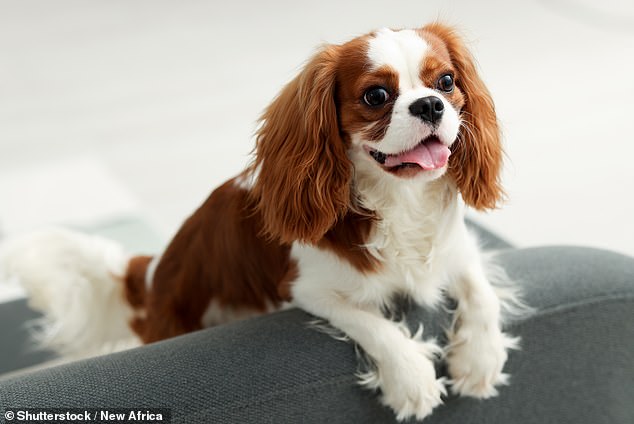
Bulging eyes, like those of a King Charles Cavalier Spaniel, may look cute, but they increase the risk of eye infections, damage, and ulcers. You should not be able to see the whites of a dog’s eyes from the front on
On a healthy dog, you shouldn’t be able to see the whites of their eyes while they are looking straight ahead.
However, breeds such as Pugs and Boston Terriers often have eyes that protrude out of their skulls.
Although this fits our idea of what a cute animal should look like, it may indicate that the dog’s eye sockets are too shallow.
This can lead to an increased risk of eye dryness, damage, infection, and eye ulcers.
4. Drooping eyelids
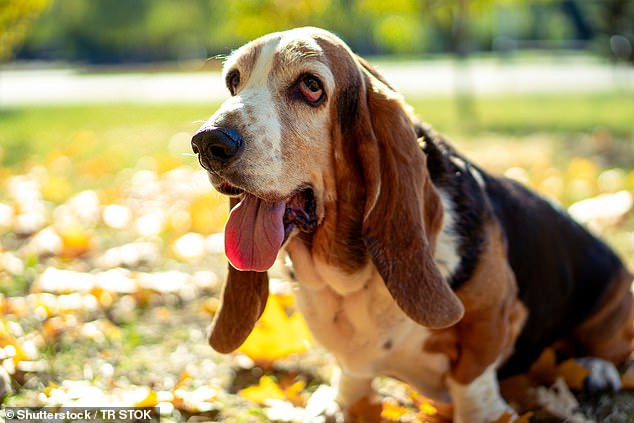
Drooping eyelids, like those of some Basset Hounds (pictured), prevent the dog from blinking normally. This leads to eye infections and corneal scarring. The eyelid should be tight to the eye and not roll in or outwards
In a healthy dog, the eyelids should rest smoothly against the eyeball to protect the eye from dust and dirt.
Looking straight on, the dog’s lower eyelids should sit normally without peeling away from the eye.
However, some dogs have been selectively bred to have eyelids that droop – rolling inwards or outwards.
This is commonly seen in breeds such as Bloodhounds and Basset Hounds.
Dogs with this extreme conformation aren’t able to clean or protect their eyes properly, leading to painful conditions including conjunctivitis, inflammation of the cornea and infections.
Eventually, excessive dryness can lead to corneal scarring, which leads to obstructed vision and partial blindness.
5. Skin folds
Skin folds are where excess skin folds over itself so that the two hairy surfaces are rubbing against each other.
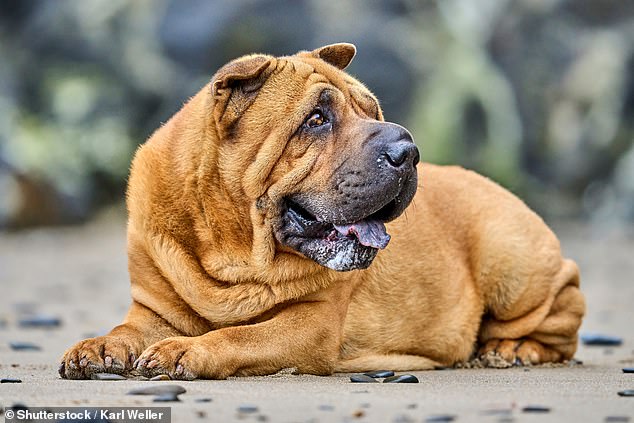
Skin folds, like those of a Shar Pei (pictured), trap dirt, moisture and heat, allowing bacteria to thrive and cause a painful condition called skin fold dermatitis. The dog’s skin should be smooth and fold–free over the head, body, legs, and tail base
In a healthy dog, the skin should be smooth and fold–free over the head, body, legs, and tail base.
Skin folds might seem harmless, but they cause issues for a dog by trapping moisture, heat and dirt.
This creates a perfect environment for bacteria and infections to develop, leading to a condition called skin fold dermatitis.
This condition leads to a buildup of bacteria and yeast inside the folds, creating sores that discharge yellow or white liquid and cause pain whenever the dog moves.
This is common in breeds with wrinkly skin, like Shar Peis, but also in the face folds of brachycephalic dogs like Pugs and French bulldogs.
6. Merle colouration
Merle, a marbled pattern of darker spots on a lighter coat, might look beautiful and unique, but it is actually linked to a wide range of health issues.
The colouration is caused by a mutation in the PMEL gene that controls how dogs form colour in their hair and skin.
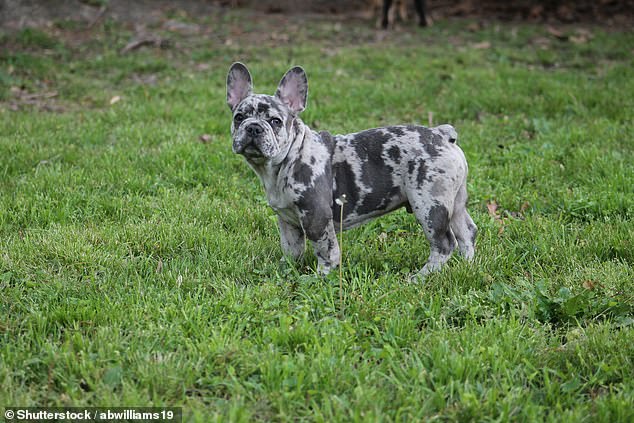
The same gene that causes the marbled colouration known as merle also causes blindness and deafness. This colouration can be found in many breeds, including French Bulldogs (pictured) and Australian Shepherds
However, this same mutation also causes inherited health risks like blindness and deafness.
While it might be as obvious as other extreme conformations, merle is no different from having stubby legs or bulging eyes.
No wild canine in nature has a merle colouration, and the gene likely arose as an accidental by-product of selective breeding.
However, this harmful gene has been intensely selected for to the extent that some breeds, like Australian Shepherds, are almost all merle.
7. Short tails
For a dog, a tail doesn’t just help with balance; it is their main method of communicating with humans and other dogs.
Dogs use their tails to display a range of different emotions, which is why they must have a tail that is long enough to wag and is in proportion to their body.
According to the IHA, a healthy dog will have a tail that is at least as long as one–third of the distance from the tail base to the knee.
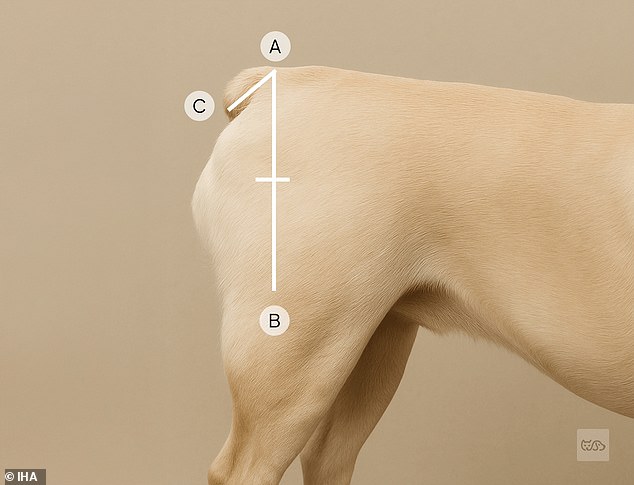
Dogs with short or absent tails, like Pugs (pictured) and French Bulldogs, are twice as likely to be involved in an aggressive encounter because they cannot communicate with other dogs. A healthy tail should be long enough to wag, measuring at least as long as one–third of the distance from the tail base to the knee
Dogs with tails shorter than this, such as Welsh Corgis, Australian Shepherds and Boston Terriers, are at a massive social disadvantage and are far more prone towards antisocial behaviour.
Tails allow dogs to offer what animal psychologists call a play inhibitor, a piece of body language that helps keep interactions friendly and prevents play fighting from escalating.
Dogs also use their tails to cover their anal scent glands when they are afraid or don’t want to interact, making them vulnerable and reactive.
Studies have shown that dogs with short or absent tails are twice as likely to have aggressive encounters as their long–tailed counterparts.
Hannah Molloy, a dog trainer and animal behaviourist, says: ‘They’ve been born into a body that has given them a social disability.
‘I have seen thousands of dogs from a variety of breeds, and I’ve seen dogs bullied, denied and socially rejected because of the bodies they were born into, and that is not fair.’
8. Misaligned jaw
A healthy dog’s jaws should be aligned so that their upper teeth close just in front of the lower set.
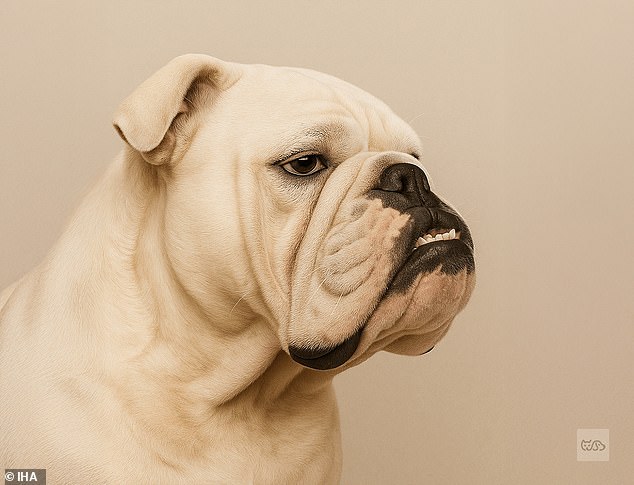
A dog’s upper teeth should sit just in front of its lower set, without the upper or lower jaw protruding. Misaligned jaws – like those of a Boxer (pictured) – cause gum disease, tooth decay, sores, and injuries to the mouth
In some cases, dogs like Boxers and Pekingese with extreme conformations will have a misaligned jaw, causing the upper or lower jaw to stick out.
This not only affects a dog’s ability to eat and play comfortably, but it also leads to a range of health and dental issues.
Dogs with a misaligned jaw are more prone to gum disease, tooth decay, sores, or injuries to the mouth.
This extreme conformation is also a common cause of the excessive drooling that some breeds, like Boxers, are extremely prone to.
9. Bowed or curved legs
Bowed legs can be a sign that a dog is deficient in key nutrients or is suffering from a ‘growth plate’ injury that is causing paired bones to grow at different rates.
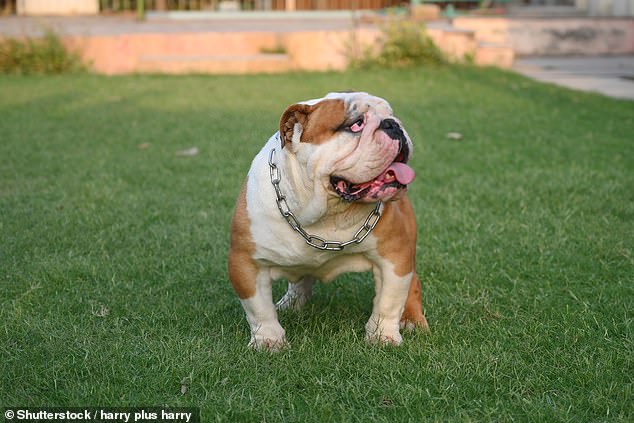
Curved or bowed legs can be a sign of malnutrition, but they are also deliberately bred in some cases, such as English Bulldogs (pictured). This causes severe mobility issues that prevent them from living a normal, healthy life
However, some dogs, such as English Bulldogs and Dachshunds, have been specifically bred to have this genetic deformity to meet aesthetic breed standards.
Viewed from the front or back, a dog that is innately healthy should have legs that are visibly straight and don’t bend to either side.
Bowed legs are a serious health problem for dogs that cause significant pain and prevent them from living a normal life.
Dogs with this extreme conformation are prone to joint injuries, slipped disks, lameness, and difficulty running.
This can prevent a dog from playing, going up and down stairs, or even going out on walks, and may require surgical intervention in extreme cases.
10. Inflexible spine
If you have ever seen a dog sleeping, curled up in a tight ball, this is a good sign that they are innately healthy.
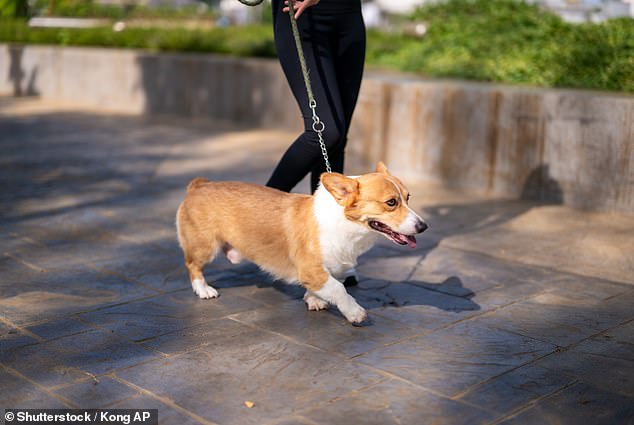
A healthy dog should be able to touch its nose to its rear. This allows it to move and sleep comfortably, as well as to perform basic functions like grooming and scratching, which some breeds, like Welsh Corgis (pictured), may be unable to do
All dogs must be flexible enough in their neck and spine to reach their rear area in order to perform basic bodily functions like grooming and scratching.
Inflexibility is a common by-product of intensive breeding in stocky, short dogs like the Dachshunds, Basset Hounds, Corgis, and French Bulldogs, but can also affect traditionally active breeds like German Shepherds and Collies.
Dogs with serious inflexibility are also more prone to spinal disease and slipped discs, eventually leading to loss of coordination, pain and stiffness, unwillingness to move, and paralysis.