Greece’s latest migration reforms threaten prison for those who aid unlawful entry — and Britain should pay attention
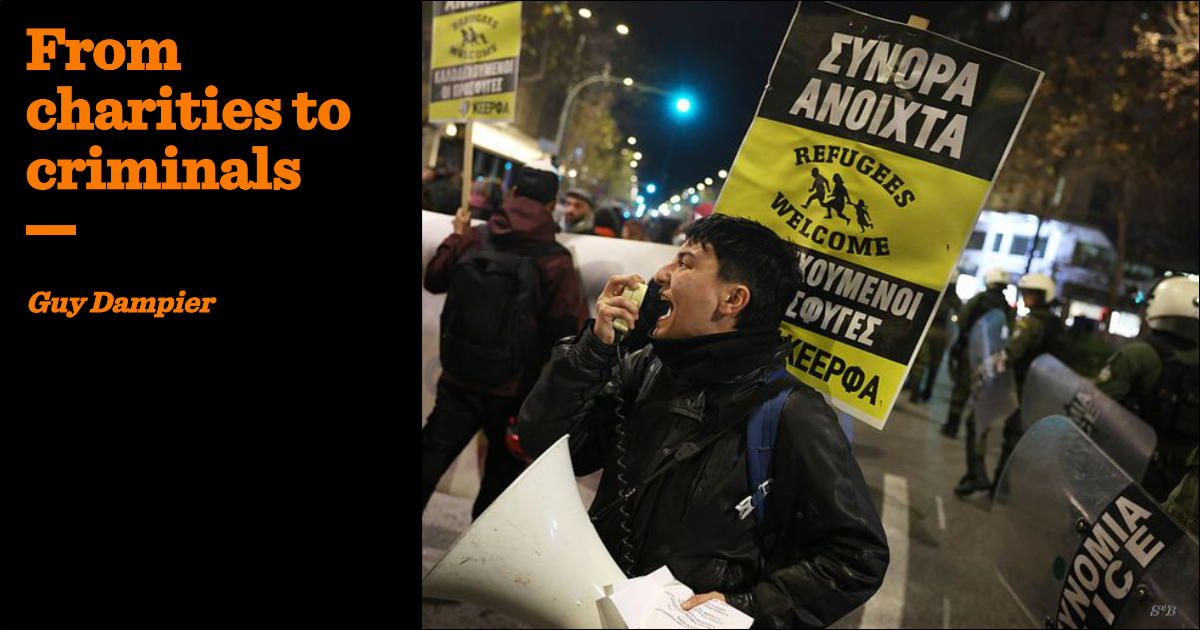
Could Greece be about to throw NGO workers in jail? A new immigration bill includes more penalties for those helping illegal immigrants to enter or stay in the country. The legislation would make being a member of an NGO which assists illegal entry into an aggravating circumstance, similar to the way it is used against those who are members of an organised group or making money from helping illegal immigrants.
The bill amends the existing Migration Code and would put NGOs on a similar level to the smuggling gangs. This means that facilitating illegal entry, which would normally lead to a base penalty of imprisonment and 20,000 Euros in fines, would instead lead to a minimum sentence of 10 years imprisonment and 50,000 Euros in fines. Transporting illegals would lead to 10 years imprisonment and 60,000 Euros in fines, and facilitating illegals to stay (by helping them avoid detection or deportation) would mean up to 10 years imprisonment and a minimum 20,000 Euros in fines.
What’s more, the Migration and Asylum Minister, currently Thanos Plevris of the centre-right New Democracy party, would have the power to deregister NGOs from the official register if one of their members faces charges. This could even be done before a conviction, cutting off the NGO’s legal ability to act or receive funds. This would place a very strong incentive on NGOs to ensure their employees stay within the law. Invariably this has led to criticism of the new laws as criminalising civil society from the likes of Medecin Sans Frontieres, Refugee Support Aegean, and the Greek Council for Refugees.
Such protestations ignore the harsh reality of the crisis in the Aegean, however. NGOs — many of them of foreign origin or reliant on foreign funding — have frequently frustrated the Green government and the wishes of the Greek people. For example, Tommy Olsen, the Norwegian founder of the NGO Aegean Boat Report, has been accused by the Greek authorities of assisting illegal immigrants. They say that by sharing real-time data about boats, he helped traffickers evade the authorities. He claims that he is only trying to alert the authorities to boats in distress, so they can prevent drownings. Greece has recently issued a European Arrest Warrant against him, although Norway has resisted prior warrants. Multiple other NGOs are currently under investigation as well.
Although many do good, some NGOs have no respect for the law and put their supposedly humanitarian principles above it
Although many do good, some NGOs have no respect for the law and put their supposedly humanitarian principles above it. This is a particular problem for Greece, which is on the frontline of the European asylum crisis. Just last year, the Greek government warned that an uptick in migration meant that the country faced an “invasion”. This imposes real costs on the people of Greece: one study found that a 1% increase in the share of refugees on Greek islands led to an increase of 1.7-2.5% in crimes compared to nearby islands without refugees. That included property crimes, knife attacks, and rape. By facilitating these illegal flows, the NGOs also assist — even if unwittingly — the traffickers, aiding organised crime. Knowing that this assistance is potentially available also encourages illegal immigrants to take dangerous journeys, sometimes losing their lives in the process.
This problem isn’t unique to Greece. The charity Care 4 Calais (C4C) has come under repeated criticism over the way it helped care for illegal immigrants trying to cross the English Channel. But that’s not its only problem. Clare Moseley, the married former CEO, was exposed as having had an affair with one of the migrants they helped, breaching the charity’s own rules. Mohamed Bajar, the Tunisian with whom she had the affair, had originally claimed to be Syrian. In 2014, prior to meeting Moseley, he had already married an older British woman back in Tunisia. In 2017, he was jailed in France for arson after attempting to burn down a C4C warehouse. Despite all this, he was able to sneak into Britain and marry a Romanian migrant (despite apparently still being married to his first wife). Moseley left her own charity after reports that she had used pepper spray on a migrant and threatened a female volunteer with violence.
The charity had wider issues, including using a personal bank account to handle payments and conflicts of interest, which led to Moseley’s sister handling a formal complaint that dealt with Moseley. The Charity Commission, which regulates charities, engaged with C4C for two years before a statutory inquiry was launched. That took three years and found that there was a failure to keep detailed records and that it didn’t have the minimum number of trustees required. Despite these issues, very little regulatory action was taken, not least as Moseley had already quit. Nor did the Charity Commission look into allegations that C4C had assisted with illegal immigration, leaving that to the police.
Simply being a registered charity does not mean an organisation is on the side of the angels
The investigation exposed how toothless Britain is when dealing with NGOs. C4C wasn’t just engaging in the highly controversial practice of aiding illegal migrants, but was clearly riddled with mismanagement and scandal too. And yet it has suffered few consequences. And it is not hard to understand why: in terms of optics, the state faces an uphill battle in going after any registered charity, no matter how spurious its dealings. But we must overcome this reluctance and be clear that simply being a registered charity does not mean an organisation is on the side of the angels.
Adopting much tougher, Greek-style rules would help to restrain rule-breaking in the sector and begin to bring overreaching NGOs to heel. Otherwise, it will remain possible to keep breaking those rules for years while investigations are underway, with trustees able to avoid the consequences by resigning before they face professional sanction. Most crucially, as long as asylum NGOs operate with impunity, the small boats will be encouraged to keep coming. Illegal immigration is dangerous, both to the British people and to migrants who are encouraged to take hazardous routes. It is also a criminal enterprise, with the millions made feeding organised crime on multiple continents. It’s only right that a tough approach is taken to those who break the law and make a mockery of our borders.