One might disagree with pro-Palestine radicals but that does not mean that they should be censored
This year my employer, University College London, is celebrating its two-hundredth anniversary. We were the first university in the UK to admit students irrespective of their religion or social background, and also the first to welcome women into higher education alongside men. We are justly proud of that liberal heritage.
In keeping with this legacy, our Provost has launched a high-profile initiative — which I enthusiastically support — to promote the ethos and skills of Disagreeing Well. We proclaim to the world that:
Being a diverse community means being a place where a wide variety of conflicting opinions and ideas exist and are expressed. The ability to discuss and debate with people who hold very different views is not without its challenges, and may mean that members of UCL’s community are sometimes exposed to ideas or opinions that they find offensive, contentious or unacceptable. UCL is committed to fostering open debate and protecting the rights of its community to lawfully test, challenge, and disagree. … UCL is committed to upholding all speech unless it is restricted by law.
But does the reality measure up to the public-relations hype? Recent events cast some doubt.
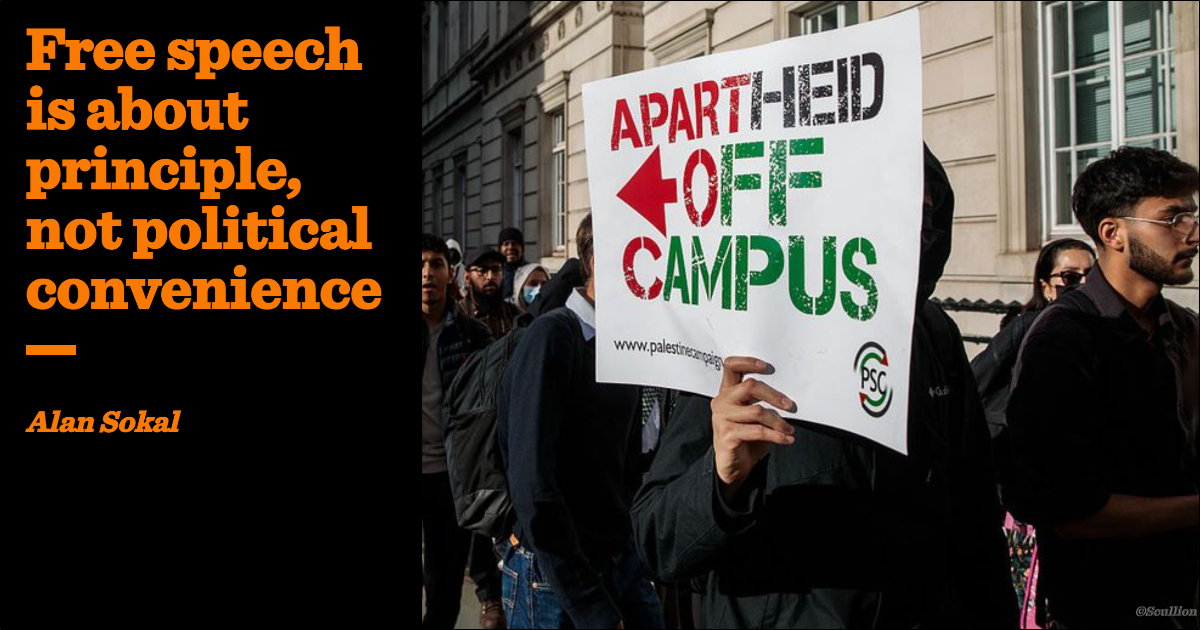
On 12 February of this year, Metropolitan Police officers arrived at the UCL campus to cover a protest called by the UCL Coalition for Palestine. This demonstration was, by all accounts, peaceful. However, one of the speakers — Jamie Bradshaw, a PhD student in Mathematics — was arrested, the Met Police announced, “on suspicion of a racially aggravated public order offence in relation to the alleged chanting of slogans involving calls for intifada”. [Full disclosure: Bradshaw is a student in my own department, though I do not know him personally.] Apparently he was held for 12 hours and then, at 3 AM, released without charge, pending investigation.
A UCL spokesperson recounted the events, and UCL’s view on them, as follows:
A demonstration took place today at UCL as part of a nationwide “Student Day of Action on Palestine”, during which a student was detained by Police for using the term ‘intifada’.
Our ongoing priority is to keep all of our staff and students safe on campus and we are urgently investigating this incident, and will take any action, as necessary. Peaceful protest is protected and supported at UCL, but protest that involves violent or discriminatory language will not be tolerated.
All forms of antisemitism are utterly abhorrent and have absolutely no place at UCL. We remain firmly committed to eradicating it from our campus and have communicated this consistently to our community through proactive messaging and targeted actions.
Freedom of speech and academic freedom are vital to university life, but they can never be used as a shield for hatred. When incidents occur, or are reported to us, we have taken — and will continue to take — swift and decisive action to address them.
More on this public statement in a moment.
But the story does not stop there. A few days after these events, UCL barred Bradshaw from the campus — a “temporary” ban that continues as of this writing — thus preventing him from teaching his tutorial classes.
In an effort to learn more about what happened and why, I asked UCL administrators a few questions:
1) Who summoned the police to UCL on 12 February, and for what reason?
2) Who authored the statement published by UCL, and who approved its public dissemination?
3) In this statement, is UCL contending that “using the term ‘intifada’ ” constitutes ipso facto “violent or discriminatory language”, or “antisemitism”, or “hatred”? If yes, on what grounds? And if not, what is UCL contending by juxtaposing these issues?
4) Is UCL alleging any unlawful behaviour by Mr Bradshaw other than speech?
5) Is it true that Mr Bradshaw has been barred from campus, suspended from his PhD program, and had his scholarship funds suspended?
6) If so, pursuant to what University policy was that decision taken, who took the decision, and what process was followed in taking it? Did Mr Bradshaw have any opportunity to be informed of the charges against him and to contest them before the decision to suspend him was taken?
I added that, in addition to these specific questions, “I would, of course, be happy to hear … any further comments that you may have on these events.” My query was addressed to:
- Michael Spence, President and Provost of UCL
- Sarah Cowls, Executive Director and Registrar of UCL [under the UCL Disciplinary Code, she would be in charge of sanctions on students]
- Oliver Curran, Head of Security at UCL [he would be responsible for liaison with the police]
- Henry Killworth, Head of Media Relations at UCL [he would be responsible for communication with the press]
As is obvious from these questions, I have two main concerns: the right of all people to freedom of speech within the law (taking heed of what the law actually says — see below); and the right of everyone to due process, including the right to be informed of the precise charges and to defend oneself to an impartial tribunal, before any punishment is imposed. It is completely irrelevant, it goes without saying, whether my own views on Israel and Palestine happen to agree or disagree with Mr Bradshaw’s.
#5,6: Sanctions against the student. Provost Spence stressed, in an e-mail to me, that “the student has not been suspended from his programme and has not had his funding suspended by UCL”. He also explained that “In response to allegations made against him [by whom?] in relation to language during a protest, he is currently not allowed to attend campus as a precautionary measure while the complaints are investigated.” (Note the use of the passive voice: “is not allowed”.)
I therefore invited Provost Spence to explain: Precaution against what? And I clarified by giving an example:
I fully understand that if there were credible evidence that a student or staff member had committed, for example, a sexual assault while on campus, then it would be reasonable to exclude that person temporarily from campus, as a precautionary measure, while the allegations were being investigated, to prevent the possibility of further sexual assaults [or intimidation of witnesses].
(In retrospect I should have said, “it could be reasonable”, depending on the circumstances of the case.) But what was the rationale for the “precautionary” exclusion of Mr Bradshaw in this case?
Alas, Provost Spence, in his response to me, did not address this question at all, so I repeated it in slightly different words:
Is it routine to bar people from campus whenever a complaint has been made about them, while that complaint is being investigated? And if not, what is special about this case that justified barring Mr Bradshaw from campus? Precaution against what, precisely?
To date I have not received any answer to these questions: neither from Provost Spence nor from Ms Cowls, who was the officer responsible for imposing the exclusion — not even an easy simple answer of “no” to the first question. (It would be even more shocking, after all, if the answer were “yes”.) Provost Spence did say:
I have shared all the information I can with the aim of reassuring you that we are following our processes properly and that there is nothing exceptional in the way that allegations about him are being investigated or managed. However I am sure you will understand that, for confidentiality reasons, I cannot go into specific details about individual cases.
Readers can decide for themselves how reassured they are, in the absence of a clear answer — indeed, any answer — to the fundamental question: “precaution against what?”
#4: Was the accusation solely about speech? Provost Spence’s e-mail makes clear that the allegations against Mr Bradshaw were “in relation to language during a protest”. He did not mention any allegation of improper behavior by Mr Bradshaw other than speech.
This point is crucial, because UCL’s own policy states unambiguously that “UCL is committed to upholding all speech unless it is restricted by law.” Therefore, unless Mr Bradshaw’s speech was unlawful — an issue that will be addressed below — UCL is formally committed to not restricting it, and in particular to not punishing it, whether “precautionarily” or definitively.
#1: Why were the police summoned to campus? Provost Spence explained that:
UCL worked with the police in advance of the protest to ensure they were aware of it. This is standard practice for us, and other universities, when managing events and protests that have the potential to attract large numbers of external participants. As a result, police were around campus from the start of the protest and were present when language was used that they considered problematic. UCL is not making any allegations against the student; as I have said, the decision to arrest the individual was wholly that of the police, based on the evidence they saw and held, and their assessment of whether an offence had occurred.
Fair enough: UCL management alerted police because of the possibility of physical disorder; although no such disorder occurred, the police happened to hear speech “that they considered problematic”; and if they took action, UCL has nothing to do with that.
But let us keep in mind: the relevant issue for the police is not, in fact, whether Mr Bradshaw’s speech was “problematic”, but whether it was unlawful. And, as just noted, that is also the relevant issue for UCL in its disciplinary investigation.
#2,3: UCL’s public statement. This public statement is, in my view, the most irresponsible aspect of UCL’s behavior in this affair. In commenting on the 12 February demonstration, the statement juxtaposed “using the term ‘intifada’ ” with references to “violent or discriminatory language”, “antisemitism” and “hatred”, without the slightest explanation of the alleged connection between the former and the latter. The obvious insinuation — which the statement, however, carefully avoided making explicit — was that the 12 February protest somehow involved “violent or discriminatory language” and “antisemitism”, and that it exploited “freedom of speech and academic freedom … as a shield for hatred”.
But antisemitism is much too serious an issue to be treated so cavalierly. Over the past 6 years, UCL’s Academic Board has commissioned no less than two working groups to analyse the various competing definitions of antisemitism and to assess the extent of antisemitism at UCL. The first working group, on which I had the honor of serving, was tasked with assessing the IHRA Definition of Antisemitism, which had been urged on universities by the previous Conservative government and had been adopted by UCL Council in November 2019 without any input from academics. We analysed in detail the arguments of both supporters and critics, and we concluded that the IHRA definition is not fit for purpose: its core definition of antisemitism is too narrow and confused, while its “examples” of antisemitism are too broad and threaten to chill legitimate debate about Israel and Palestine.
Our judgment was endorsed in a February 2021 vote of the entire Academic Board, which established a second working group to assess what should replace IHRA. Two years later, that committee issued its report, which began by observing that
… mindful of the legal and policy context respecting freedom of speech and protection against discrimination, this function [of a definition of antisemitism] should properly be educative rather than proscriptive. This meant that a definition should serve to illuminate debate of what constituted antisemitism, with a view to eliminating it; it should not serve as a standard in disciplinary contexts or in seeking to block events.
The report went on to recommend the use of a “basket” of definitions, rather than any single one, to stimulate discussion about antisemitism. That recommendation was endorsed in a vote of the Academic Board.
A month later, UCL Council “thanked the Working Group” and then decided not to vote on whether to accept its report; as a result, “IHRA remains the only officially recognised definition of antisemitism at UCL.” However, Council did apparently agree that the IHRA definition should be used only “as an educational and awareness raising tool” and that “its adoption of the IHRA working definition had no legal force and did not supersede existing law and policy at UCL.”
So, however one may define antisemitism — and this question is hotly debated, as can be seen — that definition cannot supersede existing law: namely, the criminal law on inciting racial and religious hatred (to be discussed below) and the civil law (notably the Equality Act 2010) on discrimination and harassment.
But above all, UCL never gave the slightest evidence that the 12 February protesters had employed “violent or discriminatory language” or engaged in “antisemitism”, much less that they had propagated “hatred”. Or rather, they gave no such evidence unless UCL is contending that approbatory use of the word “intifada” constitutes in and of itself “violent or discriminatory language” or “antisemitism” or “hatred”. But in that case UCL ought to have the decency to make this assertion explicit, and then to provide some reasoning in its support.
What was UCL’s management’s response to my queries concerning its 12 February statement? Provost Spence “answered” question #2 by saying that “The statement is a UCL statement; no one person or team is responsible for it.” As for question #3, he said only that “I will ensure that your feedback about it is shared and considered for any future similar statements.” But I didn’t give any “feedback” at all; rather, I posed some specific questions concerning the meaning of the statement. Provost Spence’s answer to those questions, even after I repeated them, was … Nothing. Zero. Zip.
But UCL’s illiberal attitude towards speech on Israel and Palestine is not an isolated case, nor is UCL the worst or most dangerous offender. On 17 December of last year, the police chiefs of London and Manchester issued a joint statement declaring that, henceforth, when people use “placards and chants such as ‘globalise the intifada’ ”, “We will act decisively and make arrests.” UCL management was surely aware of that police attitude when they informed the Met Police of the forthcoming 12 February protest.
But what was the legal basis for the police chiefs’ announcement? Alas, they did not even purport to provide any. They admitted that “We have consistently been advised by the CPS [Crown Prosecution Service] that many of the phrases causing fear in Jewish communities don’t meet prosecution thresholds”. They took it upon themselves to assert that “current laws are inadequate” (didn’t I naively think that such judgments were the province of Parliament, not the police?). And they concluded by declaring that they would henceforth enforce — to borrow a famous phrase from the barrister Akua Reindorf — the law as they would prefer it to be, rather than the law as it is.
But the law as it is — the Public Order Act 1986 as amended by the Racial and Religious Hatred Act 2006 — is perfectly clear. The relevant sections of that act — Section 4 on the provocation of violence or fear, Sections 4A and 5 on harassment, Sections 18 and 29B on inciting racial or religious hatred — all require “threatening, abusive or insulting words or behaviour” as a mandatory element of the offence, along with specific elements of mens rea.
Are the police chiefs claiming that the ambiguous phrase “globalise the intifada” is, in and of itself, “threatening, abusive or insulting”? If so, I think they will have a hard time defending that claim in court. But if not, on what legal basis are they purporting to arrest people who use that phrase?
Alas, it seems that, for the moment at least, the police chiefs will get away with enforcing their preferred policy without having to defend it in court. Presumably they will refrain from bringing criminal charges in all but the most egregious cases: those in which the words used were indeed unambiguously threatening, abusive or insulting. After all, they can obtain most of their desired restrictive goals by more modest means: intimidating potential protestors with the threat of arrest; and in recalcitrant cases, arresting the miscreants and then releasing them, without charge, 12 hours later.
It seems to me that the police chiefs’ announcement of prohibited speech, together with their explicit threat of arrest, is grossly ultra vires and is a prime target for judicial review. I have made this suggestion of legal action to my friends at the Free Speech Union, but they have not yet gotten back to me.
Kenan Malik, writing in The Observer, eloquently criticised the police announcement while also denouncing antisemitism in some segments of the “left”. He went on:
It is also striking that many who normally denounce hate speech laws, who castigate Britain for imprisoning people for inflammatory tweets … have not just been silent about the latest policing of pro-Palestinian speech, but even welcomed police bans.
Exposed here is a tribal world in which too many fail to take either antisemitism or Palestinian freedom seriously, and who care about free speech only when it is speech they like. If we hide in our separate silos, opposing only certain kinds of bigotry, or supporting liberty only for certain kinds of people, we will all lose.
It is of course deeply ironic that the illiberal notions first put forth by some so-called “progressives” — justifying the restriction of political debate by stretching the concepts of harassment and “harm” beyond any objectively ascertainable meaning — are now being turned against themselves. It is ironic, to be sure, but also predictable.
Still, those of us who claim to care about the freedom of expression ought to put aside Schadenfreude and keep our eyes on matters of principle. If our high-minded words, like UCL’s, are to mean anything, we must defend the freedom of speech, first and foremost, for those with whom we most profoundly disagree — those whose ideas we consider to be, as UCL aptly put it in its Code of Practice on Freedom of Speech, “offensive, contentious or unacceptable”.