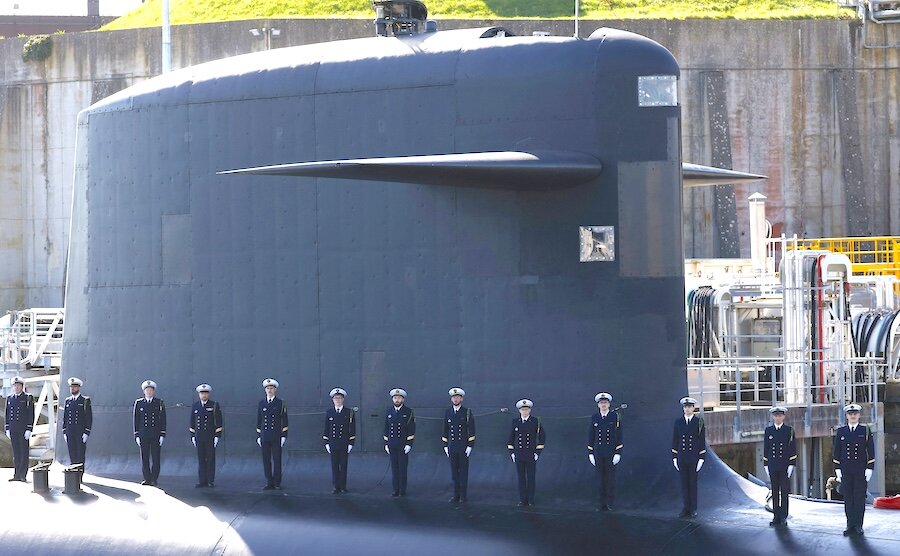
This week, French President Emmanuel Macron put his leadership legacy on the line, by explicitly offering to share the country’s nuclear defenses with key European allies. Speaking at the home port of France’s nuclear missile fleet in Brittany on Monday, Mr. Macron declared plans to increase France’s nuclear warhead stockpile (currently about 290) as well as place some of those in partner countries.
His offer marks “the most important revision to France’s nuclear doctrine in a generation,” the Financial Times wrote, calling it “indispensable for Europe’s defence.”
Since the days of Charles de Gaulle, who doubted the United States’ commitment to defend Europe from a Soviet nuclear attack, France has held to an independent stance on pursuing its own nuclear weapons development. “Would you trade New York for Paris?” General de Gaulle famously demanded of President John F. Kennedy in 1961.
Mr. Macron’s move is likely to bolster Europe’s military position at a critical time. But it also points to an opportunity to forge new and more enduring approaches to safeguarding the sovereignty and security of nations and individuals – means that go beyond the military might of missiles.
International laws and norms governing global relations are being severely jolted. Russia’s war in Ukraine, on Europe’s eastern flank, has entered its fifth year; the continent is confronting U.S. trade and geopolitical pressures; the U.S. and Israel have launched an air war against Iran. The New START arms control treaty between the U.S. and Russia expired just a month ago, even as China is rapidly growing its own nuclear arsenal, as the Monitor reported on Tuesday.
It is in this context that eight European nations will participate in France’s “deterrence” plan. They include Europe’s only other nuclear power, Britain; its largest economy, Germany; Scandinavian countries; Greece; and Poland, which shares a long border with Ukraine.
Some of these countries have previously supported nuclear nonproliferation and even disarmament. Now, however, as an analyst wrote in Foreign Policy magazine last March, nations wishing “to forge new nuclear arms control agreements will need to be nuclear powers themselves. If Europe wants to promote nuclear arms control, it paradoxically needs to go nuclear first.”
In the current geopolitical context, this view carries some weight. But, it is also worth recalling that Europe is fortified with a long tradition of democratic values and institutions. The demand on its governments and citizens is to maintain and adapt these core principles and foundations to help forge a new world order.