France is planning to restore national military service in the face of the growing threat posed by Russia and the risk of a new conflict breaking out in Europe.
President Emmanuel Macron will announce today that the country is bringing back the scheme on a voluntary basis, nearly three decades after scrapping conscription.
He is set to lay out the change in a speech this morning during a visit to an infantry brigade stationed in the Alps, according to a presidential official.
The announcement will come more than three and a half years into Russia’s full-scale invasion of Ukraine, with Macron and other French officials warning that Moscow risks not stopping at Ukraine’s borders.
France’s top general, armed forces chief of staff Fabien Mandon, sparked uproar at home last week by warning that France must be ready ‘to lose its children’, adding that Russia is ‘preparing for a confrontation by 2030 with our countries’.
Macron told the RTL broadcaster he would be announcing a ‘transformation of national service into a new form’ on Thursday, but did not provide further details.
A source with knowledge of the matter, who asked not to be named, told AFP that the plan is for 2,000 to 3,000 people to be trained up in the first year, aiming to increase those signing up over time to 50,000 per year. ‘It will start slowly,’ said the source.
This ‘new form of national service’ will be ‘on a voluntary basis’, said a presidential official. It has been said that this will most likely be in the form of a 10-month stint for both men and women.
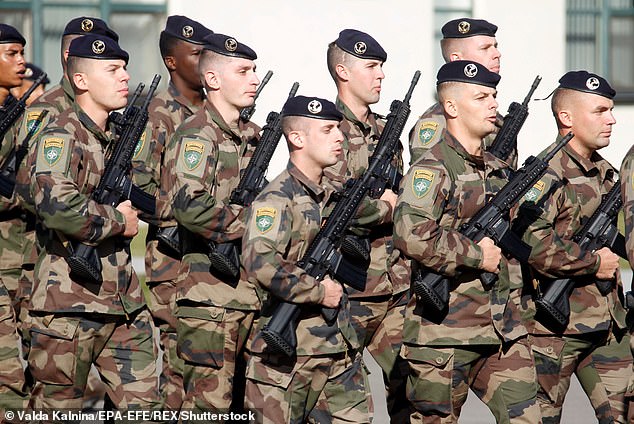
French soldiers serving at the NATO Enhanced Forward Presence battlegroup. Nearly three decades after scrapping conscription, France is reintroducing national military service
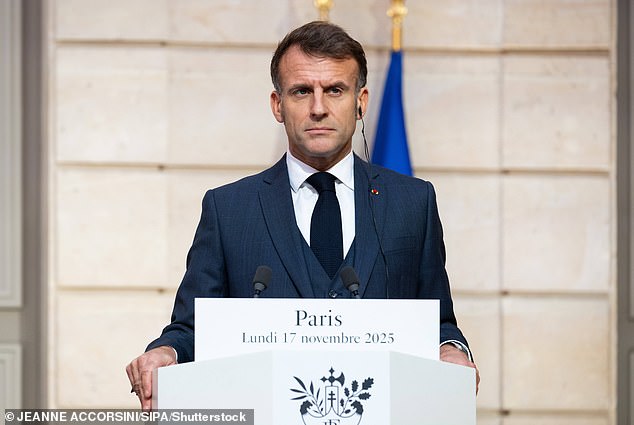
President Emmanuel Macron during a press conference in Paris earlier this month. He is set to lay out plans today during a visit to a military base in the Alps
An adviser to Macron, also requesting anonymity, emphasised it would be launched at a time of tight budget constraints.
Its implementation will therefore be ‘phased in over time,’ said the adviser, promising a ‘realistic’ project that ‘takes into account our current resources’.
While around a dozen states have some form of conscription, the use of military service is uneven across Europe.
As Russia continues to provoke European countries with airspace incursions and alleged drone sightings at airports and military bases, many countries have been looking at options to bolster their armies.
Germany’s governing parliamentary group has agreed to revise the country’s rules for joining the military. It is now floating around the idea that all 18-year-old males must undergo mandatory fitness tests.
Although Italy does not have compulsory military service since it was abolished in 2005, a new bill has been proposed to bring back a six-month period of either military or civilian service for people aged between 18 and 26.
France would now join European countries like Baltic states Latvia and Lithuania, which have brought it back mandatory military service in recent years, while others, such as Denmark, have toughened their terms.
There is so far no suggestion that the military service in France would be compulsory, as it was before then-president Jacques Chirac abolished conscription in 1997 as part of the reform of the army.
Military service is seen as a way of bolstering armies with recruits, but also of providing a large pool of potential reservists, who could be called up in the case of a future war.
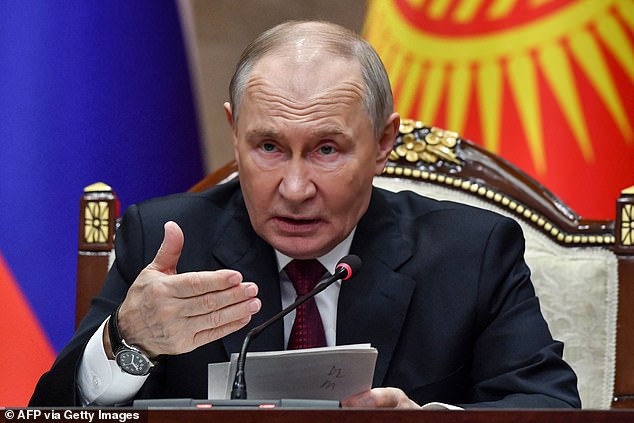
France is now joining other European countries in bringing back the scheme after recent provocations by Russian president, Vladimir Putin
The French armed forces have approximately 200,000 active military personnel and 47,000 reservists, numbers expected to increase to 210,000 and 80,000, respectively, by 2030.
The idea of conscription has often come up in French politics after it was scrapped by former leader Jacques Chirac in 1997. It has mostly been championed by right-leaning politicians.
A presidential official told reporters on Wednesday that the new scheme ‘reflects young people’s desire to serve but, even more, the operational need for the armed forces to respond to the acceleration of perils’.
Meanwhile, accused of warmongering by the left, General Mandon has expressed no regret over his comments last week, saying the aim was to ‘alert and prepare’ amid a ‘rapidly deteriorating’ context.
Mandon argued on Saturday that the reactions to his comments ‘show that this is something that was perhaps not sufficiently perceived in our population’.
But ahead of Thursday’s announcement, Macron and other officials have been at pains to douse the outcry caused by the general’s forthright comments and fears that French youth were heading for the front lines.
The president on Tuesday said he needed to dispel any notion ‘we are going to send our young people to Ukraine’.