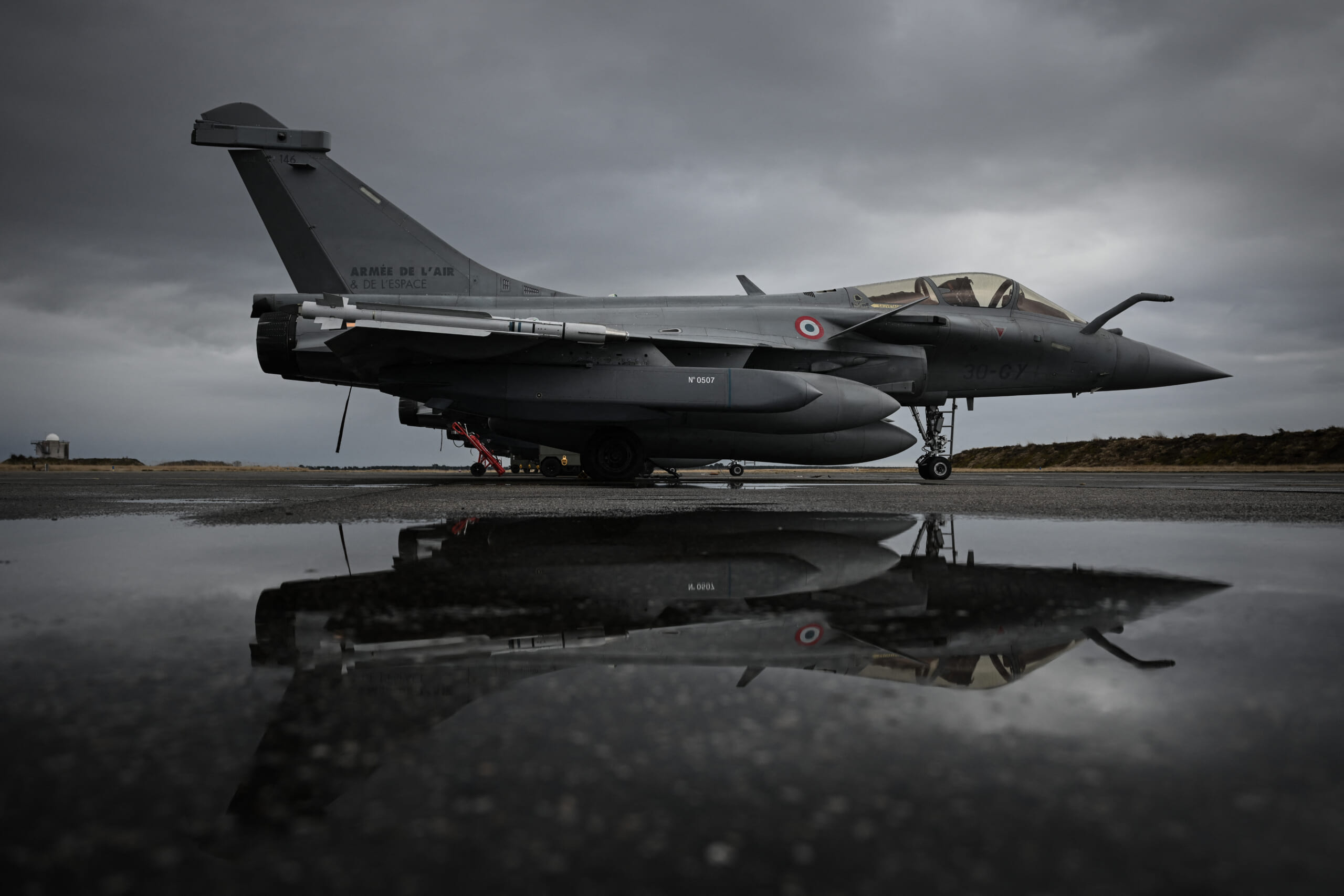
French President Emmanuel Macron stated on Monday that his government was working with eight European countries, including Germany, Britain, the Netherlands, and Poland, as part of a new “forward deterrence” strategy that could include having those countries and other European allies join France’s nuclear exercises. He also announced that Paris might “temporarily” deploy its nuclear-armed fighter jets on allied territory. Such moves signaled that Paris intends to adopt a more active nuclear strategy. The new moves also were consistent with Macron’s comment that France would increase its nuclear arsenal beyond the current estimated 290 warheads that can be fired from submarines and Rafale fighter jets.
A policy change that included stationing nuclear-armed French fighters in allied countries could prove especially significant. Although Macron did emphasize that France, alone, would keep full control over when and how to use its nuclear weapons, the other moves suggested that Paris was now flirting with a doctrine of extended deterrence—using France’s nuclear weapons capability to defend allies, not just France itself. If that policy shift proves to be real, it has widespread geostrategic implications.
New York Times analyst Mark Landler called the revised French policy “a landmark shift in its nuclear doctrine that reflects how an aggressive Russia and a retreating United States are redrawing the security contours in Europe.”
Some earlier moves by Paris suggest that the policy shift has already been underway for some time. Macron hinted this time last year that his country might consider extending the protection of France’s nuclear arsenal to other members of the European Union. Landler concludes that France
is acting not just on its own initiative, but in response to quiet prodding by some of its neighbors to spearhead a Europewide nuclear deterrent. Germany, which has historically positioned itself squarely under the American nuclear umbrella, has raised the idea with France, privately and publicly.
Germany, which began talks with France last year, issued a joint statement with the French government this Monday confirming that the two countries had established a “high-ranking nuclear steering group” for strategic cooperation. Berlin also will participate in French nuclear exercises this year, officials stated.
French leaders and the French people should be very cautious about embracing extended deterrence obligations. Primary deterrence—threatening nuclear retaliation for an attack on one’s own country—has a high level of credibility, so long as the country has the necessary weaponry to mount a serious counterstrike. Indeed, the main point of the Cold War era’s de facto doctrine of mutual assured destruction was based on that logic.
The credibility of courting similar devastation in response to an aggressor’s attack on another country—even a close ally of the defender—has always had much lower credibility. Despite Washington’s repeated promises to its European allies throughout the Cold War that the United States would respond with massive retaliation to any Soviet strike on a fellow NATO member, the European allies always seemed to harbor doubts about the reliability of that promise. That is why NATO’s European members wanted U.S. troops on the ground in Europe as a tripwire and went to great lengths to achieve that goal. If some American forces were positioned to perish in the first wave of a Soviet attack, Washington would have little choice but to honor its promise to engage in the fighting and conduct massive retaliation against the USSR.
That history raises obvious questions about how credible a French extended deterrence promise would be to its neighbors. To be blunt, would France really risk national suicide to protect small states such as the three Baltic republics, or even larger, more significant players such as Poland and Romania?
Many French voters seem wary of such an obligation. If Jordan Bardella, the likely candidate of the right-populist National Rally party, wins the forthcoming presidential election and succeeds Macron, the campaign for Paris to embrace extended deterrence could weaken quickly. Bardella and Marine Le Pen, the longtime face of the party, immediately issued a statement contending that Macron’s proposal to disperse French nuclear weapons elsewhere in Europe was a “political public relations exercise, carried out without regard to national interests.”
Indeed, French voters need to face some sobering realities. Russia possesses some 6,000 nuclear warheads, including 1,500 strategic warheads allowed under the now-expired New Start Treaty. France’s entire nuclear arsenal consists of a few hundred warheads. Given the great disparity in strategic capabilities, the Kremlin might well conclude that a French nuclear umbrella deployed over nonnuclear allies was merely a bluff—and a transparent one at that.
Hedging statements from Macron and his supporters elsewhere in Europe would tend to reinforce skepticism about the credibility of Paris’s ability to provide extended deterrence. Bruno Tertrais, deputy director of the Foundation for Strategic Research, a prominent think tank in Paris, sounded a pervasive theme, conceding that Macron’s concept would not replace the existing American-led NATO nuclear umbrella. The best rationale Tertrais could muster is that it could act as a “backstop.” Landler notes that “While parts of Mr. Macron’s speech were striking, nuclear arms experts said his plans would not, as a whole, transform European security. For political, doctrinal and hardware reasons, they said, France will never be able to replace the nuclear umbrella that the United States has provided to Europe since the end of World War II.”
Subscribe Today
Get daily emails in your inbox
The key question U.S. leaders and voters should address is whether continuing to incur the risks inherent in protecting Europe with Washington’s nuclear umbrella serves the best interests of the American people. That question is even more pertinent now than it was during the Cold War. During that era, the European allies might occasionally grouse about U.S. policies, but they reliably followed Washington’s lead on major policies.
That is no longer the case. Multiple European allies now openly defy U.S. trade and security policies and systematically undermine U.S. priorities. Such ostentatious displays of policy independence are especially concerning because several European powers are adopting dangerously hostile, confrontational stances toward Russia. Those allies have a growing potential to entangle the United States in a nuclear conflict with Moscow.
Washington should adopt a posture of neutrality regarding internal debates in Europe about proposals for either a French extended deterrence capability or a wider European version. In either case, it is time for the United States to close its own nuclear umbrella that has been shielding Europe. The risks to this country associated with extended deterrence have become much too great.