The boss of Ryanair has accused the EU of punishing British holidaymakers over Brexit by subjecting them to hours long passport control queues.
Chief executive Michael O’Leary, who voted Remain in the referendum, claimed the bloc was ‘undoubtedly’ forcing Britons to endure longer waits at airports as payback for leaving the EU in 2020.
UK holidaymakers jetting off to Europe have been warned of up to four-hour delays at airports as countries are ramping up the deployment of a new border system.
The EU’s Entry Exit System (ESS) involves people from third-party countries such as the UK having their fingerprints registered and photograph taken to enter the Schengen Area, which consists of 29 European countries, mainly in the EU.
Mr O’Leary said there had been ‘significant disruption’ at passport control since the new system was first introduced in October last year.
The system is being introduced in stages, with full operation expected from April 2026, but has already caused backlogs and increased waiting times for passengers.
‘We are beginning to see significant disruption. That’s the next big issue. And EES has just been a s*** show and a shambles,’ the Ryanair CEO told the Times.
He explained that any EU state can defer the implementation of EES for five months until the end of September, saying it would make ‘much more sense’ to do so to avoid the situation getting even worse during summer holidays.
‘There’s a bit of Brexit in this too. Here, you voted for Brexit – f*****g join the queue,’ he said.
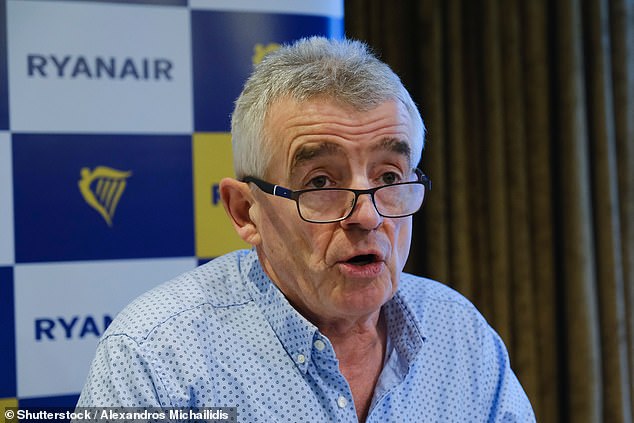
Ryanair Michael O’Leary (above) has accused EU of punishing British holidaymakers over Brexit by subjecting them to hours long passport control queues
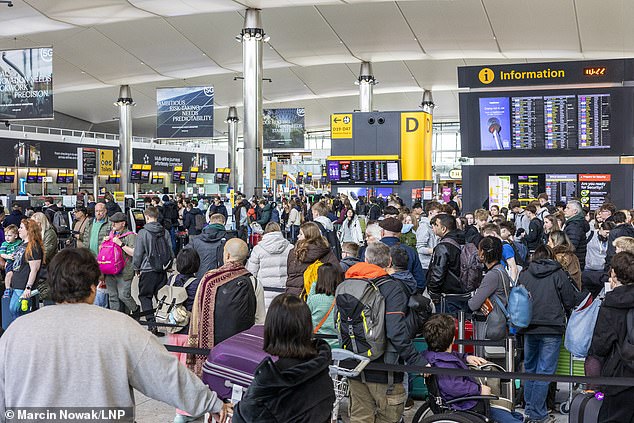
Passengers queue for baggage check at Heathrow Airport Terminal 2 in west London on Thursday as millions of journeys are expected to take place across the UK during the bank holiday weekend
Airports Council International said the latest data collected from airports across Europe shows a ‘continued deterioration in waiting times at border crossing points’ where ESS has been introduced.
Delays are ‘regularly reaching up to two hours at peak traffic times, with some airports reporting even longer queues’, it added.
The trade body previously warned that hubs in Germany, France, Iceland, Greece, Italy, Spain and Portugal were particularly impacted.
Mr O’Leary added further delays were being caused by understaffed immigration kiosks, while passengers who had already registered under the new system were being put in the same queue as everyone else.
He warned that smaller airports, such as those in Seville, Alicante, Tenerife and Faro, were likely to be most affected by delays.
The automated EES system was first launched in October 2025, but airports and ports initially had until April 2026 to fully implement the technology as a mandatory requirement.
However, last month, the EU made the decision to give 29 participating countries a more flexible timeline for the system’s introduction until early September.
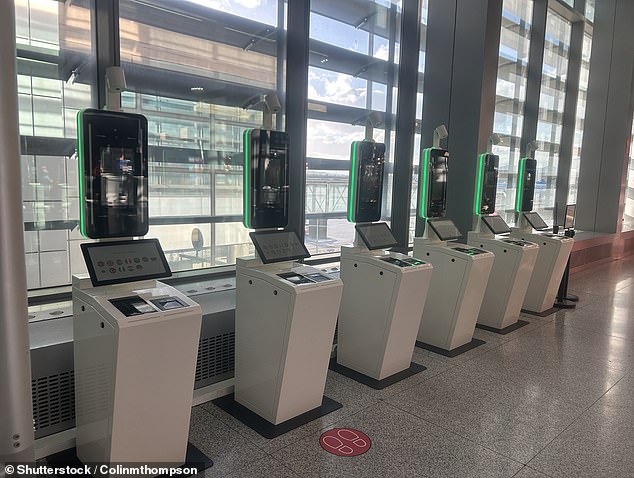
The biometric Entry Exit system requires fingerprints and photos from non-EU nationals, including UK citizens, entering Schengen Area countries
Aviation bodies previously wrote to Magnus Brunner, the EU commissioner for internal affairs and migration, demanding the EU take immediate action to prevent ‘excessive’ delays as a result of the rollout.
They warned: ‘Failing immediate action to provide sufficient flexibility, severe disruptions over the peak summer months are a real prospect, with queues potentially reaching four hours or more.’
They highlighted three core issues that are ‘compounding EES delays’, including ‘chronic’ understaffing at border control, ‘unresolved’ technical malfunctions and the ‘very limited uptake’ of the Frontex pre-registration app by Schengen states.