This article is taken from the February 2026 issue of The Critic. To get the full magazine why not subscribe? Get five issues for just £25.
To celebrate his 80th birthday in January, the novelist Julian Barnes published a new book, and did something unusual: he announced his retirement. He will do what writers almost never do: he’ll stop. “This,” he wrote in the new work, tellingly titled Departure(s), “will be my last book.” Whilst this is disappointing for those who enjoyed the latest despatches from one of the sharpest minds and wittiest pens in contemporary English literature, it enables us to view his work in whole, top to tail, and assess where he stands.
To have survived a 45-year writing career at all, let alone with all his novels still in print, is no mean achievement. It’s all the more impressive given that few could have stood out amidst that gilded generation of novelists who came to prominence in the late 1970s and early 80s: Barnes counts Martin Amis, Ian McEwan and Salman Rushdie amongst his peers and friends.
It is this writer’s view that Barnes in fact outshines them all, if not in peaks then certainly in both consistency and variety. None of those contemporaries has maintained the quality of work for so long, and none in so many literary spheres. Barnes has excelled equally in novels, essays, short stories and even translations.
But he was a slow starter. Barnes worked with words, but not in them, first as a lexicographer for the Oxford English Dictionary (letters C to G) and then on the New Statesman’s books desk, where he met his longtime friend — and, briefly, frenemy — Martin Amis. By the time Barnes published his debut novel in 1980, aged 34, both Amis and McEwan were three books into their careers.
Reading his early work, there’s a sense of Barnes trying out what sort of writer he would like to be. His debut Metroland is a clever young man’s novel about a clever young man, which took Barnes seven years to write. It earned “unexpected praise” in a letter from Philip Larkin, who declared that “he had much enjoyed it, despite his prejudice against novels with people under the age of 21 in them”.
Barnes’s own mother had a more mixed response to the sex in the book: pride and prudishness combined to ensure that she would show the cover of Metroland to her friends, but not allow them to look inside.
If she had read Barnes’s second, Before She Met Me (1982), her disdain would have turned to alarm. It’s a strange tale of retrospective sexual jealousy, where the narrator becomes obsessed with the lovers his new partner had before they met. It’s a striking account of obsession, which inevitably turns ugly, and we presume Barnes thinks little of it: in a 2008 short story, “Knowing French”, which takes the form of correspondence from an imaginary reader to Barnes, Before She Met Me is “the only book of yours you told me not to read”.
Yet this is not quite fair: the book is uncharacteristic, yes, but efficient and effective, and moreover it highlights a side of the writer — cheerful nastiness — which had existed quietly before. By quietly I mean that Barnes had already published two pseudonymous crime novels (as Dan Kavanagh) about the private detective Nick Duffy.
Duffy (1980) and Fiddle City (1981) each took Barnes a matter of days to write. They — along with two later Duffy novels — are not major works, but they are early evidence both of Barnes’s fecundity as a writer and his facility: a good writer can’t turn off his care for words, his insights, his way with dialogue. They also show his interest in exploring different literary forms.
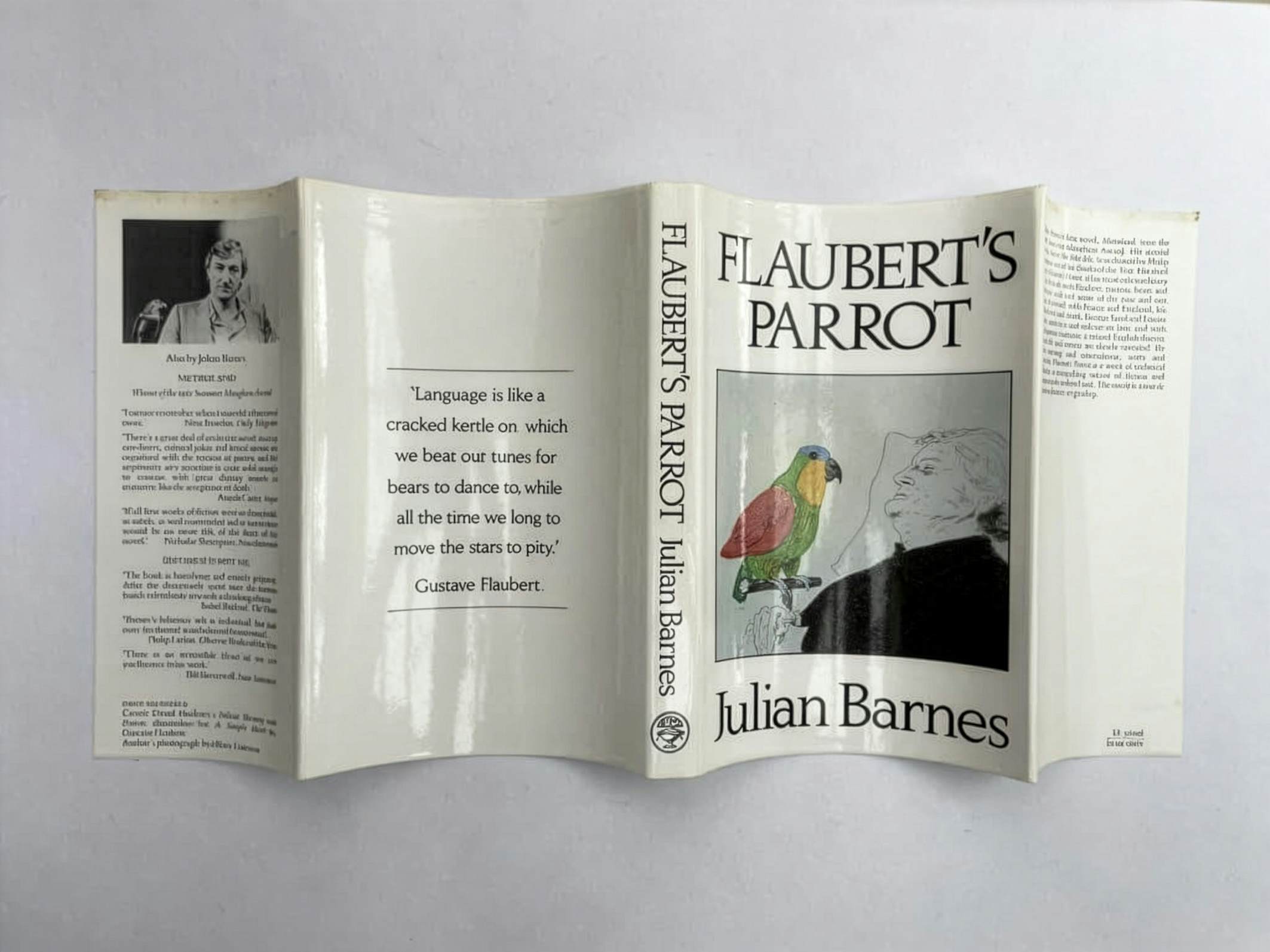
But it was his third novel proper that really brought this interest to full life. Flaubert’s Parrot (1984) is the Ur-Barnes text, incorporating many of the elements that would appear through his work in the subsequent four decades.
In many ways, it didn’t look like a novel at all, despite its fictional framing: the story of a man, Geoffrey Braithwaite, who is interested in the life of French novelist Gustave Flaubert. Within this frame, however, the book goes everywhere, mixing perception with playfulness.
It includes a dictionary, three competing chronologies of Flaubert’s life, literary criticism (and criticism of literary criticism), and even an examination paper for the reader near the end. “Books are where things are explained to you. Life is where they aren’t,” Braithwaite says. “I’m not surprised some people prefer books.”
This skittish energy would continue to be a feature of Barnes’s work. Genre-bending was now in his blood. The 1989 novel A History of the World in 10½ Chapters is made of a series of short stories, starting in Biblical times and ending in a futuristic heaven, linked thematically by Noah’s ark. Playfulness persists: the first chapter is narrated by stowaways on the ark, namely a couple of woodworms.
Barnes even managed to bring something new to the greatest cliché of literary fiction: the novel of adultery. With Talking It Over (1991), the three points of a love triangle take turns to talk directly to the reader, part Akutagawa’s In a Bamboo Grove/Rashomon, part Woody Allen’s Husbands and Wives.
The two men, Stuart and Oliver, vying for the woman, Gillian, are like the dual aspects of Barnes’s literary character. Stuart is reliable, a safe pair of hands; Oliver is dazzling, clever and witty. They appeal directly to us, the reader, as the only person present who knows what all three characters are saying. “Of course, you know if they’re really fucking, don’t you? Go on, tell me.”
He kept faith with this structural ingenuity right to the end of his career: his last novel Elizabeth Finch (2022), themed along contemporary culture wars, is half-fiction, half-essay, and his final book Departure(s) claims to be a novel whilst clearly drawing directly on Barnes’s own life.
But to return to Flaubert’s Parrot, it was not only for its playfulness that it foreshadowed Barnes’s subsequent career. It was for its French interest. Barnes is England’s greatest literary Francophile — and if France is his target, Gustave Flaubert is the bullseye. “I wish he’d shut up about Flaubert,” Kingsley Amis once said.
In one sense this is another instance of his hybridity: a prize winner in both countries, Barnes acknowledges that here he is seen “as a suspiciously Europeanised writer, who has this rather dubious French influence. But if you try that line in Europe, especially in France, they say, “Oh no! You’re so English!’” It’s true that English ways are the subject of many of Barnes’s books — Arthur & George (2005), his most mainstream novel, is about an Edwardian miscarriage of justice featuring Sir Arthur Conan Doyle; England, England (1998), Barnes’s only fictional misfire, is a satire on little-England nationalism.
But France provides the setting, in whole or in part, for several of Barnes’s novels — and even in his debut Metroland, the very first words of the book, an epigraph from Arthur Rimbaud, are in French. Anglo-French relations were the theme of his 1996 story collection Cross Channel, as well as his 2002 essay collection Something to Declare. This includes pieces on writers such as Georges Simenon (“a man incapable of being bored, so long as he remains the topic of conversation”) and, naturally, ten essays on Gustave Flaubert.
Although Barnes is a novelist at heart — “fiction, more than any other written form, explains and expands life,” he wrote — his non-fiction books are just as satisfying, witty and eye-opening. In Letters from London (1995) you will find the civilised, urbane Barnes in a state of steely outrage at the British government’s lack of backbone in the face of Salman Rushdie’s fatwa.
Throughout these collections he is the master of the telling, toothsome detail. In Through the Window (2012), his essays on writers, he tells us how Paul Theroux, acting as a Booker Prize judge in 1979, lobbed Penelope Fitzgerald’s Offshore out of a Patagonian train window, deeming it beneath his notice, only “to find himself with a polite smile on his face as the prize was awarded to Fitzgerald” six months later. Even the index is amusing: “Theroux, Paul polite smile, 4; Amis, Kingsley, limited zeal for Flaubert, xiv”.
In these essays, as in his fiction, Barnes’s dual interests are, Reithianly, to inform and entertain. By blending fiction with history, essay and memoir (but never, he says in Departure(s), “the easy garrulity of autobiography”), he plays with the reader’s confidence in what is real, whilst always steeping us in reliable facts as well as the different sort of truth that fiction provides.
It is true that some find Barnes’s style a little too cool and collected, though heat is rarely far below the surface, whether in the outbursts of passion in Talking It Over, the anger at the Rushdie affair, or his response when his old friend Martin Amis sacked Barnes’s wife Pat Kavanagh as his literary agent in 1995. In his memoir Experience, Amis wrote that afterwards, Barnes sent him a letter which included a phrase consisting of “two words. The words consist of seven letters. Three of them are fs”.
The quick wit; the interest in eye-catching facts; the unashamed pursuit of ideas in his novels, even if “some people react as if they’ve found a toothpick in their sandwich”; and his love for blending the unexpected together. It all points to the output of a mind forever whirring, feeding itself to feed the reader.
Can we believe that Barnes will really retire, and stop — full stop? We shall see, but in the meantime, as he pointed out in an interview for this final book, “You can always read the earlier ones.”You can, and you should.