Last year, the world got its first real taste of what President Trump’s “America First” foreign policy would entail.
The new coins of the realm are transactionalism, tariffs, big-power politics that include bullying of allies like Canada and Israel, and – perhaps most significant – a spheres-of-influence vision of the world reminiscent of the 19th century.
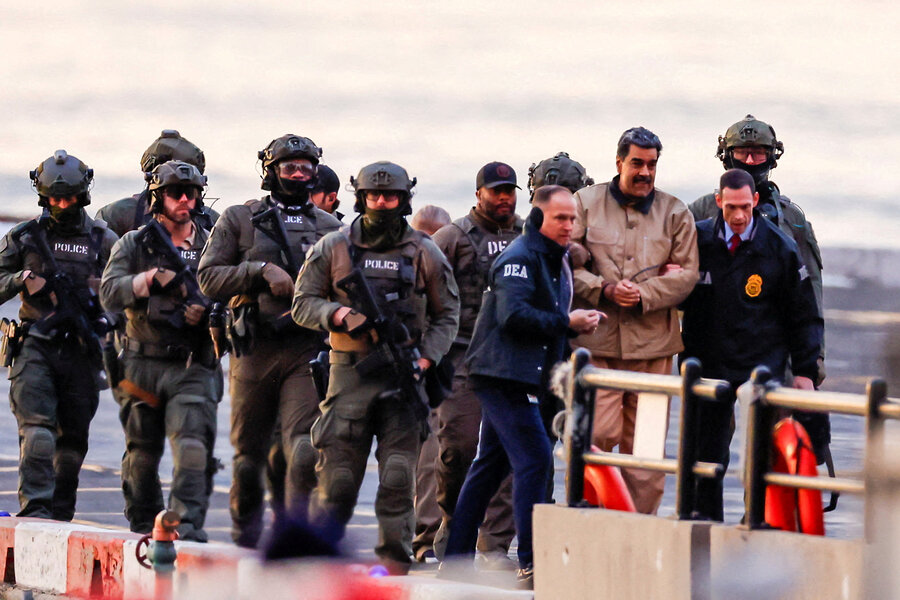
A view of the Western Hemisphere as America’s exclusive zone of interest was starkly on display with a Caribbean power buildup that culminated in a Jan. 3 military operation in Venezuela that seized President Nicolás Maduro to face drug trafficking charges in the U.S.
Out, or at least downplayed in Mr. Trump’s foreign policy playbook, are the military and economic alliances and U.S.-led international institutions born from the ashes of World War II. The idea that America enhances its own prosperity and security by building and leading communities of democratic nations has been supplanted by the view that America is strong and prosperous when it puts America first.
More stories on President Trump’s second term after one year:
• In one year, Trump has shaken up everything. With what effect?
• On the economy, no recession, but no boom either
• Battling universities over antisemitism and DEI
In his first term, Mr. Trump’s foreign policy was hindered by a lack of preparation for implementing a radically different vision of American global leadership.
But the architects of the Trump 2.0 foreign policy, including deputy chief of staff Stephen Miller, had a four-year interregnum to prepare for this term’s muscular, nationalist, America-centric approach. The arrival of this approach is seen in the evolution of Secretary of State Marco Rubio, as the former Trump critic has adapted his promotion of democracies and human rights to the America First vision.

2025 brought a deepening estrangement from European allies and more collegial relations with strongman leaders, from Russia’s Vladimir Putin to Saudi Arabia’s Mohammed bin Salman.
Mr. Trump has bombed Iran’s nuclear facilities, sought to use tariffs as leverage in America’s rivalry with China, and spurred negotiations to end the conflicts in Gaza and Ukraine. But the road toward peace in those regions remains uncertain.
The most striking application of Mr. Trump’s foreign policy came in the Western Hemisphere, where his Monroe Doctrine 2.0 includes justifying the use of force in the region to secure U.S. interests.
In the first weeks of his return, Mr. Trump threatened to retake the Panama Canal and belittled Canada as the 51st state. He spoke of acquiring Greenland, too – an idea the White House has been pushing back into the news.
Then came the military strikes in the Caribbean on suspected drug-smuggling boats and what the administration described as a blockade to stop sanctioned oil tankers from exporting Venezuelan oil.
They put pressure on Mr. Maduro, whom Mr. Trump had already labeled a narco-terrorist. But the blockade and ultimately Mr. Maduro’s capture were also seen to be directed at China, which has extensive economic and political ties across Latin America.
To Beijing, the message is this: In this new age of spheres of influence, the Western Hemisphere is America’s domain.
Read our other stories on President Trump’s second term after one year:
• In one year, Trump has shaken up everything. With what effect?
• On the economy, no recession, but no boom either
• Battling universities over antisemitism and DEI