When President Miguel Díaz-Canel stood before the Cuban flag and replaced Raúl Castro as head of the Communist Party in 2021, it marked the first time in more than six decades that Cuba’s government would be led by someone outside the Castro family.
But in a one-party, authoritarian state, the historic shift in leadership was more a cosmetic change than a cosmic one. As President Donald Trump this week publicly leaned into the idea of U.S.-imposed political change on the island, Cuba’s power structure matters.
“I do believe I’ll be having the honor of taking Cuba,” Mr. Trump said on March 16. “They have to get new people in charge,” Secretary of State Marco Rubio elaborated the next day.
Why We Wrote This
The Trump administration appears to be emboldened, after ordering U.S. military intervention to depose and capture Venezuela’s president early this year. But “taking Cuba” – as President Trump has said – would probably not be simple or easy.
After a successful U.S. military operation in January to unseat another authoritarian leftist leader, Nicolás Maduro in Venezuela, Mr. Trump’s administration appears emboldened. But Cuba experts say the model of ousting one leader by force and replacing him with someone more malleable to Washington’s wishes would not be as effective in Havana. Most of Cuba’s political opposition is in prison or has left the country, and hard-liners – including Raúl Castro – still call the shots, even if from behind the scenes.
“What nobody wants, and nobody could be expected to agree to in Cuba, is a ‘U.S. takeover,’” says Paul Hare, who was British ambassador to Cuba from 2001 to 2004. “That’s simply fanciful diplomacy and fanciful tactics.”
The Trump administration needs to “look at the wider picture,” he says.

The Castros are still in charge
The Communist Party of Cuba is the only legal political party on the island. It controls all elements of the government from local to national offices. The president of Cuba acts as head of state, but it’s the first secretary of the Communist Party who is considered to be the most powerful. Mr. Díaz-Canel became president in 2018, three years before taking over leadership of the party.
But even after handing over these visible leadership positions, Raúl Castro, who launched the Cuban revolution in 1959 together with his brother Fidel, is still considered immensely influential. And his children and grandchildren are in varying positions of importance, holding substantial sway over the military and the economy.
Cuba is “a highly disciplined government. You don’t have the various points of contact the U.S. had with elements of the Venezuelan government” before Mr. Maduro’s capture, says Christopher Sabatini, a senior fellow for Latin America at Chatham House, a London think tank. “Cuba’s structure is very vertical,” he says. ”Regime change in Cuba is impossible, and very dangerous.”
President John F. Kennedy imposed an economic embargo on Cuba in 1962. The embargo was expanded in 1996 under the Helms-Burton Act, which made regime change in Cuba part of U.S. policy. Some hoped to instigate enough frustration that people would rise up on the island and overthrow the communist regime themselves.
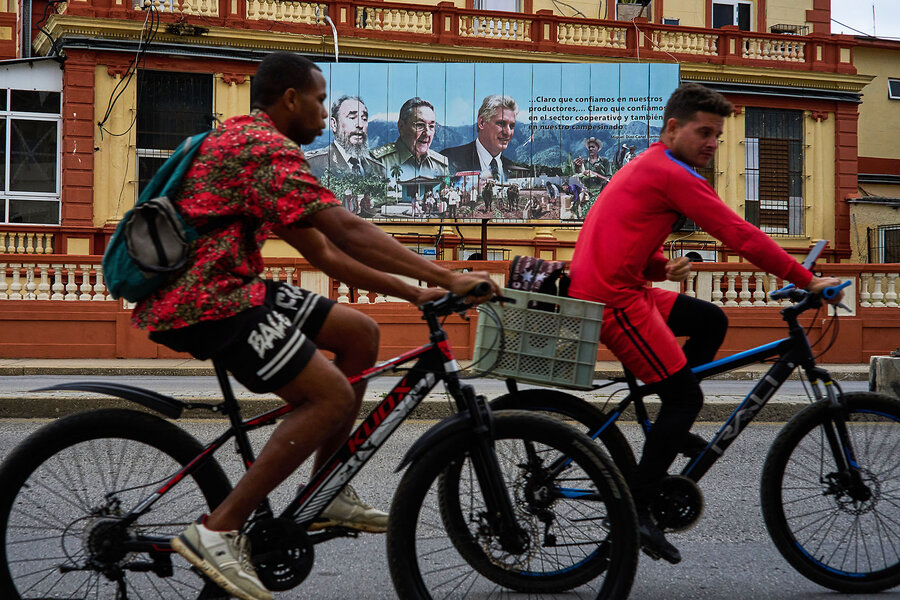
But the Cuban government has successfully leaned on the U.S. embargo to explain hardship on the island. Anti-imperialist billboards and political murals condemning the United States flank roads throughout Havana. And, over the years, benefactors have swooped in to bolster the communist regime, from the Soviet Union to later Venezuela, Russia, and China.
A recent U.S. oil blockade has added to the difficulties faced by Cuban citizens. Island-wide blackouts have limited access to food, transportation, and medical care. The humanitarian crisis also puts the Cuban government in a weakened position for negotiations with the U.S. Mr. Díaz-Canel acknowledged for the first time on March 13 that talks with the Americans were taking place.
“The blackouts are unbearable,” says Sergio Almaguer, who is in his 60s and has lived in Havana all his life. “There are external factors that have always been there, preventing us from moving forward,” he says of the U.S. embargo. “But, after so many years of pressure, [Cuba’s] government has to find a way out.”
An estimated 2 million Cubans have left since the COVID-19 pandemic, which decimated the tourism industry and worsened the island’s overall economy. Many of those who decided to emigrate were younger people. The population that remains in Cuba is the oldest in the Americas.
The Cuban government’s “interest is in self-survival. They won’t buckle under a completely exhausted population,” says Mr. Sabatini.

Change in the future
Experts do, however, see an opportunity for change within the existing economic model. And there are likely some economic reformists inside the Cuban government, says Mr. Hare, who teaches international relations at Boston University.
Raúl Castro might be counted among them: Exactly 10 years ago, then-President Barack Obama visited Cuba to celebrate a thaw in Cuba-U.S. relations that started in 2014. The two countries reestablished full diplomatic ties, travel restrictions were loosened, the U.S. removed Cuba from its list of state sponsors of terrorism, and U.S. companies were able to enter Cuba under certain business contracts.
Mr. Rubio was a leading critic of Mr. Obama’s normalization policy with Cuba, and the reforms were quashed when Mr. Trump first came to office in 2017. The economic situation on the island has deteriorated in the interim, alongside a bungled currency reform and widespread public protests in 2021 over living conditions.
Cuba announced on March 12 that it would release 51 political prisoners, a measure facilitated by the Vatican. Mr. Díaz-Canel also promised “opportunities” for the Cuban diaspora, inviting Cubans abroad to invest in private businesses on the island, or even partner with state enterprises.
Mr. Rubio’s team has met with another potential economic reformist within the Cuban government, as well. That’s Mr. Castro’s grandson, Col. Raúl Guillermo Rodríguez Castro, who also serves with his private security detail.
“If you want to get to Raúl Castro, why not go through the grandson, part of this new generation,” says Michael Bustamante, a Cuba expert at the University of Miami. The U.S. might convince the younger Castro, who he says is known to be a “party boy,” that “you can have a better future under a different economic model.”
For many in the politically powerful Cuban diaspora in the U.S., where Mr. Rubio grew up and climbed the political ranks, the idea of economic change in Cuba without democratic transformation is unthinkable. But even Mr. Rubio has hinted at the need to expect gradual change in Cuba.
“It would be nice to have fair and free elections, but … since 1902, there have only been about 13 years of functioning democracy in Cuba,” Mr. Hare says. “You can’t just parachute in there and restore democracy.”
Rudy Cabrera contributed reporting from Havana.