This may sound daft but for the past 18 months I’ve suffered from a very cold nose – even when the rest of my body is warm or I’m in a warm house or bed. My GP said it was probably Raynaud’s disease. It’s quite painful and I suffer during cold weather. Any advice?
Judith Hurst Shaw, Oldham.
Dr Martin Scurr replies: I agree with your GP’s assessment and believe you have a form of Raynaud’s. But instead of affecting your fingers and toes (the classic form) in your case, it’s your nose.
Raynaud’s is a condition where, when exposed to the cold, the small blood vessels go into temporary spasm, reducing the flow of blood. This leads to dead-looking white and painful fingers.
The same thing appears to happen on the tip of your nose: even a small degree of cooling can cause the tissue to get cold and the blood vessels to spasm. Your nose will feel intensely chilly and may change from white to blue.
There are two types of Raynaud’s – the main type, known as Raynaud’s phenomenon, is largely hereditary and tends to come on much younger (you’re now 80, you say).
If this is a new symptom then it could be Raynaud’s disease, which is associated with conditions that affect the connective tissue, such as scleroderma and lupus. Both are autoimmune conditions.
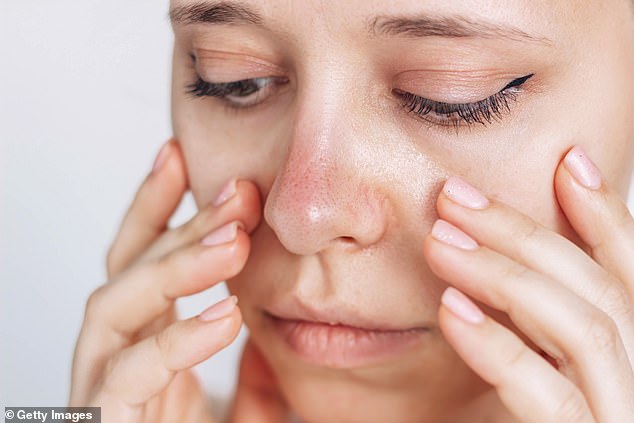
With Raynaud’s, even a small degree of cooling can cause the tissue to get cold and the blood vessels to spasm. If it affects the nose, your nose will feel intensely chilly (picture posed by model)
In scleroderma, this affects collagen production, causing thickened skin and damaging blood vessels. Lupus can cause a range of changes, including inflammation in the blood vessels, affecting blood flow.
It can also be a side-effect of some medications: decongestants, beta blockers (prescribed for hypertension) and triptans (to treat migraine) may all trigger these symptoms.
My advice is that you should at least undergo a blood test to screen you for these disorders, given your age.
I’ve recently had scans for various health conditions and I am now worried about accumulated radiation. I had PET-CT scans in November 2025 and September 2024, and in 2017 and 2018. I’ve also had private annual mammograms following lobular breast cancer in 2017, on the advice of my breast cancer surgeon. Should I wait a couple of months before my next mammogram? I’m over 65.
Name and address supplied.
Dr Martin Scurr replies: There’s no official ‘safe limit’ for radiation from medical scans. Instead, a scan is only performed if the doctor decides the benefit to you outweighs any risk.
Everyone’s lifetime risk of getting cancer (from all causes) is around 40 per cent. This risk increases by around 1 per cent for every 100millisieverts (mSv) of radiation exposure.
A millisievert is the unit used to measure the amount of radiation absorbed by your body.
Each PET-CT scan (where a radioactive tracer is injected to show up any cancer, alongside a detailed image of the anatomy) will have given you an exposure of about 20mSv and each mammogram about 0.4 to 0.7mSv.
Adding up all your scans (four PET-CTs, plus several mamm-ograms), your total exposure is estimated at somewhere between 80 and 100mSv.
This puts your added lifetime cancer risk from all these scans at approximately an extra 1 per cent on top of the general risk everyone carries.
So your exposure does indicate a real but tiny increase in your overall risk. This is not sufficient grounds to defer or cancel your next mammogram, particularly given that you’ve had breast cancer in the past, which means regular further screening is of great importance.
Catching any recurrence early gives you the best chance of successful treatment.
In my view… Learn to beat hunger on weight-loss jabs
Weight-loss jabs – GLP-1 agonists – have revolutionised healthcare. Their results – from the changes in people’s appearance, but, more importantly, to their impact on reversing type 2 diabetes and reducing cardiovascular events, such as heart attacks – are astonishing.
But as we all now know, once someone stops injecting the drug, they rapidly regain weight.
The problem is that obesity is a disease of appetite. When an effective appetite suppressant (which is how these jabs work) is stopped, the hunger returns and so too does the weight.
The answer is to encourage people while they are on the drug to retrain their appetite and commit to a healthy diet.
This is a long-term commitment and many of us in medical practice are now starting to accept that continuing the drugs for life is inevitable for some people at least (as they will still always need that help with appetite suppression).
The worry is, of course, the long-term effects of being on such drugs.
I fear this is very much a giant experiment on a willing population who may learn, too late, the true cost.
- Write to Dr Scurr at Good Health, Daily Mail, 9 Derry Street, London, W8 5HY or email drmartin@dailymail.co.uk – include your contact details. Replies should be taken in a general context and always consult your own GP with any health worries.