My late father outlived several good souls from his native parish who fondly believed that each, alone, were his exclusive source of guga, an esteemed local delicacy — smoked, cured, spatchcocked gannet.
He was many things — a prominent Free Church minister, an eminent theologian, a sparkling columnist for several newspapers and in fluent command of six languages — but he was particularly pleased to be a Niseach.
He was born in Habost, Ness, by the very Butt of Lewis in November 1940, on the soil of the same township where we would bury him in May 2023. For at least a thousand years — and, probably, far longer than that, lost in the mists of the Icelandic sagas — ten men of Ness have annually harvested gannet-poults from the remote, tiny, craggy little island of Sùla Sgeir.
Not baby-gannets, which are too bony, but plump, near-ready pubescents on the brink of their first flight and enjoying the Upper Sixth common-room.
It is a daunting expedition. Sùla Sgeir — the very name means “Gannet Rock” — is almost forty miles north-east of the Butt, amidst the swell of the Atlantic Ocean, but with the treacherous currents surging from the Minch.
Even making footfall there, with neither a harbour nor a quay, would daunt the stoutest spirit. Yet the men come, and subsist for a fortnight, in venerable drystone-walled cells that have stood for centuries, beyond mobile-phone coverage.
Until a spray of insecticide, they spend the first night or two asleep with scarves wrapped about their heads: Sùla Sgeir crawls with earwigs.
They bring a VHF radio for emergencies, but just imagine it — the ear-wigs, two weeks without a shower, without YouTube and — save, of course, on the Sabbath — the exhausting snaring, thumping, plucking, gutting, singeing, smoking and curing great piles of flightless fluffy “solan geese,” as they were once generally dubbed.
The hunt is perfectly legal — it was granted a special derogation under the Protection of Birds Act 1954, carried through the Wildlife and Countryside Act 1981 — and monitored closely, with courtesies on both sides, by what is now NatureScot, the all-things-that-creep-or-fly quango headquartered, these days, in Inverness.
Just within living memory, guga was a vital source of winter protein in a subsistence Hebridean economy. All my great-grandfathers were crofter-fishermen in the north of Lewis. But these are wild, exposed shores for such a dangerous enterprise.
There were weeks on end when no one could venture out in their rowboats and skiffs. Occasional, terrible disasters: in the “Great Drowning” of 1862, thirty-one Ness fishermen perished — leaving twenty-four widowed women and seventy-one fatherless children.
Indeed, between 1834 and 1900, ninety-six men of Ness were lost at sea — from a coastline smaller than the Gaza Strip. Indeed, both the President of the United States and I can claim descent from drowned Lewis fishermen. The waves have some mercy, but the rocks have no mercy at all …
Daddy kept his guga — there were usually two or three a year — in plastic bags in his west-end Glasgow garage. He fretted not about rats: they take one whiff of oily-rags fare like something censors would have surely scissored from Doctor Who and the Green Death, and recoil.
He always cooked it himself, it was always on a Saturday, and it was usually October or November. In rare tolerance, my mother actually let him boil it in the manse. (Even in Ness, most men are banished to the byre with a camping-stove.) Guga, washed, quartered, boiled for an hour and a half with one change of water, is ceremonially served with plain potatoes boiled in their jackets and a chilled glass of milk. It is eaten with your fingers.
Even as a small boy, I thought guga delicious — think of very fishy duck — and the skin, thick as bubble-wrap, was almost the best part. That needs to be put in perspective: even in posh G13, our usual Saturday repast was salt herring, thick with bones, kept in a bucket in the porch and a frightening dish for small boys.
Nor was guga of yore a taste peculiar to the Western Isles: as “Mistress Margaret Dods” recorded in her 1827 Scottish cookbook, “highly relishing… smoked solan geese are well-known as contributing to the abundance of the Scottish breakfast.” Particularly in Edinburgh, where gannets were readily to hand on the Bass Rock.
With the inevitable profanities, Gordon Ramsay, no less ,was rather enchanted with guga when, two decades ago, he travelled all the way to Ness to taste it. But, even then, there was a vocal cosmopolitan lobby calling for the gannet-cull to be banned — and, soon, with the added megaphone of social media.
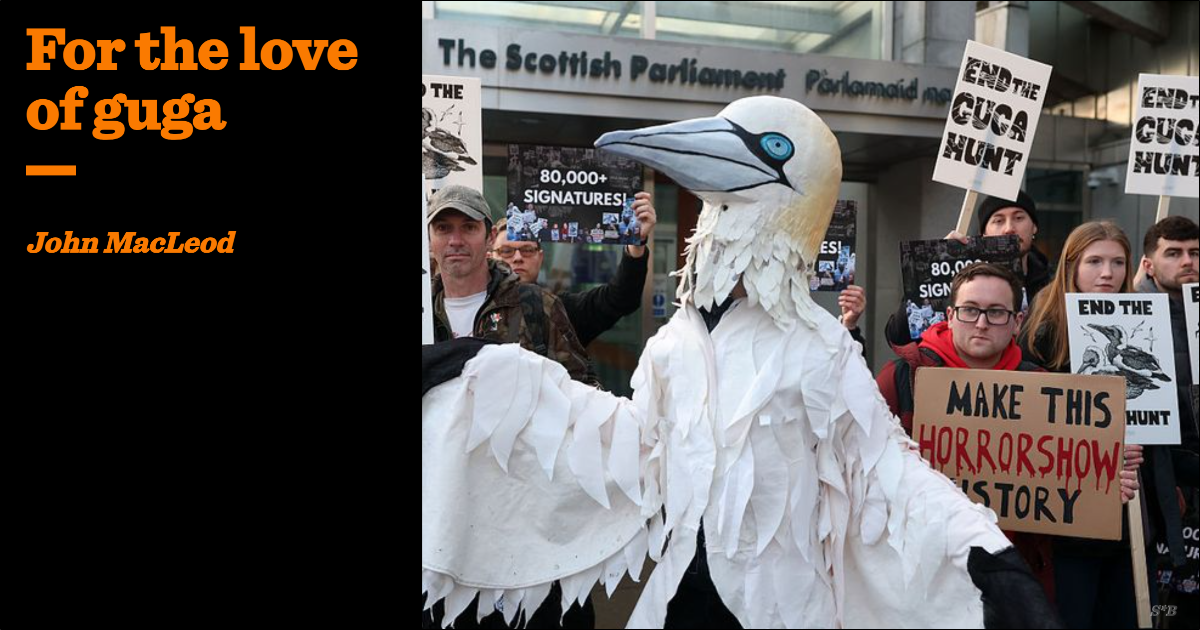
As I write, an online petition to the Scottish Parliament — created by one Rachel Bigsby — has gained nearly 90,000 signatures. For years, now, folk have been wailing as if the men of Ness have been slaying, stuffing and spit-roasting babies.
Only last year, Rebecca Douglas (“Visual storyteller, photographer, filmmaker, drone pilot, ocean advocate and President of the Board of Trustees for Whale Wise”) said:
It is July 2025, and I am shaking with disbelief. NatureScot has granted permission for a group of people to sail to Sùla Sgeir, a remote and uninhabited island north of the Isle of Lewis, to kill 500 juvenile gannets, young birds taken before they have ever flown.
“The conquest and control of wild creatures,” she stormed, “the assumption that they are there for human taking, is a worldview rooted in colonisation and upheld by patriarchal values. It is time to choose differently.”
The SSPCA has clamoured for an end to the cull for years. As far back as 1939, Sir Julian Huxley — who would found the World Wildlife Fund — brayed to readers of the Geographical Magazine his hopes that “public opinion and the county council will soon put a stop to this practice.”
As satirised as long ago in Compton MacKenzie’s 1957 comic-novel Rockets Galore — subsequently, quite a good film — the folk of the Outer Hebrides have long been resigned to an order where wildlife is increasingly prioritised over people.
There have been emotive clashes over the age-old custom in the Ness district of Lewis of using the young of the solan goose as food,” mused James Shaw Grant in 1990:
Once a necessity, now a locally esteemed luxury; the culling of seals in Orkney; the use of a wildfowl habitat in Islay to provide peat for the distilleries; the depredations of geese on the grasslands of Uist and the afforestation of the Flow Country in Caithness.
Each has raised different issues in the relationship between conservation and development; between the indigenous population and outside pressures.
There has also been a long and irritating disdain, from the men — and they have mostly been men — averred experts on our wild creatures for the ordinary country folk who simply live with them.
There is nothing new in this: the writings of John Muir, the Scots-born father of modern conservation and the United States national parks, drip with rank, racist contempt for Native Americans.
It takes a heck of a lot of knowledge of birds if you are going to have any hope of catching them
As Professor Tim Ingold of the University of Aberdeen sharply pointed out, the scientific understanding of an animal contrasts with — and is not self-evidently superior to — the intimate knowledge of the hunter, a knowledge which he argued is “as we would speak of it in relation to persons.”
To know an animal, as Fraser MacDonald put in 2014, “was to know their tastes, patterns, moods and quirks. And as a model of animal-human relations, this is rather at odds with the spectatorial gaze of the modern environmentalist.
It is also an ancient form of knowledge which has often been devalued. In St Kilda for instance, Britain’s most famous sea-fowling community, one gentleman-naturalist complained that the islanders had little knowledge of birds; they simply ate them …
But it takes a heck of a lot of knowledge of birds if you are going to have any hope of catching them. This could not have been better-framed than in Patrick Galbraith’s recent reflections on rough shooting in these esteemed columns: “Anybody who can’t read the landscape tends to go home empty-handed. A good rough shot knows that woodcock like to be beneath holly bushes, they know where the snipe will be, and they’ve learned how to use the wind to their advantage…”
For years, Millwall-supporters style, the men of Ness rather leaned into the hatred and vituperation. In 2013, Ness Football Club even held a “World Guga Eating Championship Night” in the local social club.
The winner — Peter MacRitchie, 33 — downed half a gannet and nearly a pound of potato in three minutes, forty-four seconds. Against a background of online dementedness: some 74,000 hysterics signed a petition damning the tongue-in-cheek event.
“Stop this insane, monstrous and animal-unfriendly chick eating contest in Scotland!” roared Jeannine Bolink in the Netherlands. “We are not in [the] Middle Ages anymore and idiotic things like this must be stopped and should be forbidden!”
For years, nonetheless, the “Ten Men of Ness” happily posed for snaps in the local paper, granted interviews, and even allowed the odd reporter or photojournalist to join them on Sùla Sgeir. Such glasnost ended, practically overnight, from 2017 — when they received a death-threat from the south of England, with the usual emotive howls about “baby birds being bludgeoned to death.”
The hunters now keep a low profile; have silenced themselves to reporters and documentarians. It is scarcely as if they are in it for the money. The 2,000 birds they were licensed to catch — the quota was last year reduced to five hundred and, given NatureScot’s concerns over avian flu, that was the first hunt sanctioned since 2021 — were sold on the Port of Ness quayside for £30 to £40 a brace, barely covering the costs of the expedition and a fortnight off work.
One suspects that many of the … activists who sign petitions like this … have no qualms about stuffing themselves with industrial chicken
There is little logic to the sustained venom. Britain’s gannet population actually increased sixfold across the twentieth century, and when the men of Ness returned to Sùla Sgeir in 1946 — after some years when we had far weightier matters to fret about — they were startled to find its gannet-colony had all but collapsed, so long it had been in symbiosis with the August cull.
Which makes sense when you think about it: dim, slow-moving, unwary gannet-teens are the most readily caught and would hardly strengthen the Sùla Sgeir gene-pool.
One suspects that many of the left-leaning and largely female omnicause activists who sign petitions like this — and usually of one mind on Palestine, trans, Meghan Markle, “systemic racism,” foie gras and so on — have no qualms about stuffing themselves with industrial chicken, processed from birds that never saw daylight or a blade of grass.
Local reflections on that 2017 death-threat were rueful. “I don’t think he realises how long it’d take to get up here,” mused Murdanie MacLeod, a merchant-mariner, of the threat. “And sure, he might kill a guy, but he’d never get off the island alive himself.”
MacLeod was not that wild about guga. “It’s not all that tasty. If it were available year-round, I’d still only eat it once or twice.” But it is hard to disagree with MacLeod’s assertion that the self-righteous campaign to ban the gannet-hunt is in itself a form of colonialism – the colonialism of people convinced they have a right to tell people in a remote and fragile community what they can and cannot do.
Ness is fragile indeed. It has been exporting its young for decades; the mass of its children are educated to leave.
It is in one of just two parishes left in all Scotland, according to the 2022 census, with a Gaelic-speaking majority. No longer the majority tongue of the Western Isles as a whole and, since the Millennium — like the Outer Hebrides generally — Ness has suffered from sustained reverse-migration.
As young Niseaich annually leave for Glasgow, Aberdeen and so on, ever more strangers move in, largely from England. As recently as 2000, you could have bought a pleasant 3-bedroom family home in Ness for around £40,000.
Today, you are looking at prices north of £130,000: one property currently invites offers above £259,000 — far beyond a couple on typical local wages.
That pressure on housing and the Gaelic language apart, there have been broader assaults on the culture: it was largely at the clamour of incomers that we now have Sabbath flights, Sabbath ferries and, since October 2024, 7-day opening at Stornoway’s Tesco.
Some, for TV cameras on the day, literally danced in the streets for joy. If present trends continue, the men of Ness may yet be a minority in their own community even as folk they do not know, far from their shell-sand shores, damn and defame them online.
“The English destroyed their own countryside,” one local crofter has mused, “And now they’ve come to tell us how to run ours.”