Barely four years ago, a visit from Moscow to Helsinki, Finland’s stately capital on the Baltic Sea, took just over an hour’s flight.
Nowadays, to reach Helsinki by air, you begin by flying in the opposite direction. And you’ll be on the ground in 10 hours at the earliest, assuming you don’t stop for an overnight on the way.
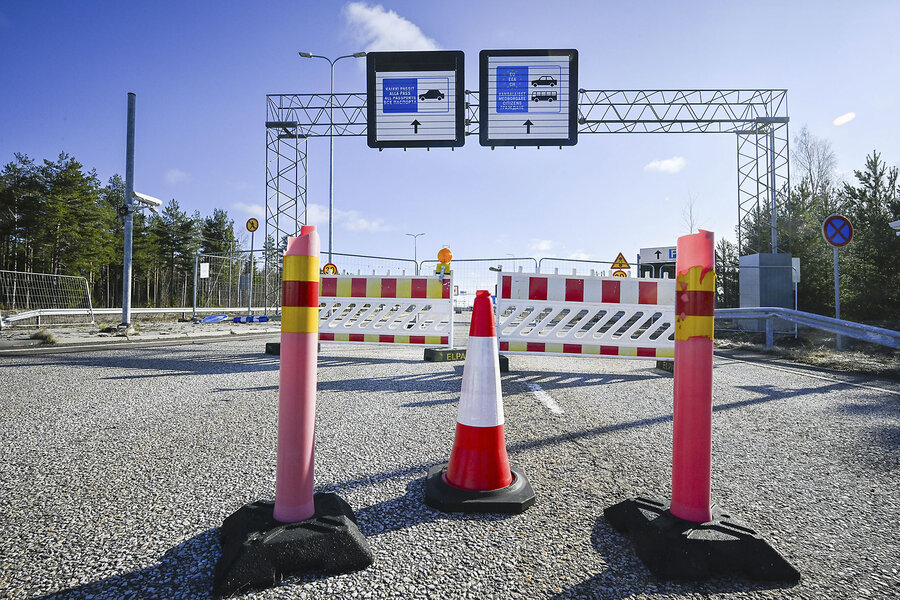
The old Iron Curtain hasn’t slammed down across Russia’s border yet. But Western Europe, until recently easily accessible from Moscow, has become extremely hard to reach for most Russians since the war in Ukraine began almost four years ago. Air and rail links with all European Union countries were quickly severed when the conflict began. Finland completely closed its border with Russia in late 2023, and the once-lively cross-border traffic halted.
Why We Wrote This
Getting from Russia to the rest of Europe should just be as easy as stepping across a border. But since the start of the war in Ukraine and Western sanctions, it’s become a frustration – as the Monitor’s Moscow correspondent knows from experience.
So, when my wife and I decided to make a three-day visit to Helsinki in late December, the itinerary for the round trip envisaged nearly four days on the road, involving planes, trains, boats, and cars. And, to be clear, it probably wouldn’t have been possible at all if either of us were traveling on a Russian passport. Last November, the European Union stopped issuing multiple-entry Schengen visas to Russians, and clamped down hard on single-entry ones.
The most common portal for Russians traveling to the West these days is Istanbul. Baku, Azerbaijan; Yerevan, Armenia; and Belgrade, Serbia also provide tenuous air bridges between Moscow and the outside world. For Russians heading to North America, Casablanca in Morocco is a popular gateway.

But even getting to Istanbul is a much longer flight than it used to be, because the plane has to detour around the Ukrainian war zone, adding at least an hour to the now almost-five-hour trip.
“The flow of Russian tourists to Europe has reduced considerably. There are no organized tours at all anymore,” says Mikhail Maltsev, chair of the Urals region association of tour operators. “It’s expensive, it’s complicated, it’s exhausting. Some people still go to Hungary, where the public attitude toward Russians is welcoming,” and visas are more readily obtainable.
But Istanbul is a nice place to overnight, with mild weather and good food, before another five-hour flight across the continent to reach Helsinki the next day. The Finnish passport control officer took a long and deep interest in my Canadian passport – with all the Russian stamps in it – and gave me a very quizzical look, but didn’t ask for an explanation.
As a frequent visitor to Finland over the past four decades, I find the change in attitude toward Russians since the Nordic country joined NATO in 2023 is palpable. Finland was once one of the most Russian-friendly countries in Europe and proud of its neutrality. But polls now show that three-quarters of Finns support NATO membership and, outside of a few border areas that have suffered from the cutoff of trade and tourism, they appear to have largely turned their backs on their huge Slavic neighbor.
“Our relations with Russia have changed permanently,” Finnish President Alexander Stubb noted in his New Year’s address, adding that future relations will “depend on Russia’s actions.”
One thing I learned on this trip is that, unlike Cold War days, there are a lot of Russians in Europe. After decades of relatively free movement, statistics suggest that more than 1 million Russian-born people reside within the EU, including more than 300,000 passport holders. Finland alone has a Russian minority of more than 100,000 and, ahead of the then-approaching New Year holiday, quite a few of them were planning to visit friends and family back in Russia.

There is an alternative to returning to Moscow by air via Istanbul. It’s much closer to Helsinki and a lot cheaper but is just as time-consuming and massively inconvenient. It involves getting to one of the handful of crossings that are still open on the tense border between Russia and NATO, located in the Baltic states of Estonia, Latvia, and Lithuania.
Those can be difficult to reach, and involve crushing lineups and strict checks on both sides. There do not appear to be any that are currently open to road traffic, so you must walk across, lugging your baggage, often in foul weather. The Russian daily Izvestia recently ran an article about conditions at the Estonian crossing point at Narva, describing it as an “obstacle course” – with wait times of up to 20 hours – that is not for the faint of heart.
Friends advised us that conditions at the Estonian border crossing of Koidula, near Tartu, were more bearable. The first step to getting there was to board the Megastar, a giant car and passenger ferry that was something like a floating shopping mall, for a two-hour passage across the Gulf of Finland from Helsinki to Tallinn, the Estonian capital. We spent the night, enjoying a very pleasant evening in Tallinn’s medieval walled city, which featured a lively Christmas festival in the old town square.
We left early the next morning in a hired car for the four-hour drive to Koidula, hoping to make it before the regular daily train from Tallinn disgorged hundreds of people seeking to cross the border. Only a few dozen souls, all speaking Russian, were already there and, at least for us, the Estonian checks were polite and relatively quick. Then, it was a walk of about 500 yards across what can only be described as no-man’s-land to the Russian side, where the first point filtered people according to whether they had a Russian passport or not. My wife has one; I do not.
After some discussion, I was allowed through on the strength of my permanent Russian residency papers and official foreign journalist accreditation which, despite recent unpleasantness, is still a fairly strong document in Russia. At the next, much more stringent checkpoint, I managed to avoid being directed to the long line of rather forlorn-looking people waiting to have a “conversation” with security officers about their reasons for wanting to visit Russia.

A long and thorough customs inspection followed – no “nothing to declare” option here – and then it was out to a waiting car to take us to the nearby Russian city of Pskov. The border crossing took us about three hours altogether, which others who’ve been through it say was amazingly fast.
In Pskov, we boarded the overnight train to Moscow. We had splurged for one of the new deluxe compartments, which feature double bunk beds, dinner, and breakfast, and an en suite bathroom with shower, for the roughly 500-mile trip. When we rolled into Moscow’s Leningrad Station the next morning, it was almost exactly a week since we had set out to spend three days in Helsinki.
Some Russian travel experts say the rift with Europe is probably permanent, and that travel-loving Russians are compensating by discovering their own vast and varied country and also by turning to parts of the world where Russians are still welcome.
Anton Krotov, a prolific travel blogger, says that air travel to the East has become much easier, China has dropped visa requirements for Russians, and Beijing is now the main hub for Russians traveling to Asia and beyond. “I myself recently visited New Zealand, via China,” and encountered none of the problems that beset travel to Europe, he says.
But Mr. Maltsev says nothing will replace Europe as a coveted destination for Russians.
“We feel that the interest has been postponed until better times,” he says. ”But once all these restrictions are eased, there will be a lot of pent-up demand to return to popular European places.”