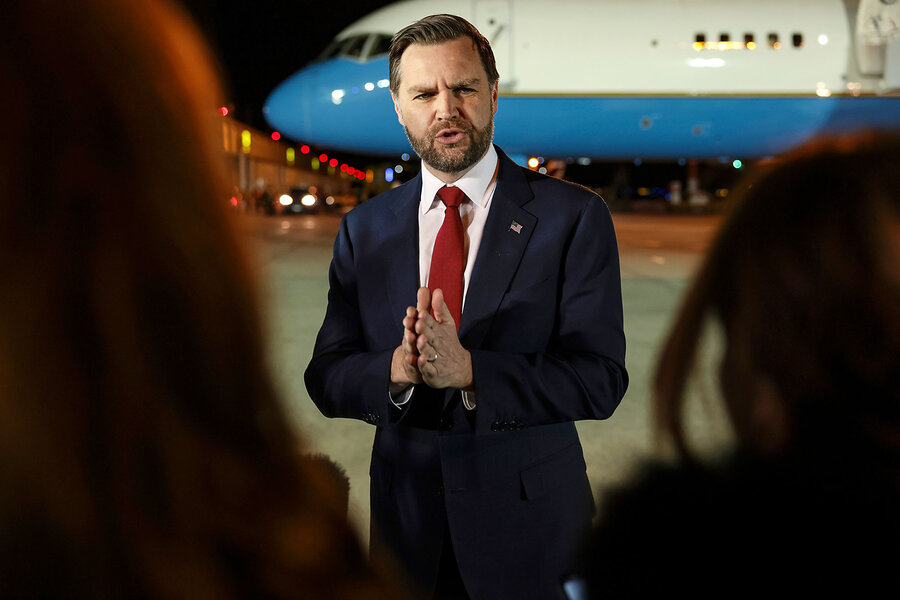
By sending Vice President JD Vance to spearhead U.S. peace talks with Iran, President Donald Trump has handed his vice president a high-stakes role with far-reaching global consequences. It’s also a role that carries high political stakes for Mr. Vance, an avowed skeptic of foreign military interventions who serves a president who has embraced brinkmanship in wartime as few U.S. leaders have done before.
Mr. Vance is due to begin talks with Iranian officials in Islamabad, Pakistan on Saturday along with Mr. Trump’s Middle East envoy Steve Witkoff and Jared Kushner, the president’s son-in-law. The talks come after a two-week ceasefire was agreed to Tuesday in a war launched six weeks ago by Mr. Trump in concert with Israel. The U.S. and Israel have pummeled Iran in a spiraling conflict that has severely disrupted trade in the Persian Gulf and spread to other countries in the region, including Lebanon, which Israel has partially occupied.
The ceasefire is designed to allow the U.S. and Iran to try to come to terms that satisfy U.S. goals of curbing Iran’s nuclear ambitions and offensive missile capabilities while also providing Iran with economic sanctions relief and security guarantees. Also key is the reopening of the Strait of Hormuz, which Iran has throttled since the war started, and where it is now seeking to levy tolls on transiting ships, including oil tankers critical to supplying global markets.
Why We Wrote This
As he prepares to lead the U.S. delegation in Pakistan to try to reach a peace agreement with Iran, Vice President JD Vance’s longtime anti-interventionist stance could help build trust with the Iranians. But Mr. Vance also could end up taking the blame if talks fall apart.
It’s unclear whether the two sides will talk directly or indirectly through mediators. Were Mr. Vance to meet directly with Iranian officials, he would become the highest-ranking U.S. official to do so since the 1979 Islamic Revolution that ended decades of U.S. involvement in Iran under royal dictatorship.
Mr. Vance’s longstanding opposition to “forever wars” in the Middle East has raised questions about his support for the war against Iran. The New York Times has reported in detail on the doubts he raised in prewar administration meetings, including about likely negative reactions from Mr. Trump’s “America-First” supporters who had welcomed his pledge to end costly wars and focus on domestic programs. The vice president’s reputation as an anti-interventionist reportedly led Iranian officials to specifically request that he play a role in peace talks (Mr. Vance said on Wednesday that he wasn’t aware of any requests.)
Mr. Vance has made no public criticism of Mr. Trump’s decision to go to war. But his private skepticism has been telegraphed and now he’s entering a “political minefield” as the point man for U.S.-Iran talks – possibly a loyalty test set by Mr. Trump, says Matt Wylie, a Republican strategist. “He’s tried to make it known he wasn’t for this, which is why he gets to be the face of doing it.”
Mr. Wylie adds, “I think he is going to run into a problem where his loyalty to Trump will sort of destroy a lot of his political base.”
MAGA divisions over Iran
That base is divided over Iran policy, questioning Israel’s role in initiating the conflict, and unhappy about rising gas prices at home. While it’s too early to know what issues will matter in the 2028 election in which Mr. Vance is expected to seek the Republican nomination, “it’s very hard for vice presidents to extricate themselves from the policies of their president,” says Matthew Dallek, a political historian at George Washington University.
For now, “he’s got to be the chief defender of the war in Iran. He’s got no choice,” Professor Dallek says. That puts Mr. Vance “in a particularly tough political spot.”
Vice presidents are often tasked to lead efforts that don’t yield easy solutions, but rarely as the principal in peace talks to end a war, says Joel Goldstein, professor emeritus at St. Louis University School of Law and an expert on the vice presidency. Traditionally, presidents have tapped senior diplomats and special envoys for such roles.
While the vice presidency can be a springboard to the presidency, Mr. Vance will be in the unusual position in 2028 of only having served a single term, given Mr. Trump’s term limit. Past vice presidents who served two terms in that role could use the first term to establish themselves and then start preparing to run for the top job, says Professor Goldstein. “In Vance’s case it’s all compressed into one.”
During his successful run for the U.S. Senate from Ohio in 2022, Mr. Vance, a first-time political candidate, leaned into his hardscrabble working-class background and military service to burnish his America First credentials with Trump voters. He had served in Iraq as a public affairs officer in the Marine Corps, an experience that he said shaped his political views.
In 2024, he said on the Senate floor, “I saw when I went to Iraq that I had been lied to. That the promises of the foreign policy establishment of this country were a complete joke.” Later that year, Mr. Trump picked Mr. Vance as his running mate, elevating a politician nearly half his age to a position that would make him a future standard-bearer for a post-Trump Republican Party.
A loyal No. 2
Last June, Mr. Vance defended Mr. Trump against criticism in the run-up to U.S. airstrikes on Iran’s nuclear sites. The airstrikes, which Mr. Trump claimed at the time had “obliterated” Iran’s nuclear program, were opposed by some high-profile MAGA media figures like Tucker Carlson. Mr. Vance wrote on X that voters “are right to be worried about foreign entanglement after the last 25 years of idiotic foreign policy. But I believe that the president has earned some trust on this issue.”

Before the latest strikes against Iran, Mr. Trump had raised the possibility of sending Mr. Vance and Mr. Witkoff to talk with Iranian officials. Instead, he used Mr. Witkoff and Mr. Kushner as his envoys, before U.S. and Israeli airstrikes began with the assassination of Iran’s supreme leader, Ali Khamanei, whose son has since replaced him.
When Mr. Trump ratcheted up his rhetoric against Iran, threatening on Tuesday to destroy its “civilization” if it didn’t reopen the Strait of Hormuz, Mr. Vance, on a visit to Hungary, was far less bellicose. He said the U.S. had “largely accomplished its military objectives” and that the war would shortly conclude. He also spoke in measured terms after the announced ceasefire about the negotiating stances of both sides.
But the idea that Mr. Vance’s past skepticism towards war with Iran will smooth his path to a deal in Islamabad may be wishful thinking, says Mitchell Reiss, a former U.S. special envoy for the Northern Ireland peace process under President George W. Bush. One reason: Mr. Vance’s boss, Mr. Trump, tore up in 2018 the detailed nuclear non-proliferation deal with Iran signed under President Barack Obama. Iranians also may suspect the last U.S. negotiations, with Mr. Witkoff and Mr. Kushner, were simply a ruse to buy time before preplanned military actions.
“The Iranians are going to be extremely skeptical of whoever the American interlocutor is,” Ambassador Reiss says. “You could be Mahatma Gandhi and show up on behalf of the United States, and I don’t think it’s going to impress the Iranians at this point.”
Barbara Slavin, an Iran specialist and distinguished fellow at the Stimson Center, a Washington think tank, says the chances of a breakthrough seem slim because the two sides’ demands are so far apart. That could put Mr. Vance in a near-impossible situation as Mr. Trump seeks an exit strategy from the war.
“Nobody knows that this [ceasefire] is going to even last two days, let alone two weeks,” she says.
Staff writer Victoria Hoffmann contributed to this report.