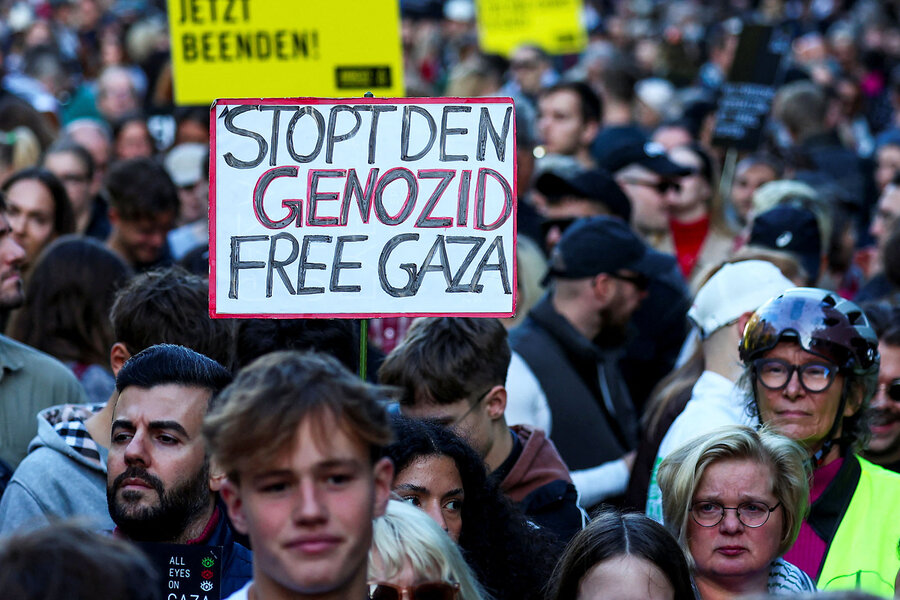
Israeli soccer fans banned from attending a match in England; “free Gaza” graffiti across Berlin; calls to exclude Israel from the Eurovision Song Contest; a pledge by thousands of Hollywood figures to boycott Israeli film institutions.
These are just a few recent examples contributing to Israelis’ growing feelings of international isolation as a result of the war in Gaza – even after Israel and Hamas agreed to a ceasefire and to stop the war.
The first stage of the ceasefire was implemented last week in the form of an emotional exchange of Israeli hostages for Palestinian prisoners and detainees.
Why We Wrote This
Individual Israelis and professional organizations are feeling increasingly isolated internationally as the world focuses on severe Palestinian suffering in Gaza. But do boycotts of academic and artistic institutions further the cause of peace?
Still, individual Israelis are feeling the ripples of isolation across academia, the arts, and sports.
“After Oct. 7, Israel received lots of sympathy and understanding for our situation, and we were grateful for it,” says Shlomi Barzel, spokesperson for the Israel Football Association, referring to the Hamas attack that killed 1,200 people and took 251 others hostage.
“But as time passed and the situation in Gaza got more and more complicated, we found out the world did not care so much about what Israel was going through, including rocket fire from Hezbollah and Houthis,” he says. “For them, Israel had simply gone mad.”
The language of many of those protesting against Israel and calling for boycotts, including new decisions announced by the University of Amsterdam after the ceasefire, and by the faculty of McGill University in Montreal just before it, rests on allegations that Israel’s war against Hamas had morphed into an outright genocide.
The United Nations Human Rights Council issued a report in June categorizing Israel’s actions as a genocide, a charge Israel rejected as “distorted and false.”

But the perception that Israel overreached in its campaign against Hamas – more than 67,000 people have been killed in Gaza, among them militants but including more than 18,000 children, according to Gaza health records – has rendered Israel increasingly toxic.
A Pew Research Center survey issued in June found views of Israel in 20 out of 24 countries it polled to be overwhelmingly negative. In countries including Australia, Greece, and Spain, for example, three-quarters or more of respondents expressed unfavorable views of Israel. The survey also found that 58% of Israelis think their country is not respected internationally.
Gabriella Shalev, a former Israeli ambassador to the U.N., says it is too soon to say whether the ceasefire alone can reverse Israel’s plummeting international standing.
“Much of the damage has already [been] done and stems from deeper political and humanitarian concerns. Lasting improvement will depend on credible and sustained commitments to diplomacy, accountability, and addressing civilian suffering,” she says.
“Rebuilding trust will require transparency, restraint, and genuine engagement to show that Israel genuinely seeks stability and a path for peace. I do not believe that can be achieved with the current far-right and radical government.”
Surge in academic boycotts
“I think the reputations of Israeli universities have been damaged in ways that will be difficult to repair,” says Milette Shamir, vice president of Tel Aviv University, in charge of international academic collaboration.
Even before the war, academics in Israel were the first to bear the brunt of being shunned by colleagues, institutions, and associations abroad.
“I think a lot of our colleagues [overseas] are under the mistaken assumption that boycotts will put pressure on the Israeli government to change policies. They don’t see what we see, which is that the government is not impacted by academic boycotts at all,” says Dr. Shamir.
Although boycotts of Israeli academia existed previously, she traces the surge in such sanctions to the encampment movement on U.S. university campuses in the spring of 2024. That was followed by another burst of activity this past March when Israeli policies – following the collapse of a second ceasefire deal – exacerbated the hunger crisis in Gaza.
“At first most of the incidents [of exclusion and boycott] came from the United States, but now the arena we are most worried about is Europe,” she says.
About a third of Israel’s research funding comes from the European Union, she notes, and that is now at risk.
In addition to explicit boycotts, there are also covert ones, Dr. Shamir says, which include “ghosting, cutting of ties suddenly, journal editors rejecting the submissions of academic articles even before they are reviewed.”
“This is all speculative, because no one says, ‘I stopped emailing you because you are Israeli,’” she adds.
This sense of isolation is especially alarming for Israeli academics who – particularly but not only in the sciences – rely on international networks to collaborate on research. It’s also how Ph.D. dissertations get reviewed and how young scholars are accepted for postdoctoral work, critical moments in their professional development that can forecast the trajectory of their contributions.

Raquel G. Frohlich/Sipa USA/AP
The arts
In September, Hollywood actors and other industry professionals, including stars like Emma Stone and Mark Ruffalo, signed a pledge not to work with Israeli film institutions they claimed were “implicated in genocide and apartheid against the Palestinian people.”
In response, Israel’s screenwriters guild condemned it as counterproductive to forging peace. Guild chairman Nadav Ben Simon noted that for decades, Israel’s creative class had been working hard to give “voice to Palestinian narratives, criticism of government policies, and the diverse perspectives that shape our society.” This has included working with Palestinian colleagues on films and television shows.
“Such measures risk silencing the very voices striving tirelessly for reconciliation and understanding,” he said.
Avigail Sperber, a Tel Aviv-based documentary filmmaker, took a contrary position. As painful and jarring as the boycott is, she posted on Facebook, it should be used by the film community and other Israeli artists to realize they need outside help to oppose the war and government policies in Gaza and the West Bank.
Like many of her Israeli counterparts, Ms. Sperber relies on international coproductions for funding and has felt the pinch of that kind of work drying up. For her, it’s a price worth paying if it will have contributed to the international pressure that stopped the war in Gaza.
It’s also common experience by now that film festivals abroad are hesitant to accept Israeli films.
“Even though it might not stem from antisemitism or anti-Israeli sentiments, there’s an understanding that screening such films could be complicated as they may have to deal with protests,” says Ms. Sperber.
Mr. Barzel, of the Israel Football Association, directs his concerns to the impact of boycotts on the general public, saying he fears what could happen if international sporting bodies officially boycott Israeli sports.
“When a country’s sports are boycotted, it is one of the worst things that can happen to a civilized country,” he says. “It has the power of turning your nation into a leper, a pariah.”