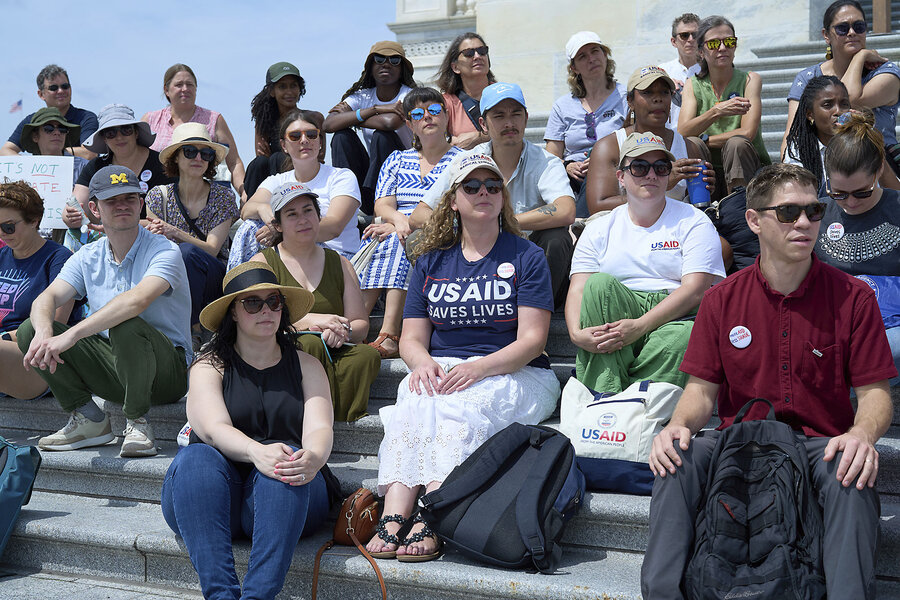
For beleaguered federal workers, this week’s government shutdown was just one more blow in what many describe as the hardest year they’ve ever had on the job.
Since President Donald Trump established the Department of Government Efficiency by executive order on Inauguration Day, the federal workforce has gone through mass layoffs and resignations, funding cuts, and the shuttering of entire agencies. There have been lawsuits and rehirings, as depleted agencies scramble to complete essential work. And now, after congressional Democrats and Republicans couldn’t agree to a temporary budget to keep the government open, comes a shutdown that has resulted in more than 1 million federal workers either furloughed (prohibited from working and unpaid) or required to work with no pay.
“I’ve worked under a few administrations, and this is the absolute worst that I have ever felt,” says a Department of Housing and Urban Development employee of almost 15 years who has been furloughed. In her job, she helps issue grants intended to make cities safer and more accessible, through things such as ramps for people with disabilities and street resurfacing, and to provide housing to some of America’s most vulnerable populations. But now, she’s wondering how she will pay her own mortgage if the shutdown drags on – and brainstorming how to make the food in her pantry last a little longer.
Why We Wrote This
Federal workers who have experienced previous government shutdowns say the uncertainty is always stressful. But this one already feels worse, multiple federal employees tell the Monitor, coming after months of interagency upheaval and layoffs from the Trump administration. Many feel uneasy about not only the immediate standoff – but what will happen when it ends.
Federal workers who have experienced previous shutdowns say the uncertainty is always stressful, whether it goes on for two days or 35, like the last one in 2018-19, which was the longest in U.S. history. But this shutdown already feels worse, multiple federal employees tell the Monitor, coming after months of interagency upheaval and contempt from the president and his administration. Many feel uneasy about not only the immediate standoff, but what will happen when it ends.
“Even if the shutdown is lifted today, we still have the same concerns tomorrow because it’s going to be the same rhetoric and emails,” says a Veterans Affairs employee who is still working with pay and who, like all the workers interviewed for this story, was granted anonymity to speak freely. “For the last nine months, it’s been like psychological warfare.”
The furloughed workers, and those working without a paycheck, are supposed to be paid “as soon as possible” after the shutdown ends, according to a 2019 law. But some say they’re not counting on receiving back pay, given the ways in which the Trump administration has already thwarted much of Congress’ constitutional authority. And they’re wondering whether they’ll even have jobs to come back to.

Threat of “consequential” layoffs
Russell Vought, the director of the Office of Management and Budget, who has spent years working toward a goal of dramatically shrinking the federal bureaucracy and was one of the key architects of the Heritage Foundation’s Project 2025, has promised “consequential” layoffs during the shutdown. So far, the only announced cuts have been to transportation and energy projects in states and cities that didn’t vote for President Trump: Mr. Vought said that roughly $18 billion in New York City infrastructure funding had been paused, along with $2.1 billion in Chicago infrastructure funding, and that nearly $8 billion in “Green New Scam” funding was canceled within the Department of Energy.
But White House Press Secretary Karoline Leavitt said that coming firings could be “in the thousands.” President Trump posted on social media that he was meeting with Mr. Vought on Thursday “to determine which of the many Democrat Agencies, most of which are a political SCAM, he recommends to be cut” during the shutdown. He added: “I can’t believe the Radical Left Democrats gave me this unprecedented opportunity.”
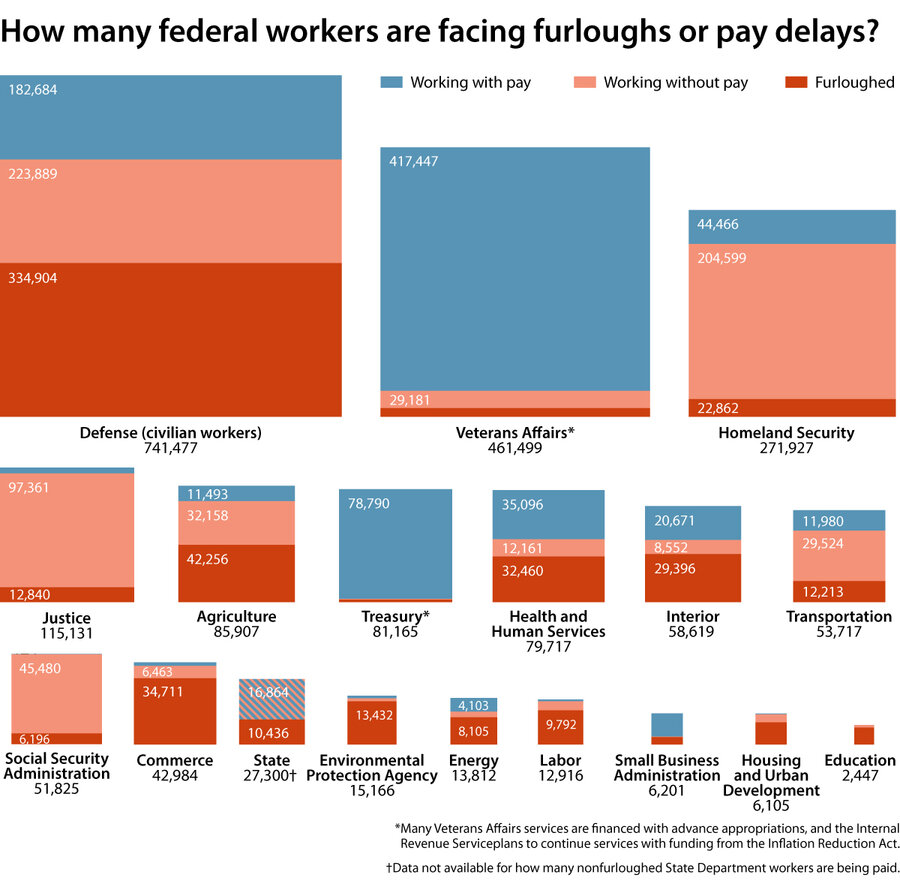
U.S. Department of Defense, U.S. Department of Veterans Affairs, U.S. Department of Homeland Security, U.S. Department of Justice, U.S. Department of Agriculture, U.S. Department of the Treasury, U.S. Department of Health & Human Services, U.S. Department of the Interior, U.S. Department of Transportation, U.S. Social Security Administration, U.S. Department of Commerce, U.S. Department of State, U.S. Environmental Protection Agency, U.S. Department of Energy, U.S. Department of Labor, U.S. Small Business Administration, U.S. Department of Housing and Urban Development, U.S. Department of Education
|
Jacob Turcotte/Staff
Some federal workers also see this moment as an opportunity – a rare chance to push back against the administration. While not exactly embracing the shutdown and its impact on them and their co-workers, after the year they have had, some support the politics of it.
“This battle is important enough that if they can’t reach an agreement that will work for the American people, then this is where we need to be at until [Republicans] will come to the table,” says the Veterans Affairs employee.
Others, however, feel as though they are being used in a political game that’s likely to end badly. Some even feel betrayed by congressional Democrats, who they thought were fighting for them.
“The Democrats seemed to me to be the people who were supportive of federal employees, but that’s something they seem to be casting aside,” says a furloughed civilian employee of the Department of Defense. Democrats are using federal workers as leverage for their own political purposes, this employee says. “It frustrates me.”
Federal workers, who account for less than 2% of the U.S. civilian workforce, are often stereotyped as bureaucrats making six-figure salaries in the Washington area. In reality, federal employees live and work in states across the country; fewer than 20% of workers in the U.S. Office of Personnel Management database live in the District of Columbia, Virginia, or Maryland. And more than one-third make between $50,000 and $89,000 a year – comparable to the median U.S. salary. Some say they will have to draw down their savings until the government reopens.
As is typical, congressional Republicans and Democrats are blaming each other for the shutdown. The short-term spending bill passed by House Republicans, known as a continuing resolution, would simply extend current spending levels for seven weeks, keeping the government open while the two sides continue to negotiate over the budget. But the bill needs bipartisan support to pass in the Senate, and Democrats there have refused to support it unless Republicans agree to undo Medicaid cuts in the One Big Beautiful Bill and extend expiring subsidies to the Affordable Care Act.

Agency websites and emails blame Democrats
What’s not typical, however, is how agencies seem to be getting involved in the politics.
A U.S. Patent and Trademark Office employee says the email that arrived in his inbox Tuesday afternoon in preparation for the shutdown was “more political” than similar emails he has received regarding previous shutdowns during his almost two decades with the agency. “President Trump opposes a government shutdown,” began the missive to Commerce Department employees, according to a copy shared with the Monitor. “Unfortunately, Democrats are blocking this Continuing Resolution in the U.S. Senate due to unrelated policy demands.”
Similar jabs have popped up across agency websites this week. “The Radical Left in Congress shut down the government,” reads a banner on the Department of Housing and Urban Development’s website. “Democrats have shut down the government,” echoes another on the Department of Justice’s website. Several Education Department employees told NBC News that their out-of-office email replies were changed without their permission to explicitly partisan messages. Democrats say it’s all in clear violation of the Hatch Act, which prohibits federal employees from engaging in outwardly political activity.
“Why do I have to be a pawn in this whole budget thing?” asks the patent office employee. “It’s just one drama after another. It’s exhausting.”
The Office of Personnel Management projects that the federal government will have shed 300,000 employees by the end of the year, including the 150,000 who took the voluntary buyout option offered in the “Fork in the Road” email and whose last day was Sept. 30. If these figures turn out to be correct, it would mean the Trump administration will have pushed out 12.5% of the federal civilian workforce. But exact numbers have been difficult to pin down, because some laid-off employees were later rehired because of need or lawsuits. The administration has said its goal is greater efficiency, but federal workers say the turmoil of the past few months has hardly been efficient. The 150,000 federal employees who took the buyout offer were paid for months to not work, and hundreds of thousands who have been idled until the government reopens will get back pay for the time spent not working. Rather than eliminating waste and fraud, some federal employees tell the Monitor the indiscriminate layoffs caused a “brain drain” of some of the government’s best employees.
“Morale isn’t good,” says the Department of Defense employee, who has started to look for jobs outside of government because of the “latent threat” of reduction-in-force notices. “People are resigned to the fact that this is the new normal.”
For some, like the patent office employee, the shutdown was the final straw in this new normal. He had already been thinking about leaving the government; by Thursday, he accepted a new job in the private sector.
Staff writers Simon Montlake and Linda Feldmann contributed to this report.