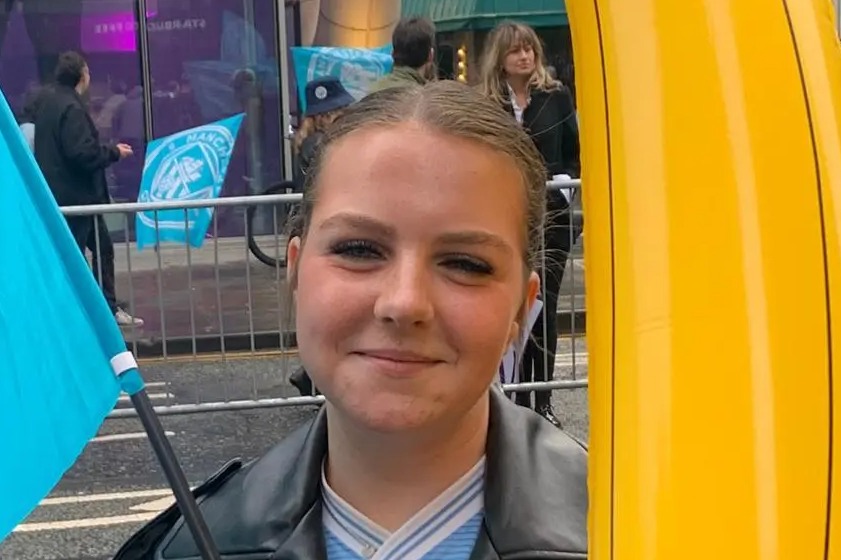
AN URGENT warning has been issued after a “fit and healthy” teenager tragically died weeks after complaining about stomach pain.
Maisie Almond, 14, from Manchester, was rushed to hospital after her eyes suddenly turned yellow in September 2024 – indicating jaundice.
The youngster had complained of a tummy ache just weeks before but her family presumed this was just down to a “run-of-the-mill” stomach bug.
But Maisie’s stomach pain didn’t go away and after her eyes turned yellow, her parents, Kathryn and Stuart, took her to the emergency department at Tameside Hospital for tests.
Maisie’s mum and dad previously said: “We thought it was just a tummy bug that goes round school and that, after a day off school, she’d be fine,” mum Kathryn told the Manchester Evening News (MEN).
“We thought it was probably a run-of-the-mill tummy bug, especially with going back after the holidays.”


Even after she was admitted to hospital, the teen’s jaundice worsened and several tests, including for hepatitis, came back negative.
Doctors soon realised that Maisie was suffering from acute liver failure and needed a transplant in order to survive.
The teen, who had dreams of travelling the world, was quickly pushed to the top of the donor list after being admitted to the Children’s Intensive Care ward at Leeds General Infirmary.
A matched donor was found on October 1 and she was taken into theatre at around 11pm.
However, Maisie’s deterioration continued and she would have been “too weak” to undergo the gruelling 12-hour procedure, which would have also required large amounts of donated blood, her family previously said.
She tragically died in the early hours of October 2.
Senior consultants told Maisie’s parents that she needed a donor liver urgently and that receiving it just a day earlier might have changed the outcome.
“We are utterly devastated by the sudden loss of our beautiful girl Maisie”, mum Kathryn said at the time.
Now, following an inquest into the tragedy, a coroner has issued a prevention of future deaths report.
The report is addressed to the Secretary of State for Health and Social Care and the Director of Organ and Tissue Transplantation at the NHS Blood and Transplant Service.
Adrian Farrow, assistant coroner for the area of Greater Manchester South, found that “no underlying cause could be found” for Maisie’s liver failure.
The report concludes that Maisie “died from the effects of a rare form of acute liver failure before a suitable donor liver could be found for priority transplantation.”
According to the coroner, by the time a suitable donor liver was found, Maisie had “sustained cerebral oedema and other organ damage.”
Farrow’s report continues: “This made the prospects of her survival so low that the transplant did not take place.”
The prevention of future deaths report reads: “In my opinion there is a risk that future deaths could occur unless action is taken.”
During the inquest the court heard from a medical expert who explained there was a national shortage of donor livers generally, particularly “for children in the ‘super urgent’ category.”
Evidence given to the inquest detailed a drop of donor livers by roughly a third.
Historically, the coroner’s report said, a donor liver could be expected to be made available within 48 hours; however, now the wait has been extended.
This means patients, even those in the “super urgent” category, could now expect to wait up to a week for a suitable donor liver to be found.
The coroner’s report concludes: “That delay gives rise to a clear risk that lives will be lost due to the unavailability of suitable donor organs.”
Everything to know about giving blood and donating organs
DONATING blood and organs can be an amazing gift to people who desperately need it for ongoing medical treatment or in an emergency.
But who exactly is eligible to provide a donation? Here is all you need to know…
How to donate my organs
An opt-out system is in place in England, Scotland and Wales. This means everyone is in to consent to organ donation unless they have opted out.
However, it still remains essential to communicate your wishes to your family, as they will still be consulted about your decision at the time of donation.
Who can give blood?
Most people are eligible to give blood.
You can donate if you are:
- Fit and healthy
- Weigh more than 7st 12lbs or 50kg
- Are aged between 17 and 66 (or 70 if you have given blood before)
- Are over 70 and have given blood in the last two years
Men can donate more often than women can.
How often can I give blood?
Men can give blood every 12 weeks, while women can donate every 16 weeks.
This is because it takes several weeks for all the red blood cells to be replaced in the body.
Over 6,000 people are needed to donate each day to meet the needs of hospitals, and there is a drive for black donors to donate to help black patients with sickle cell disease.
To make an appointment to donate your blood at the nearest centre, click here.
What happens when you give blood?
Appointments to give blood typically last no longer than an hour.
1. Welcome and preparation
You will be given a leaflet to read and 500ml of fluid to drink just before you give blood. You’ll be asked to drink it over a five-minute period to help ensure you don’t feel faint or nauseous after donating.
2. Health screening
NHS staff will make sure it is safe for you to donate, and that your blood is safe for a patient to receive.
3. Giving blood
Once you are comfortable in a chair, staff examine your arm to find a suitable vein and clean it with antiseptic.
A needle will then be inserted into your arm, which will be used to collect your blood into a blood bag with your unique donor number.
You shouldn’t feel any discomfort or pain.
If you do, tell a member of staff.
A scale is then used to weigh the blood you have donated, and stops when you’ve given 470ml.
This usually takes between five and ten minutes.
The needle is then removed and a dressing is put on your arm