The belief that the pyramids were not built by human hands has fascinated conspiracy theorists for decades.
No one promoted that idea more persistently than Swiss author Erich von Däniken, often described as the father of ancient alien archaeology.
Von Däniken, who died this month aged 90, argued that extraterrestrial visitors played a direct role in helping ancient Egyptians construct monuments that would otherwise have been impossible.
In his 1968 bestseller ‘Chariots of the Gods,’ he claimed alien ‘astronauts’ visited early civilizations, including the ancient Egyptians and Mayans, and shared advanced technology.
As evidence, von Däniken pointed to the pyramids’ precise engineering, unanswered questions about construction methods, striking mathematical and astronomical coincidences, and ancient carvings showing visiting beings.
He insisted the engineering precision of the Great Pyramid could not be explained by human skill alone, questioning how massive stone blocks were moved, how the structure was lit internally, and how builders appeared to possess advanced knowledge of mathematics, Earth, and space.
Taken together, he argued these mysteries proved the pyramids were not built solely by humans.
Despite his popularity, the claims have been repeatedly challenged by archaeologists and historians.
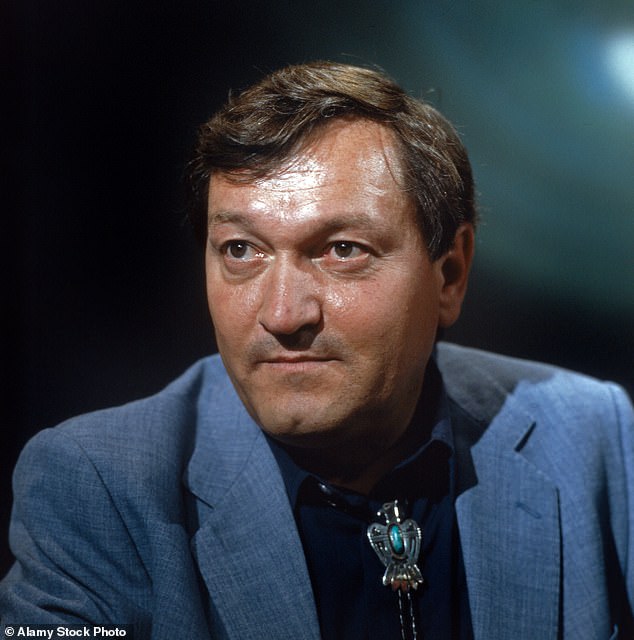
In von Daniken’s 1968 bestseller Chariots of the Gods, he wrote that ancient alien astronauts visited the Mayans and the ancient Egyptians
Research and archaeological evidence show large numbers of laborers were present in ancient Egypt, with records detailing how workers were fed and housed, along with cemeteries where they were buried.
Entire worker towns have also been discovered near pyramid sites, as well as quarries where stones were cut and transported.
Von Däniken is often described as the father of ancient alien archaeology because his bestselling books popularized and defined the idea that extraterrestrials influenced early human civilizations.
His works sold more than 60 million copies in 32 languages and helped push the theory that the pyramids were built with otherworldly assistance.
The Swiss author passed away on January 10, bringing his controversial ideas back into the spotlight.
The notion that aliens built the pyramids has appeared repeatedly in popular culture, from Futurama to Star Trek, and was recently endorsed by Elon Musk.
In July 2020, the billionaire posted on then-Twitter: ‘Aliens built the pyramids obv.’
Von Däniken’s work built on earlier theories suggesting non-human forces were responsible for the pyramids, including claims made by author Ignatius L. Donnelly, who proposed the structures were built by survivors of the lost civilization of Atlantis.
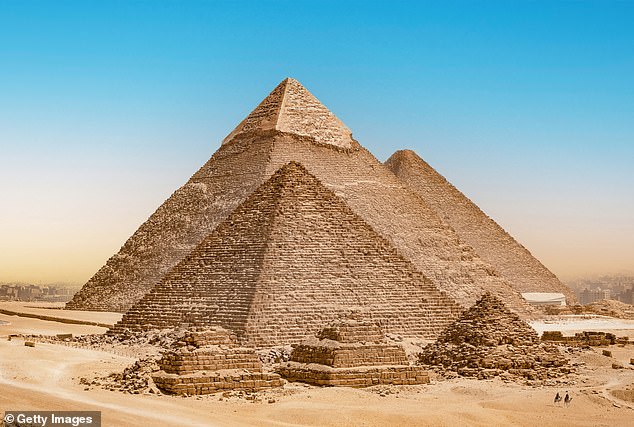
Von Daniken claims that the technology to build the pyramids was not available to ancient Egyptians
In ‘Chariots of the Gods,’ von Däniken argued that alien beings promised Egyptian pharaohs a ‘second life,’ which he said explained why rulers were mummified and buried with treasures intended for use after revival.
According to his theory, these god-like visitors would one day return from the stars to reawaken the preserved bodies of the dead.
Describing the Great Pyramid, von Däniken wrote: ‘An artificial mountain some 490 feet high and weighing 31,200,000 tons stands there as an incredible achievement, and this monument is supposed to be nothing more than the burial place of an extravagant king! Anyone who can believe that explanation is welcome to it…’
‘Drawings and sagas actually indicated that the ‘gods’ promised to return from the stars to awaken the well-preserved bodies to new life,’ he continued, also claiming Egyptian carvings showed beings ‘visiting’ ancient people.
Although lacking formal archaeological training, von Däniken traveled to Egypt and Latin America and used books, lectures, and videos to spread his theories worldwide.
He repeatedly argued the technology required to build the pyramids did not exist in ancient Egypt, writing: ‘There are many problems connected to the technology of the pyramid builders and few solutions.’
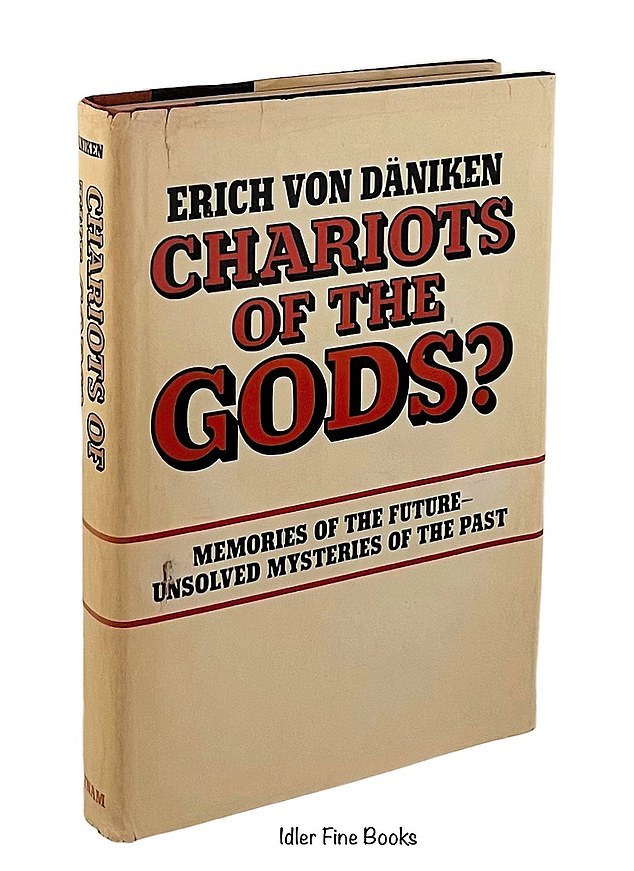
The book made von Daniken rich and famous around the world
Among the mysteries he highlighted was the transportation of massive stone blocks, arguing that moving them on rollers would have required more wood than was available at the time.
He also claimed there was no evidence of workers or torches inside the Great Pyramid, suggesting the structure reflected scientific knowledge ancient humans could not have possessed.
‘Is it really a coincidence that the height of the Pyramid of Cheops multiplied by 1,000 million corresponds approximately to the distance between the earth and sun?’ he asked, before questioning whether it was a coincidence that a meridian running through the pyramid divided continents and oceans into two equal halves, and whether the pyramid’s dimensions reflected the mathematical constant π.
‘Is it a coincidence that calculations of the weight of the earth were found and is it also a coincidence that the rocky ground on which the structure stands is carefully and accurately levelled?’ he further wrote.
Von Däniken went on to write 25 more books expanding on ancient alien theories, while television series such as Ancient Aliens introduced his ideas to a wider audience.
Nigel Watson, author of Portraits of Alien Encounters Revisited, said von Däniken’s success was rooted in belief rather than evidence.
‘At a time when there was the excitement surrounding the Apollo moon missions and the release of Stanley Kubrick’s 2001: A Space Odyssey, Daniken used a mixture of speculation to link virtually any ancient structure with alien visitations,’ Watson said.
‘Thumbing his nose at mainstream archaeology, he claimed aliens either directly built the pyramids or helped humans to build them,’ Watson added. ‘It did not matter what sceptics said, as this was all based on belief rather than facts.
‘He exploited these beliefs, and he did not care whether they were true or not; they made him rich and famous. Some will see him as a cynical conman, others as a fearless pioneer who fought mainstream science.’