A ban on “junk food” commercials is an ominous case of public health overreach

A new dawn has broken, has it not? Fat children will soon be a memory and our precious NHS will be saved. “Junk food” commercials will never again blight our television screens before 9pm and you will no longer see ice creams legally advertised on the internet.
When the advertising ban came into effect on Monday, “public health” campaigners allowed themselves the briefest moment of celebration before moaning about the “loophole” that allows food companies to advertise on billboards (as I predicted in 2024).
You probably didn’t notice the ban coming into effect. Terrestrial television is moribund, no one pays much attention to advertising and the craven food industry had already stopped advertising their “less healthy” products in October 2025 in a futile gesture of goodwill towards the state. The government put out a press release claiming that the ban will “reduce the number of children living with obesity by 20,000 and deliver around £2 billion in health benefits over time”. This is all based on a risible impact assessment and laughable junk science. Even if the ban somehow succeeded in reducing childhood obesity by 20,000, it would be impossible to prove because it is in the realm of rounding errors. There are nearly two million children “living with obesity” according to the official statistics and the £2 billion in putative savings is over a period of 25 years. We are, therefore, talking about a theoretical reduction in obesity prevalence of 1 per cent and a theoretical reduction in annual NHS spending of 0.04 per cent.
And while the press release insists that 22 per cent of five year olds are “living with overweight or obesity”, nobody who is familiar with how these statistics are produced — including, most recently, Full Fact — finds this remotely credible. Moreover, the £11 billion that the government claims obesity costs the NHS each year is based on a report which implicitly assumes that people who don’t die from an obesity-related condition won’t die from anything that will require healthcare.
Dishonesty is nothing new in the arena of the nanny state but it is hard to find anything truthful about what the government calls its “landmark junk food ad ban”. Take the name, for example. “Junk food” has no legal definition and is a pejorative term invented by campaigners. “Junk food” is in the eye of the beholder but no sane person associates it with muesli or porridge, even if served with sugar or syrup. And yet these are the kinds of foods covered by the ban. Throughout the long years of agitation for these regulations, neither the campaigners nor the media were candid with the public about how far-reaching they would be. The government had to create a whole new category of “less healthy” food to avoid including high-fat products like butter and olives, but listing each verboten food by name only served to show what an arbitrary and farcical endeavour it was. What a thrill it must have been for some bureaucrat to add crumpets and potato croquettes to the list! We may never know how close the civil service came to forgetting about “novelty potato shapes (such as smiley faces)” when it compiled The Advertising (Less Healthy Food Definitions and Exemptions) Regulations.
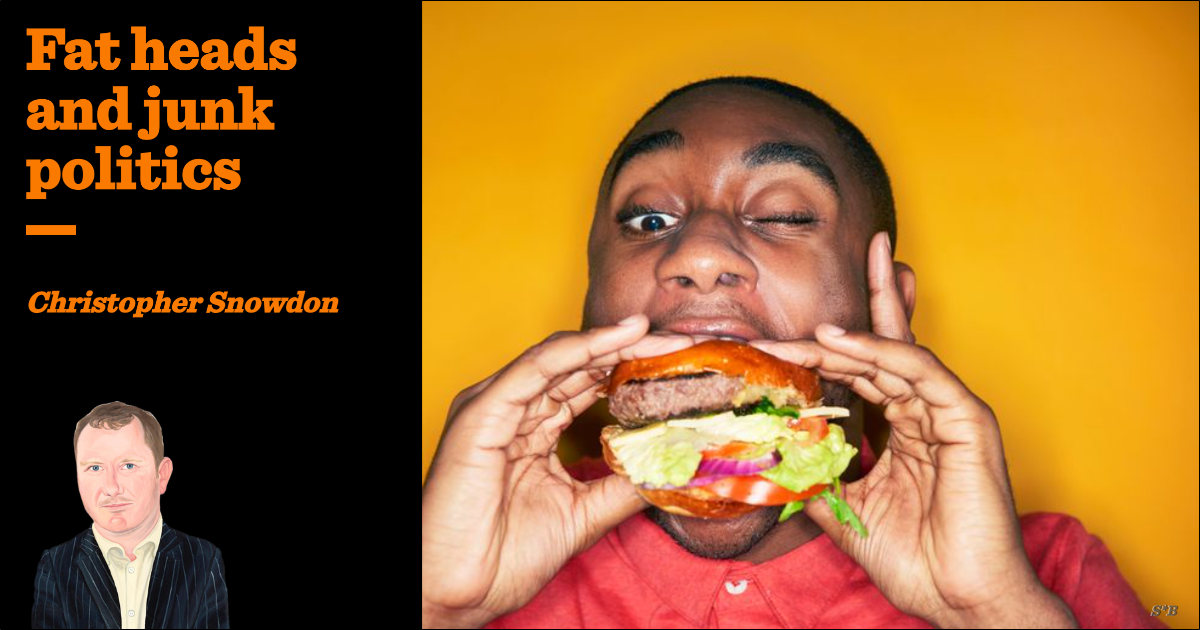
The “junk food” diversion continued to the bitter end. Reporting on the law coming into force this week, the BBC used the term “junk food” in the headline — as it always does — but sheepishly admitted that: “As well as more obviously unhealthy foods, the ban also covers some breakfast cereals and porridges, sweetened bread products, and main meals and sandwiches.” The story was nevertheless illustrated, as ever, with a photo of cheeseburgers.
It takes wilful blindness not to see that food is being dragged down the same slippery slope as tobacco
This is the last element of an anti-obesity strategy that can be traced back to the Cameron government to become law. We now have a sugar tax, mandatory calorie labelling, traffic light labelling, restrictions on where “less healthy” products can be displayed in supermarkets, a ban on volume price discounts such as buy-one-get-one-free, and now an advertising ban. No country in the world has done anything like this, but as far as the “public health” industry is concerned, we are only getting started. An “activist” at Jamie Oliver’s front group BiteBack 2030 said (in the government’s own press release) that it is a “first step”. The Royal College of Physicians said “this cannot be the end point”. The Health Foundation complained that “loopholes on sports sponsorship, outdoor and online advertising means that children will still be reached by other channels.” Most tellingly, Alice Wiseman, vice-president of the Association of Directors of Public Health, referred to “our experience of tackling tobacco harm” and called the advertising ban “a significant and welcome step forward in protecting people from industry influence”.
It takes wilful blindness not to see that food is being dragged down the same slippery slope as tobacco, with a full advertising ban being the next step. Where is the food industry in all this? Where are the advertising platforms and TV companies? The Food and Drink Federation hasn’t put out a press release since mid-December and hasn’t tweeted for over a month. In an unbelievably tepid quote given to the BBC, it said that it was “committed to working in partnership with the government and others to help people make healthier choices” and claimed that its members’ products “now have a third of the salt and sugar and a quarter of the calories than they did ten years ago”. Whoopee. Where has that got them? With the most hostile business environment in the developed world, that’s where. And there is undoubtedly more to come. I don’t expect a trade association to call for the head of Wes Streeting but it could at least say that it is disappointed with the government and call for a ceasefire. Instead they essentially boasted about shrinkflation.
As for the broadcasters, they have spent years whipping up hysteria about food and are now sowing what they reaped. The boss of Channel 4 has said that the ad ban could cost her company £50 million a year. She should have thought about that before she commissioned all those Jamie Oliver documentaries. ITV has been no better with its scaremongering about “ultra-processed food”. These companies were perfectly placed to put out an alternative viewpoint and had years to do so, but they never did, even though it would have been justified in the name of balance.
Let’s hope the billboard industry has a bit more backbone. It’s going to need it.