This is the first picture of a tragic teenager who died following a meningitis outbreak that has killed one other and put at least 11 more in hospital.
Juliette Kenny, 18, died on Saturday surrounded by her family after falling victim to the deadly bug which has swept through several towns in Kent.
The sixth form student lived in Whitstable with her father Michael, 46, mother Rebecca, 49, and older sister Florence, 20.
Her father said they had been left ‘beyond devastated and they have no words to express their loss’.
Juliette’s heartbroken grandmother Linda Kenny also told the Daily Mail: ‘I just can’t bring myself to say anything otherwise I will cry.
‘We are all on antibiotics because we were with Juliette in hospital when she passed away.’
On Monday the head teacher at the Queen Elizabeth’s Grammar School in Faversham Amelia McIlroy fought back tears as she paid tribute to Juliette.
She said: ‘We’ve got a lot of very upset children. It is with great sadness that we are confirming the loss of Juliette – a much loved and treasured member of our school community.
‘Juliette was a student at our school for seven years. She was incredibly kind, thoughtful and intelligent, and she loved our school. She was really very happy here.

Juliette Kenny, 17, died on Saturday surrounded by her family after falling victim to the deadly bug which has swept through several towns in Kent
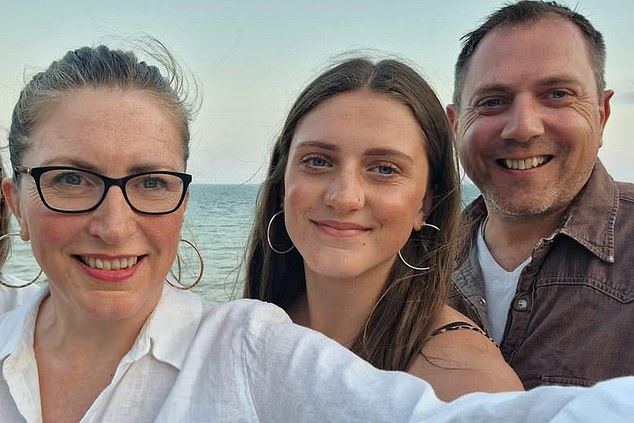
Juliette (centre) lived in nearby Whitstable with her father Michael, 46, mother Rebecca, 49, and older sister Florence, 20
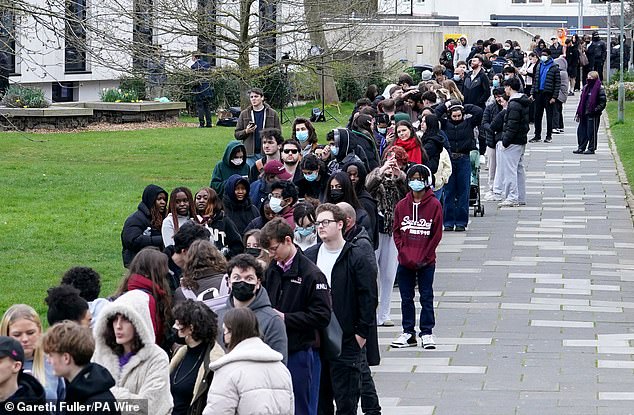
Students queue at the University of Kent in Canterbury today amid the meningitis outbreak
She continued: ‘Juliette embraced everything that school had to offer, with great enthusiasm and joy, and her humour and her positivity were captivating.
‘In short she was a lovely girl. Her beautiful smile, her loving nature and her sense of fun will be hugely missed.
‘We are all devastated. Our love and our thoughts are with her family and friends at this terribly sad time. Our priority now is the safety and well-being of all members of our school community, and we are continuing to work closely with the UKHSA to ensure they are all as well as they can be.’
A 21-year-old student from the University of Kent has also died after contracting the disease, while 11 other people have been left seriously ill.
Pupils from two other schools have also been diagnosed with the disease following the outbreak at the weekend.
Norton Knatchbull School in Ashford said one of its Year 13 students has meningitis and is now ‘receiving appropriate hospital treatment’.
A Year 13 pupil from the Simon Langton Grammar School for Boys has also been admitted to hospital with meningitis.
A club in Canterbury has closed its door following the outbreak, after being told by the UK Health Security Agency that one of its attendees at the weekend was diagnosed with meningitis.
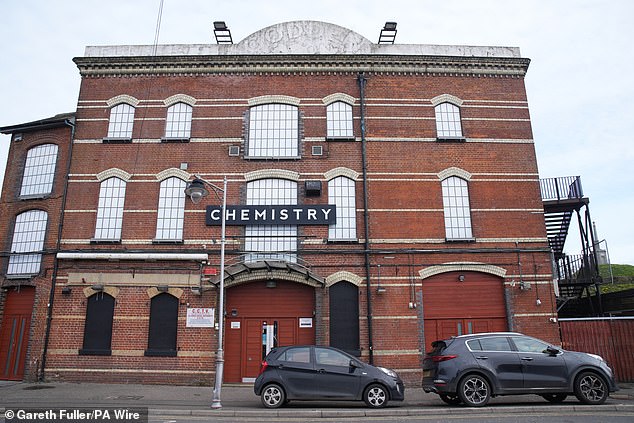
Club Chemistry in Canterbury which has been linked to the meningitis outbreak

Keeleigh Goodwin, 21, has been diagnosed with meningitis after attending an event at Club Chemistry on Thursday

Keeleigh, who lives in a house-share in Canterbury, has been diagnosed wtih meningitis B and is currently in hospital
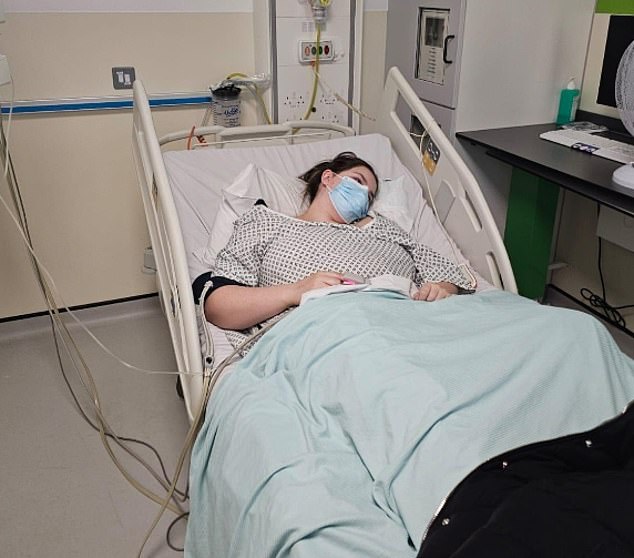
Casey Marlow, 19, was rushed to hospital a few days after her and her friends spent the evening at a nightclub thought to be at the centre of the deadly outbreak of meningitis

Casey’s mother Emma Marlow said her daughter should make a full recovery with antibiotics
The government body has also urged anyone who visited the nightclub on March 5, 6 or 7 to come forward for antibiotics as a ‘precautionary measure’.
Two girls who attended an event at the club on Thursday and were sharing vapes with each other have since developed meningitis symptoms
Keeleigh Goodwin, 21, who lives in a house-share in Canterbury, has been diagnosed with meningitis B and is currently in hospital, where she is expected to stay for at least a week.
Casey Marlow, 19, was also rushed to hospital a few days after she and her friends visited the venue to celebrate her birthday.
Meanwhile, a party in Whitstable has also been linked to the outbreak after the Mail revealed one of its attendees has subsequently been diagnosed with the disease.
Jude File, 15, said he heard in a text from friends today that the person was now in a coma.
The party was held at a private address on Saturday night and the person in a coma was said to be a boy aged around 17-18 years old.
Speaking with his father’s permission, Jude told the Daily Mail: ‘Everyone’s a bit freaked out.
‘The party was for pupils from Langton Boys School and Langton Girls School in Canterbury, where I have friends. I don’t know [the person who fell ill], he’s a friend of a friend.’
Matthew McDonagh, 16, and his brother Luca, 17, were also at the party in Whitstable on Saturday. They confirmed that one person from their friendship circle was already in an induced coma after recently contracting meningitis.
Luca, who is in Year 13 at Simon Langton Grammar School, said no one in his year group at school is allowed to go in for lessons. He and his brother, at the same school, were told to come to the University of Kent to receive a precautionary antibiotic.
Matthew said: ‘It’s quite scary. I can’t believe it. It’s just insane. It’s actually happening since Covid. I thought this literally never happened again, and then I’m in a massive queue. It’s completely unbelievable. I never thought this would happen again.’
‘We’ve been told that we don’t even know if the pill that they give you is actually going to help us,’ Matthew said. Luca added: ‘It’s pretty terrifying.’
Queues formed today outside the Senate building after the university asked anyone who believes they have come into contact with those who contracted meningitis and have not been contacted by the UKHSA to attend between 9am and 4pm.
More than 30,000 students and staff at the campus have been alerted by the UK Health Security Agency (UKHSA), warning them to stay vigilant against symptoms. The university has now postponed some in-person exams and moved others online.
Speaking at the university today, Mashaal Chughtai, 22, a third-year law student, said: ‘My mum and dad are on their way to get me now from Birmingham. It is going to take them about four hours. My mum rang about seven times asking if I was alright. It is all very strange.
‘I am in a dodgeball society and my friend texted me. At first we thought it was someone in Kent, not a student, but then we were told someone in the university had died.
‘We got an email from the UKHSA saying these are the symptoms and to watch out if we start to feel any of them. Then the university emailed us too. I am going up to the Senate building just as a precaution because my mum told me to take the antibiotics.’
One girl living in Tyler Court, where an ambulance and doctors in hazmat suits arrived yesterday, added: ‘A close family friend was taken to hospital last night because she was complaining of symptoms. She was in my flat. We heard this morning her temperature has come down and hopefully she will be alright.’
Meanwhile a second block, thought to be the Turing block, is also said to be affected.
Josh, a man whose sister is in hospital with suspected meningitis, spoke to Sky News while queueing to get antibiotics this morning.
He said: ‘It shakes your day a little bit, I can tell you that. As far as I’m aware she’s actually just spoken to the consultant again, they’re going to keep her in a little bit longer. But to the best of my knowledge, I’ve just spoken to my mum, and she seems okay.’
Confirming that he was queueing for the medicine, Josh added: ‘Having been Mother’s Day yesterday we were together, me, my mum and my sister, and so obviously it’s precautionary more than anything, but we just wanted to make sure that we could get up here. We spoke to 111 and this is what they said to do.’
On campus last night, several people could be seen wearing masks in their own flats.
An ambulance was also seen parked outside one of the student blocks, with paramedics dressed in protective clothing and face masks preparing to enter.
Final-year history student Sam Shuker said: ‘It’s quite grim. I didn’t think I’d be dealing with this four days out from my dissertation deadline.
‘My thoughts go out to those who are suffering and please stay safe. I don’t think we know what strain it is at this point but we’ve got to be on our toes. Social distance and all that.’
Eloise Thorne, a third-year psychology student, said the mood on campus was ‘very surreal’. She added: ‘It just feels like Covid all over again. Everyone is confused and no one knows what’s going on.
‘It’s really sad as well. I keep seeing people spreading videos of people who are sick around and I just feel like that might not be the best idea. It’s just scary, sad.’
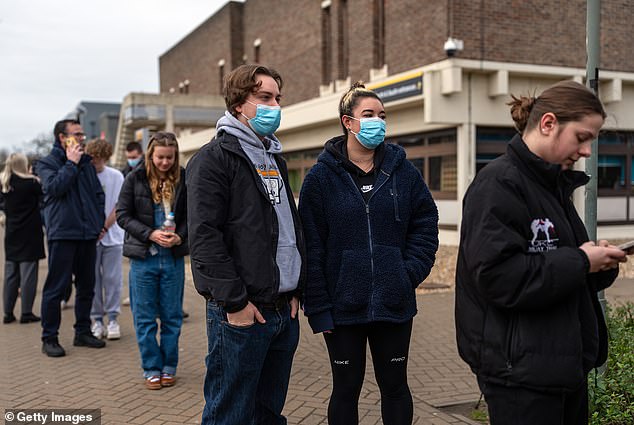
Students queue at the University of Kent in Canterbury today amid the meningitis outbreak
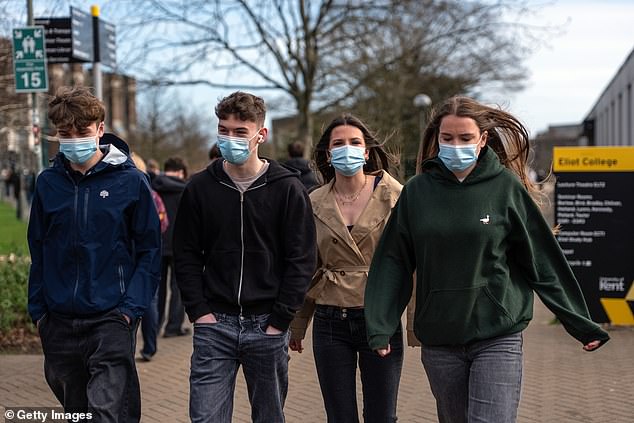
Students wearing face masks walk through the University of Kent campus in Canterbury today
Ms Thorne also said: ‘I think people need to take it seriously so more people don’t end up like that [seriously ill]’.
Brittany Nsongo, a first-year astrophysics student, said she has had a few friends report in group chats that they were feeling sick with flu-like symptoms.
She has been alarmed by the circulation online of images of students allegedly being taken out of buildings while visibly unwell. ‘It just feels like there is no respect for the actual victims,’ Ms Nsongo added.
Another student, Ethan Falkner, 23, who is studying politics and international relations at the university, said friends of his were ‘nervous and anxious’.
‘First reaction to hearing the news is wishes to the people who have lost their lives already and to the ones currently in hospital suffering,’ he said.
‘I had friends sat in the library this evening who on finding out the news, immediately packed bags and left to avoid contact with people.
‘The university are yet to communicate to myself and as it stands my friends I’m in contact with and others in the university community have had no contact from the university itself regarding this critical issue.’
Meningitis is spread through close contact such as kissing, and microbiology experts today confirmed the Canterbury cases are of the serious bacterial form of the disease.
Infectious disease experts believe the outbreak is ‘unusual’ and may be linked to a combination of lower vaccination rates since the Covid pandemic and a ‘new strain with different behaviours’.
The vaccination ACWY-135 is received by teenagers in England between the ages of 13 and 14, in Year 9. Experts say vaccination rates among students are at 73 per cent.