Families of failed asylum seekers have been offered up to £40,000 to leave Britain voluntarily in a new pilot scheme.
The Home Office today informed 150 families they are eligible for lump sums of £10,000 a head for up to four people if they agree to go.
The programme could be expanded to thousands more families if it proves successful.
Home Secretary Shabana Mahmood has sanctioned the huge pay-outs in a bid to save even larger sums currently being spent on keeping the families in migrant hotels and other types of accommodation at the taxpayers’ expense.
Financial incentives are necessary because Labour scrapped the previous government’s Rwanda scheme, which would have seen adult asylum seekers compulsorily sent to east Africa to lodge claims there rather than here.
The pay-outs are also an attempt to overcome barriers faced by the Home Office when it attempts to remove failed asylum seekers, including last-minute human rights claims and problems obtaining travel documents from their home nations.
The Home Office is also planning to use physical force to remove failed asylum seeker families – including against children – if they reject the offer, it has emerged.
It has launched a consultation with experts in the police, teaching and care work to determine what levels of force could be used against children in what officials said would be a ‘lawful, dignified and proper’ way.
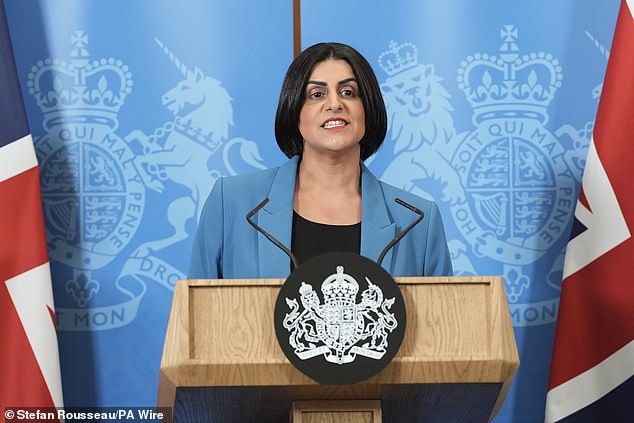
Home Secretary Shabana Mahmood has unveiled the new scheme – which begins immediately – as she delivered a keynote speech on immigration policy in central London today
The pay-outs will save taxpayers’ money because it currently costs an average of £158,000 to support a family of failed asylum seekers.
‘That is a staggering amount of money, which is ridiculous,’ a Home Office source said.
‘We need to get them out.’

Migrants sprint across Gravelines beach in northern France earlier this week to board smugglers’ dinghies bound for Britain
Asylum seekers in the first batch of 150 families have been given seven days to accept the new offer.
If they fail to do so it will then be permanently withdrawn.

Migrants jostled for a spot on the dangeroudly overcrowded dingies
If they agree to leave, the money will be loaded onto electronic payment cards which can be accessed once the families reach their home country aboard taxpayer-funded flights.
The £10,000 per head sum could be increased – or lowered – depending on take-up of the pilot scheme, source said.
There are currently thousands of failed asylum seeker families being supported by public funds, officials said, but the exact number is not known by the Home Office due to weaknesses in its data-gathering.
The families have had claims rejected by the Home Office and have then gone on to fail to win refugee status in the appeal system.
But sources were able to confirm that 700 Albanian families who have exhausted their appeals process are still being supported by the public purse.
The new scheme came as the Home Secretary delivered a keynote speech today outlining a number of immigration reforms.
Challenged over the principle of handed failed asylum seekers such a huge sum of money, border security minister Alex Norris told LBC: ‘This is better value for the British taxpayer.
‘The situation today which will house them indefinitely [is] costing £158,000 a year.’
He added: ‘The people we’re talking about are families who have failed in their initial application. They’ve failed in their appeal.
‘They have no live asylum application in this country, and no future in the country.
‘It’s not good for them, not good for the children.
‘So we’re supporting them, as has been done before in the past, but we’re increasing the levels in this pilot of support, up to that number, to incentivise them to leave.’