It surely involved collusion, a sleight of hand perpetrated on the watching public to preserve the burgeoning image of Formula One. Or you could call it a disgraceful act of media manipulation.
I am talking about the sport’s hierarchy and their sensitivity over controversial new regulations that resulted in a near accident at the start of Sunday’s Australian Grand Prix being blanked from, or at best marginalised on, your TV screens.
Certainly, that drama was not granted the prominence it deserved, as a high talking point it might have been in normal, less fretful circumstances for those who govern this revolutionary era that has transferred to half-electric/half-combustion engine power units, making their debut in Melbourne, in perhaps the most significant loosening of F1 from its roots.
The incident in question: Liam Lawson stalled his Racing Bulls car and Franco Colapinto swerved to save himself from ploughing into the back of the New Zealander. Under the new engines, of hairdryer noise rather than the old V8s or V10s with their banshee screams, drivers rev up their turbos on the grid before the lights go out, the emphasis on building up power in their batteries.
And one of the criticisms of the new regulations in the build-up to the opening round was the fear there might be an accident on the starting grid as a consequence, this time narrowly avoided.
George Russell, the race winner, threw up his hands on watching the Lawson escape in the cooldown room afterwards, for it was shown then on the screen there, in amazement that something awful had been averted by Colapinto’s quick avoidance.
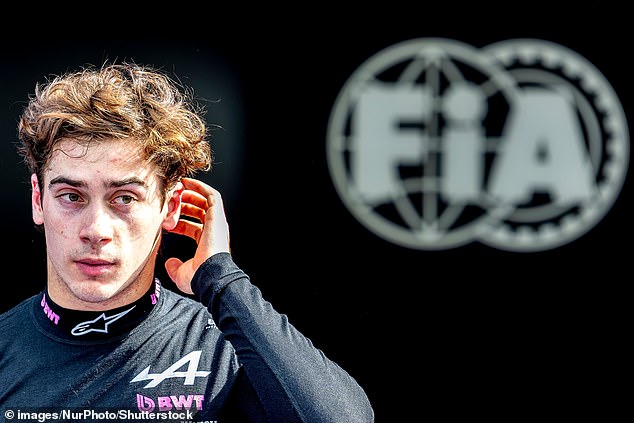
Franco Colapinto was forced into a dramatic swerve to avoid a serious accident after Liam Lawson stalled
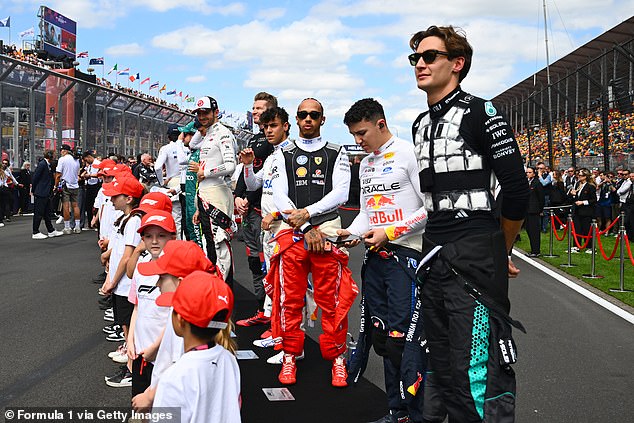
Do the 2026 regulations sound ‘complex’ – Lewis Hamilton’s word for them, not only mine? Surely yes, unless you have a first-class degree in engineering from Imperial College
Do the 2026 regulations sound ‘complex’ – Lewis Hamilton’s word for them, not only mine? Surely yes, unless you have a first-class degree in engineering from Imperial College. It is a grotesque distortion of Formula One, and beyond the wit of the watching fan to understand and digest entirely.
That is a problem as the sport has embraced – in woke style – the green lobby, ironically just as car manufacturers in Germany are turning back to diesel. This formula feels out of date already. It is also a fraud, given that Formula One travels around the world burning carbon through a thousand flights.
And then you have drivers having to lift off the gas to harvest energy for their batteries. The noise of the engine falls off on straights – the very antithesis of everything Formula One should be about. Yes, the speed through corners is impressive if adequate power is accrued, but still it is ‘artificial’, as Max Verstappen said.
The four-time world champion went further, adding: ‘If you enjoy it, then OK, but that is what I do at home playing Mario Kart. I didn’t enjoy the way we raced. It was not proper.’
Which brings us to the main point. Formula One should be about human endeavour rather than an Xbox substitute entirely led by technology. It is inescapably a fusion of the two components, in reality, but these regulations have skewed the balance in the wrong direction.
Yes, there was some superb driving from Russell at the front, exchanging the lead six times in nine laps against the almost equally adroit Charles Leclerc. But the yo-yoing was largely attributable to how each deployed extra battery power in order to overtake. It was a computer game played out at the touch of the overtaking boost button.
Formula One bosses claimed there were 120 overtakes, compared to 45 here last year. Fine, if you believe that, not that we saw so many moves on the monitors in the Media Centre or you saw on TV.
Passing should be hard earned, not commonplace like scoring in NBA games. The preyed upon driver in close combat can do little to defend himself against greater battery power.
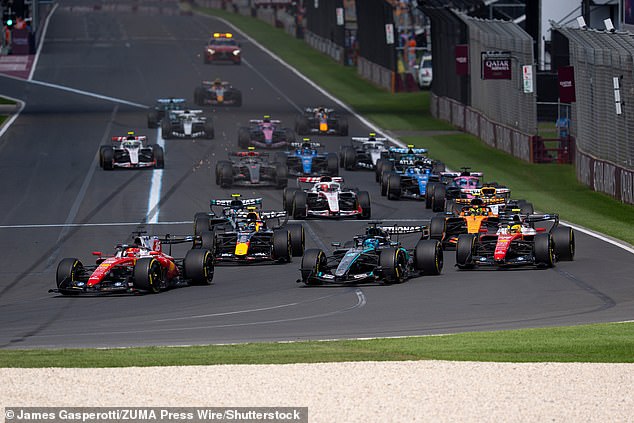
George Russell and Charles Leclerc swapped places six times in nine laps – but the yo-yoing was largely attributable to how each deployed extra battery power in order to overtake
The solution? Abandon this absurd situation at the end of the year and return to proper engines, ear-splittingly loud – and, by the way, which would be considerably faster over a lap than the current breed (they were 2.5sec slower in qualifying compared to last year) – a strive for excellence and speed that is the natural cornerstone of Formula One.
What’s wrong with Aston Martin? How long have you got!
Let’s not be unkind. There’s nothing wrong with Aston Martin other than for the owner, the team principal, the drivers, the car and the engine.
I only half-jest after the more-money-than-sense team perpetrated perhaps the most embarrassing performance in modern Formula One history. Fernando Alonso retired hurt in Melbourne while Lance Stroll was 15 laps behind the victorious Russell – yes one, five – when his prolonged agony of an afternoon ended.
The car was so bone-shakingly bad that Adrian Newey, the said team principal, revealed beforehand that he feared repeated laps would leave his drivers with nerve damage.
Lawrence Stroll, the Canadian billionaire owner, has spent big but often unwisely. His ambition is embodied in the £200million spent on their state-of-the-art factory at the gates of Silverstone. It wants for nothing, including its up-to-the-minute wind tunnel.
Everything else is wrong. His nepo son Stroll Jnr carries a perpetually bored air, an emblem of the malaise. Newey is known not to rate Lance but dare not say boo to the boy’s dad, a forbidding presence.
Alonso is one of the best drivers of his generation – and he made a flying start in Melbourne by the way, up from 17th to 10th – but he turns 45 this year and cannot go on forever as his powers inevitably decline. But he is the least of Aston’s concerns right now.
Stroll Snr appoints his key staff with an appalling lack of judgment. Newey is a genius designer, the best the sport has ever known, but is cast in a managerial capacity ill-suited to his introspective nature. He needs to be sitting at his drawing board, pencil in hand.
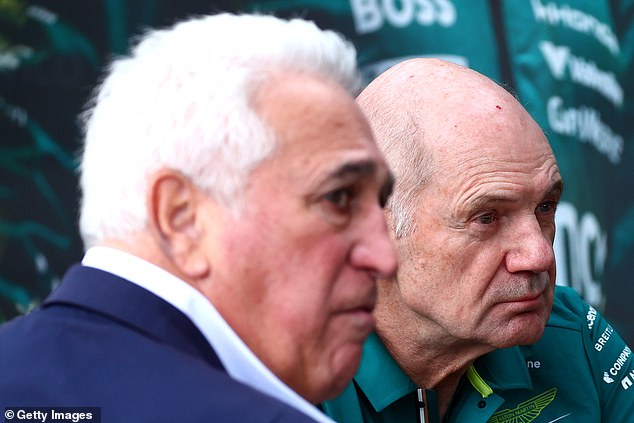
Lawrence Stroll (left) appoints his key staff with an appalling lack of judgment. Newey (right) is the best designer F1 has ever known, but is cast in a managerial capacity ill-suited to him
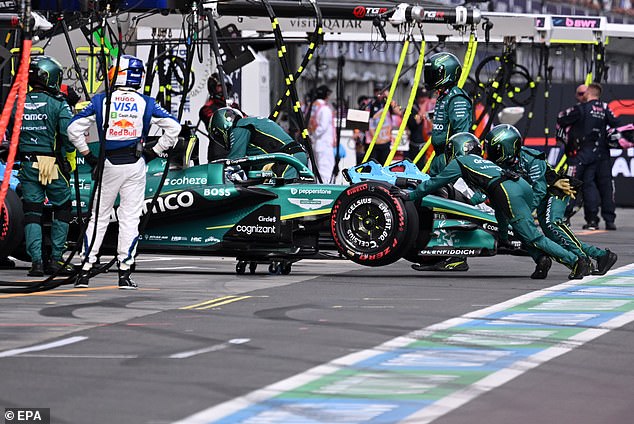
Fernando Alonso (pictured) retired hurt in Melbourne while Lance Stroll was 15 laps behind the victorious Russell – yes one, five – when his prolonged agony of an afternoon ended
When he was at Red Bull, Newey was deliberately cocooned by Christian Horner, sitting in the adjacent office, sympathetic to Newey’s temperament. Stroll’s decision to bring him in last March with a shareholding and on a £25m-a-year deal reveals his (Stroll’s) vaulting ambition. To make Newey team principal, however, reveals his lack of F1 nous and human intuition.
As for the Honda engine, it is inexcusably bad. But the problems run far deeper. The green fish is rotting from the head down.
PS: I note Aston are now talking about a 10-year plan to win the world championship. Last time I checked it was a five-year plan, and this is the fifth year. Just saying.
Middle East races set to be cancelled
It looks likely that Bahrain and Saudi Arabia will fall off the calendar this season, collateral damage of the Middle Eastern conflict. I am told a firm decision will be made in the next couple of weeks, and that, as it stands, neither will be replaced or rearranged.
Let’s see. Rapacious Formula One may succumb to any bidder who offers them a zillion dollars. But this is not Covid, when the sport scrambled an emergency package of races to fulfil their TV rights obligations. There would still be 22 races this year and that contractual obligation to the broadcasters is comfortably reached.
So if Bahrain, scheduled for April 12, and Saudi, April 19, fall victim to force majeure, there would be no Formula One race in April at all, a breather between the Japanese Grand Prix on the last Sunday of this month and Miami on May 3.
A whacked-out travelling tribe, enduring a radically increased roster of races in recent times, would not say no to the hiatus.
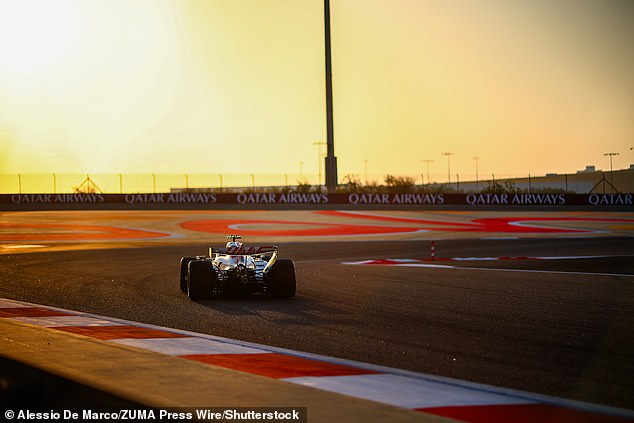
Bahrain and Saudi Arabia are set to lose their grands prix for this year as the mass bombing continues in the Middle East
Lando’s next honour
A exhortation from a member in the comments book amid the chandeliered splendour of the Royal Automobile Club in Pall Mall calls for Lando Norris to be offered membership after his title success last year.
The relevant committee is looking into it with some enthusiasm. Quite rightly. And never mind his title, only last July Norris lifted the RAC Trophy, awarded to the winner of the British Grand Prix and then housed at the Club.
One hopes the world champion will be offered honorary membership, thus gratis, and will not need to set up a direct debit for annual subs north of £2,000. Unlike some others of us.
Blowers’ Aussie quip
Patrick Head, now Sir Patrick, the engineering guru when the Williams team ruled the tracks, was travelling in company with cricket commentator Henry Blofeld one year.
Head and others were flying into Adelaide for the grand prix, Blofeld for the Ashes. Stopped at the immigration desk on arrival, Blowers was interrogated over his suitability for entry into Australia.
‘Do you have any criminal convictions to declare?’ the old Etonian was asked. To which he replied: ‘I didn’t know it was still a requirement here.’
Thank you, Murray
On the back of my article celebrating 20 years as Formula One Correspondent of the Daily Mail, a word about Murray Walker and Australia, where today the sun is shining.
I went to see the unmatchable Voice of F1 at his house in the New Forest to seek his thoughts when I started out in the sport. It was the first of several trips across a cattle grid and a long driveway, learning at his knee in his study.
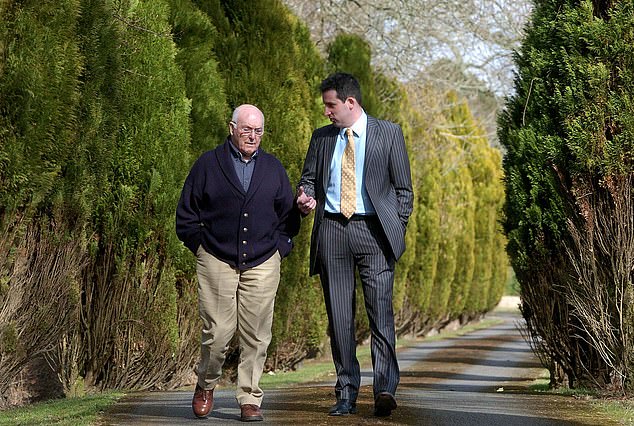
With the legendary Voice of F1 when I first began this job 20 years ago – thanks, Murray, for your kindness and wisdom when I first took to the road
‘Oh, Australia!’ he exclaimed in a way you can hear if you ever heard his pants-on-fire decibels. ‘That is my FAVOURITE F1 venue of them all. Everything is perfect. Switch on the taps and you can be sure the water will come out.’
Which proves Alan Whicker’s assertion that we all like our unspoilt paradises to come with a few mod cons.
By the way, Walker was as famous Down Under, where he commented on V8 Supercars, as he was in Britain. He was a kind of Richie Benaud in reverse.
And thanks, Murray, for your kindness and wisdom when I first took to the road.