
There are no guarantees with Turandot: even though it’s not very long, and despite that aria and some scenes that can hardly fail, it can be a bit of a slog. But given a few great singers, a conductor with fire in his belly, and a following wind, it can blow your socks off. As it happens, I retained my socks during this revival of Covent Garden’s long-running staging, but it’s still a forceful, hugely enjoyable and pretty thrilling ride.
Andrei Serban’s 1984 production is the oldest show in the Garden cupboard and a reminder of times before the puritans had entirely taken over the opera world and dictated that it should henceforth be a wholly penitential experience — though it’s worth remembering too that, back then, this show was seen as all rather discomfitingly new (replacing one of those lumbering old let’s-rebuild-the-Forbidden-City-on-stage jobs), Serban one of the dodgy new breed of theatrical “producers” with dubious agendas.
In fact, with its pan-Far East stylisation and rather intimate setting — the three-tiered wooden gallery (a bit like the Globe seats) where the people of Peking observe this immorality tale being performed for their instruction — in 1984 plenty found this a triumph of style over substance. Now we tend to wonder if Turandot actually has any substance — a reflection of how we’ve been browbeaten into regarding opera as a sort of Khmer Rouge-run re-education programme by two generations of activist directors. There is, happily, nothing to be “learned” from Turandot: no relevance, no moral or political instruction. The glow you take away from it is not one of exaltation-through-art so much as the sort you’d get from a bracing gym workout with blaring disco — but importantly with none of the tiresome physical exertion.
Turandot is a fourth-hand retelling of an old pseudo-Oriental fairytale, turned into a commedia dell’arte romp by the 18th-century Venetian Carlo Gozzi, earnestly adapted by Friedrich Schiller, before Puccini’s librettists made it over for early 1920s Italy. It is a dream of an etiolated, fantasy-exotic empire collapsing into pointless, bloody tyranny, expressed through the figure of the pitiless Emperor’s daughter, Turandot, whose suitors have to answer three riddles or get the chop, and the Prince of Tartary, Calaf, who finally gets the right answers and sweeps the chilly gal off her feet. Gozzi’s sarcastic commedia tone survives in the three court counsellors Ping, Pong and Pang (Guardian readers faint at this point) who make pointed comments about how stupid everything is.
Naturally, everyone now has to pretend to find this problematic in various ways — oddly enough, not including Turandot’s murderous behaviour. No doubt some of this neurosis has been incorporated over the years into the show, but it’s not really obvious. Actually the quality of this staging over the decades has depended greatly (as well as on the singers) on the director chosen to revive it, and the last few goes have been by Jack Furness, who along with choreographer Kate Flatt, has sharpened up no end a thing I’ve sat through a few times without being remotely electrified.
To say the thrill it produces is wholly aesthetic is perhaps not entirely true. Those lights, that smoke, that atmosphere, the black white and red colours and stately choreography, Puccini’s grandiose and massively exploitative music, which works on the least subtle of the emotions ― is this all a bit Nuremberg? Puccini died in 1924 with Turandot not quite finished, but he definitely liked the cut of the early Mussolini’s gib, and admired the March on Rome ― none of which makes him a proper Fascist, even avant la lettre, of course. But Turandot certainly reflects something in the air of early Twenties Italy, and we are perfectly free to see this Peking as an adumbration of whatever we like. Nor is Puccini entirely averse to the harshness and cruelty he depicts, as when he conjures up the new figure of the slave-girl Liù, whose only purpose is to be tortured and die on stage for our delight.
But, as noted, neither Turandot nor this staging is intended to be a school lesson for slow-brained children, unlike most of what is dished up these days, so we are free to wallow in the unfamiliar bath of somewhat brutal sensuality unmediated by other considerations ― which is, actually, nice.
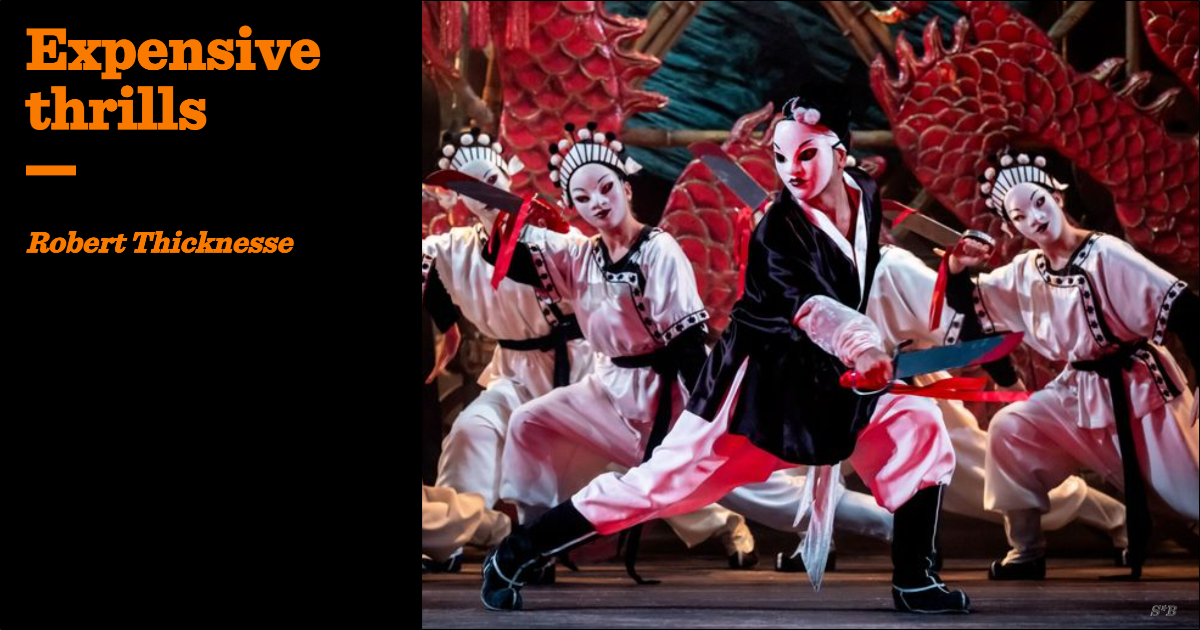
Though it does without hundreds of supers milling around, Serban’s staging manages a stylised grandeur from the first roiling scene, as fluttering banners cascade from the flies and the population works itself into frenzied anticipation of the upcoming execution of Turandot’s latest suitor — while the huge mask-like heads of his unlucky predecessors decorate the middle air. This is operatic pageantry of a non-idiotic sort, hieratic dancers sublimating the violence into elegant, sinister routines, the huge whetstone colourfully trundled on to sharpen the headsman’s sword — and Puccini’s driving, thunderous orchestra and chorus whipping up a good deal of nasty excitement … suddenly hushed and stopped in its tracks by a yearning impressionism, as the fatal moonrise impends.
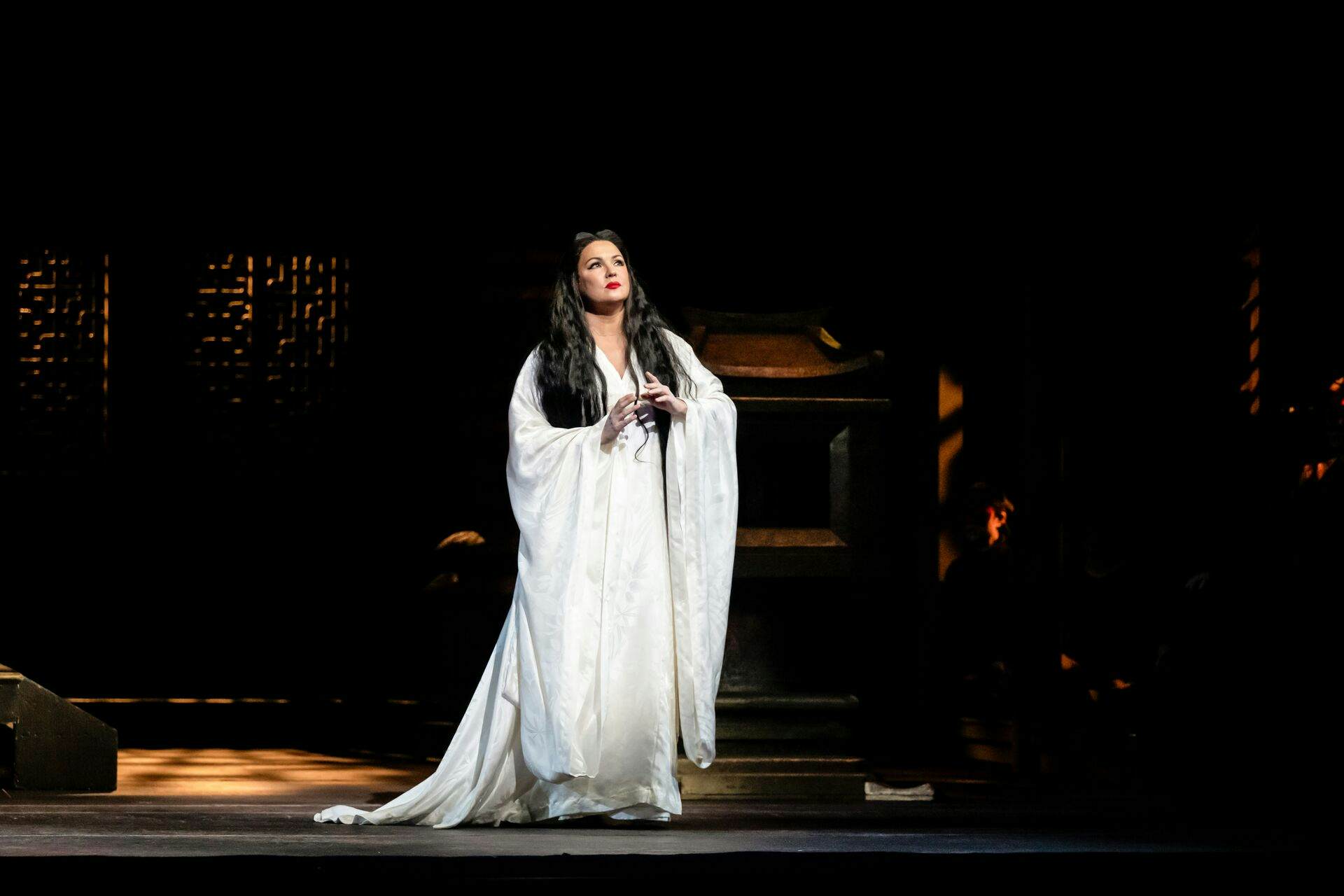
Of course what everyone — including the Ukrainian protestors outside — is really here for is Anna Netrebko’s appearance as the Princess, and though this Turandot remains pretty enigmatic, the voice is certainly still value for money, sounding a bit more secure than in her return-from-political-exile Tosca earlier this year. This role comes with a lot of voice-killing mythology, but between the Castafiore-level tempests of ever-higher yelling there is actually room for some subtlety, and Netrebko gives us just a bit of that; but her big, long-delayed entrance aria, “In questa reggia”, where she patiently explains her psychopathic motivation, is only fairly convincing. But when she gets going ― and in competition with her real-life ex Yusif Eyvazov’s full-throttle Calaf ― all bets are off, and the audience is bombarded with the kind of hair-raising frissons that only the most no-holds-barred opera, and the biggest-voiced singers, can produce.
As mentioned, subtlety in this performance is pretty much limited to the twelve rather marvellous masked dancers, with their hypnotising, slow-mo shape-throwing, and occasional orchestral moments where conductor Daniel Oren indulges at least some of Puccini’s magical, pointillist fantasies. For the rest, Masabane Cecilia Rangwanasha provides the vocal beauty as sweet Liù, our Pings, led very strongly by Simone del Savio — and these days very determinedly non-Chinese, very Venetian indeed in their baggy getup — put the mayhem into rather effective relief with their musings on a peaceful life in the country; Calaf turns “Nessun dorma” up to eleven, Turandot surrenders rather girlishly to his terrific kissing technique, and love and hope return, though not of a sort likely to fill you with much joy. The expensive thrills here are different: excitement, passion, blood, danger, death — and isn’t that what Christmas is all about?