GETTING your child to eat a healthy and balanced diet can be a gruelling task – especially if they are particular about food.
But one pediatric dietitian has come to the rescue with her tips on how to encourage even the fussiest of eaters to budge.
Hannah Hargrove, who specialises in baby and toddler nutrition, told her 71k followers on her @tinyeatersnutrition page how she navigated a lunchtime battle with her daughter.
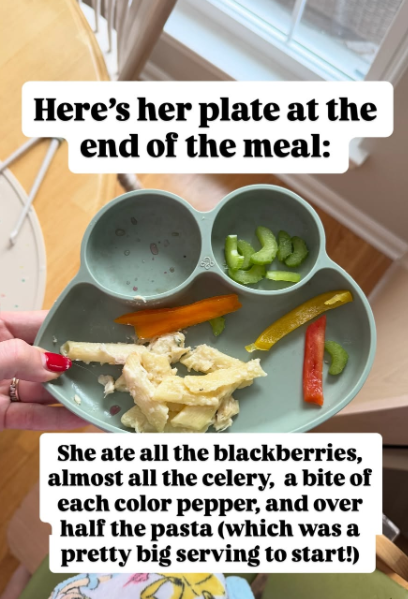
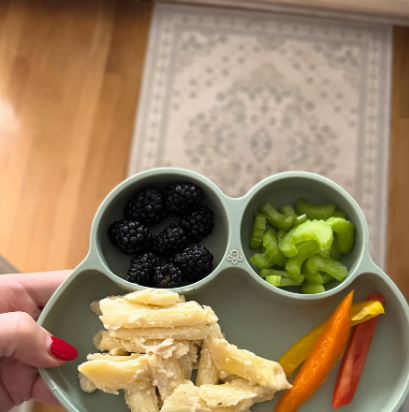
Hannah presented her with a plate of tuna pasta, peppers, blackberries, and celery.
“Today my 2.5-year-old looked at her plate and announced: ‘I don’t want that’.”
Hannah said that she calmly replied and said: “Well this is what we’re having for lunch today. If you’re not hungry, you don’t have to eat it.”


Then Hannah let her toddler decide what utensils she wanted to use to eat her lunch.
She wrote: “She chose new tongs we’ve been practicing with and a pink fork. To you, this might seem minor. To a young child, this can be huge.
“You’re giving them an element of control.”
Hannah then told her followers what she made sure to avoid doing in the situation.
She explained that she didn’t ask her daughter what she wanted, instead, or try and convince her little one that she “does like pasta.”
She also stressed the importance of not bartering or bribing kids to get them to eat their food.
Hannah said that after implementing her methods created a positive result.
“She sat down in her chair and initially ate all of her blackberries and then some celery, and eventually started eating the pasta,” she said.
“She even said, ‘mmmm I love this pasta!’
“I didn’t say ‘I told you so!’ even though I was 100% thinking about it. I just took a bite of mine and said, ‘me too!’
Hannah added: “Remember, as the parent, it’s your job to decide what and when meals are offered.
“It’s your child’s job to decide if and how much they’re going to eat.
“Hold strong, but kind boundaries, and trust the process even when it’s hard.”
Her followers loved the tips and praised her in the comment section.
One wrote: “Omggg I needed to hear these tips thank you for sharing.”
“This is so helpful thank you,” wrote another.
One mum related and said: “JUST had this happen this morning with breakfast
Although some people pointed out that it doesn’t always work, especially when the child straight-up refuses.
Another added: “Unfortunately, that wouldn’t work with kids with ARFID but it does make sense.”
ARFID stands for Avoidant/Restrictive Food Intake Disorder, which was first named in 2013.
It often affects children with Autism or other learning difficulties.
How to get your child to eat their five-a-day
WHEN children turn their noses up at everything from broccoli to bananas, it can be difficult to know where to turn. Why not try…
- Including fruit and veg that are a range of colours – just like the rainbow – to get kids excited about eating them.
- Adding fruit to each meal, especially breakfasts, salads and desserts.
- Making fruit as fun as possible for the family. That way kids can understand more about the textures and flavours of fruit. Have a go at mashing up berries and using them for fruit art where you can draw your favourite fruit.
But if these tips don’t work, Ciara Attwell, food writer and founder of My Fussy Eater, says you may have to resort to hiding vegetables from children if they point blank refuse to eat them.
She has several recipes to choose from, including:
- Baked meatballs – filled with sweet potato cut into chunks, chopped tomatoes, bay leaf and carrots – but the kids will never notice.
- Macaroni cauliflower cheese – this one contains hidden vegetables as an added healthy bonus.
- Shepherd’s pie – this classic dish is filled with veg including chopped tomatoes, cauliflower, and courgette.
- Beany enchiladas – vegetarian enchiladas are filled with peppers and they take just a few minutes to make.
- Sweet pepper frittata – peppers give a sweet crunch to this healthy dish.
Another paediatric dietitian, Lucy Upton, also recently shared her top tips on how to keep things under control and avoid your child having fussy eating habits, or worse, a disordered relationship with food, as they get older.
Her first tip was to avoid over-prompting.
One study exploring parental behaviours during mealtimes found that parents prompt their children to eat an average of 17.5 times per meal, in some cases going up to 30 to 40 prompts.
These prompts often lead to more pressure on a child and further mealtime struggles.
She also advised against labeling foods.
Lucy explained: “Labelling foods (as ‘good’ or ‘bad’, ‘healthy’ or ‘unhealthy’, ‘rubbish’, ‘naughty’ or ‘junk’) may lead young children to believe that if they eat them, they themselves are ‘good’ or ‘bad’.”
Studies have shown that children feel guilty when eating foods that they are told are ‘bad’.
Language like this can also lead to confusion, unnecessary fear or unhelpful attitudes and behaviours towards food.
Another tip is to avoid excessively restricting children’s access to ‘bad foods’
She said: “Research shows that while some boundaries are beneficial, over-restriction can lead to overeating or unhealthy attitudes towards those foods in the long run.
“You can establish age-appropriate healthy boundaries without resorting to over-restriction.”