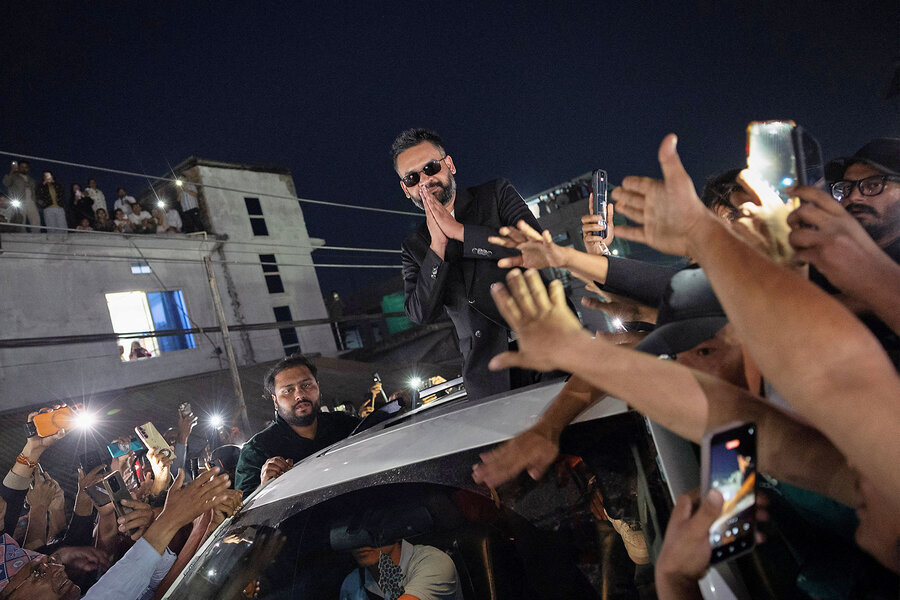
Waving to a cheering crowd from a car sunroof, wearing his signature black blazer, T-shirt, and shades, Balendra Shah looks every bit like a famous rapper that he is. But he’s not visiting the eastern district of Jhapa to perform – he’s celebrating a massive election win that has helped pave the way for him to become Nepal’s next leader.
This rural area has long been a bastion of support for the veteran communist politician K.P. Sharma Oli, who served as Nepal’s prime minister until youth-led protests toppled the government and forced him to resign last year. In the country’s first elections since the unrest, Mr. Shah – a rapper-turned-politician widely known as “Balen” – came to challenge the old guard on its own turf. His confidence paid off.
According to Nepal’s Election Commission, Mr. Shah secured 68,348 votes – the highest total ever recorded in a parliamentary race, and nearly 50,000 more than his opponent, marking one of the most dramatic upsets of the election. And with his Rastriya Swatantra Party (RSP) winning a majority of seats in parliament, the former Kathmandu mayor is poised to become the country’s next prime minister.
Why We Wrote This
Once dismissed as a political novice, Balendra Shah is on track to become Nepal’s next prime minister. His bold leadership style has helped mobilize young voters, but could be a challenge when it comes to governing a nation.
His rise reflects a deeper upheaval in Nepal’s politics, driven largely by young voters frustrated with corruption, unemployment, and decades of revolving-door governments.
“Young people were attracted to the way he presented himself – direct, outspoken, and willing to challenge the traditional political culture,” says Uddhab Pyakurel, professor of political sociology and acting dean of the School of Arts at Kathmandu University.
But governing this democracy of 30 million people effectively will require more than swagger.

“The expectations young people have today cannot be fulfilled overnight,” says Dr. Pyakurel. “Leadership requires constant dialogue and consultation. A leader cannot simply impose decisions; they must work with institutions, parties, and the public.”
Frustration with the old guard
Nepal’s political instability has been persistent. Since the monarchy was abolished in 2008, the country has had more than a dozen governments, and no prime minister has completed a full five-year term.
“Power kept circulating among a small group of old leaders,” says Kathmandu-based political activist Nabeen Tiwari. At the same time, millions of young people left the country searching for work abroad.
Frustration boiled over last year when protests – initially sparked by government restrictions on social media – spread across the country and grew into demonstrations against corruption, unemployment, and economic stagnation.
“At that point there was a political vacuum,” Mr. Tiwari says. “Many people were no longer willing to trust the traditional parties.”
And Mr. Shah, who’d already established himself as a political outsider who could get things done, was a ready and willing alternative.
The rise of an outsider
Mr. Shah joined Kathmandu’s emerging hip-hop scene in the early 2010s, while also pursuing degrees in civil and structural engineering. Performing on city rooftops and in underground rap battles, he built a following with tracks that railed against corruption, poverty, and the country’s entrenched political class.
“People supposed to protect the country are idiots,” he raps in “Balidan” (or “sacrifice” in Nepali), a song viewed millions of times on YouTube. “Leaders are all thieves looting the country.”
But in a rare interview with The New York Times in 2023, he said that entering politics was always part of his broader plan.
Buoyed by his popularity as a musician, Mr. Shah defeated candidates from established parties in the 2022 Kathmandu mayoral race, running as an independent. Once in office, he cracked down on illegal construction and launched efforts to improve urban management – efforts that won praise from supporters who saw him as decisive. But his methods also sparked controversy, including in 2023, when his administration cleared roadside vendors from parts of Kathmandu without providing alternative spaces for them to continue their businesses.

Throughout his tenure, he rarely spoke to the press, preferring instead to communicate directly with supporters through social media. (His team declined repeated interview requests for this story.)
It’s through those channels that Mr. Shah echoed protesters’ calls for the government to step down late last year. In a social media post addressed to “Gen Z and all Nepalese,” he urged the public to remain patient as the interim government took over.
“You are now stepping towards a golden future,” he wrote. “Please don’t panic at this time. … This interim government’s job is to conduct elections that will give a new mandate.”
In January, he announced his decision to participate in those elections, resigning as mayor and throwing his weight behind the RSP, a political party founded in 2022 that had positioned itself as antiestablishment and anti-corruption.
Realities of governing
Rebika Gurung, a 27-year-old casino manager, says she persuaded her entire family to vote for the RSP last week.
“I don’t necessarily support his party, but I voted for [it] because of Balen,” she says. “He is not only young but educated, and … has already delivered as a mayor.”
Nepal is still counting votes, but so far, the RSP has secured 183 of the country’s 275 parliamentary seats. Like many young voters, Ms. Gurung is frustrated by what she sees as decades of corruption and political stagnation, and hopes that Mr. Shah can use his position as prime minister to help create jobs and keep young people from moving abroad.
But some Nepalis have doubts.
Mr. Balen’s critics have described him as uncompromising, opportunistic, and impulsive. A few months ago, he posted an expletive-laden, late-night message on Facebook trashing India, China, and the United States, along with Nepal’s traditional parties. The post was later deleted.
For some observers, the episode highlighted uncertainty about how he might navigate Nepal’s delicate diplomatic balance between India and China. And although Mr. Shah’s party is emerging as the largest bloc in Parliament, he will still need to work with lawmakers from the same traditional parties he’s railed against for years, including the Nepali Congress, the Communist Party of Nepal, and Maoist factions, which have won dozens of seats in Parliament.
“People want change very badly,” says Mr. Tiwari. “But transforming the system will be much harder than winning an election.”
Yet this is a gamble many young voters are happy to take.
“If Balen does not deliver, we will again hit the streets and remove him,” says Aaditya Karna, one of the Gen Z leaders in last year’s protests.