A recent survey showed that half of young people would, if they could choose to, live in a world without the internet. Technological optimism is a fast receding trend, even as global capital floods into AI research — a development that has itself been met with deserved scepticism. Increasingly, there’s a feeling that today isn’t living up to the promises of yesterday.
Burnt out zoomers aren’t the only ones who would like to “retvrn” to the sunlit uplands of the recent past. Restore Britain, under Rupert Lowe, recently launched itself as a version of Reform, but let’s do it hard, good and proper without any apologising for racism this time. Matters were kicked off (inevitably) with a Twitter video of Lowe stomping around a farm, peering off onto the far horizon and promising to detain — and deport — illegal migrants, before moving onto the legal ones.
I am today launching Restore Britain as a national political party.
Join us.https://t.co/RMtEuHopgV pic.twitter.com/jQMAOjQJ5A
— Rupert Lowe MP (@RupertLowe10) February 13, 2026
Professional centrists and midwits will be scratching their heads over why such “extreme” movements are gripping the minds and imaginations of so many modern Britons. The usual explanations of American or Russian interference, misinformation and the bloodstained ghosts of Britain’s supposedly unaddressed racism will all be paraded before the cameras.
The truth, that people are being radicalised first and foremost by current events, is still too awful to contemplate. Two decades on from the optimistic experiment of equalities legislation, multiculturalism and trans-national Britain, matters have horribly fallen apart. We’ve crashed out of the EU, have hotels full of often disreputable young men causing chaos across half the country, Pakistani rape gangs, stagnating wages, failing public services and a worsening housing crisis. In response to all this, institutions from the arts, to academia to schools and workplaces, have doubled down on progressive propaganda, presenting British culture as simultaneously unreal and oppressive.
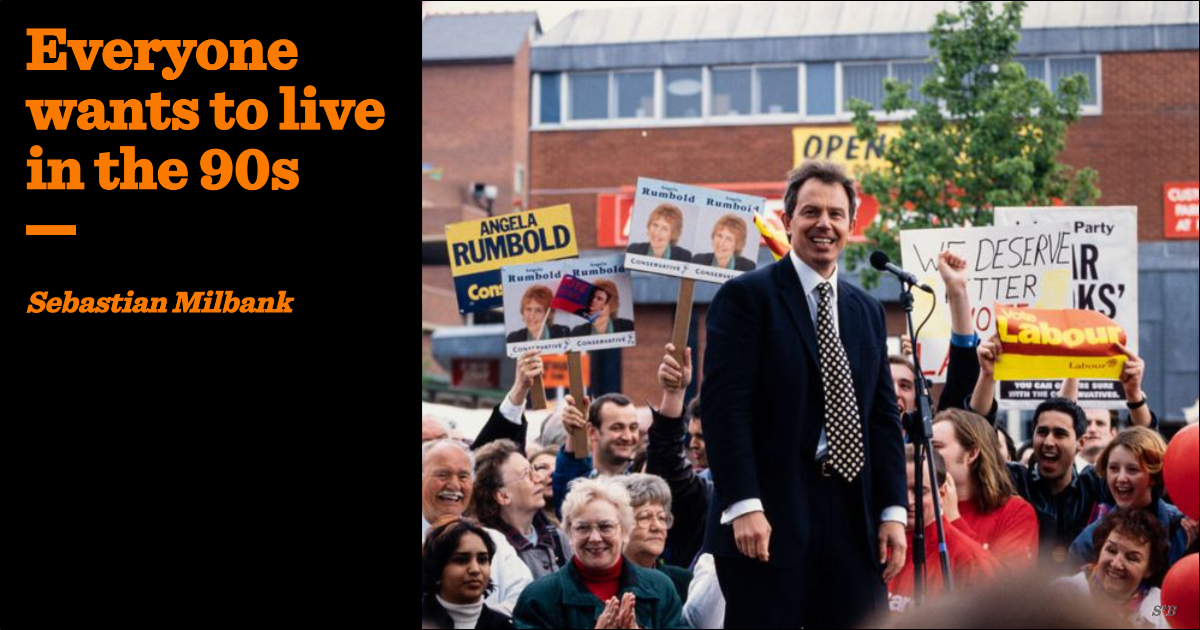
Much like the teenagers sick to death of scrolling, those of us who are contemplating this desperate situation wish we could go back to the 1990s — a place in time that now seems simpler, more hopeful, and more cohesive.
I don’t think I can fully articulate just how much most people didn’t want to be where we are now
In 1992, the year I was born, the British economy was growing fast, migration was well under 100,000 a year, and Britain was a free, democratic and successful state without any need for the Human Rights or Equality acts. Most strikingly, integration appeared to be going well, and on both sides of the Atlantic, it was expected and eagerly anticipated that here in the West we were moving towards a post-racial society.
I don’t think I can fully articulate just how much most people didn’t want to be where we are now. As recently as 2010, we were celebrating the defeat of the BNP in Barking and Dagenham, and the idea of British ethnonationalism was a backward looking punchline. But if you were celebrating in 2010, you weren’t paying attention. Even as the BNP were leaving office, Lutfur Rahman was entering it, as Tower Hamlet’s first elected mayor.
A British Bangladeshi politician who has been linked to an Islamist group, Rahman became a Labour candidate before being removed in contentious circumstances, and instead was elected as an independent. Rahman was found guilty of electoral fraud in 2015 amid a “culture of cronyism” and “undue spiritual influence”. As so often, the British system proved uniquely vulnerable to bad faith actors, and was slowed and paralysed by the fear of appearing to target minority groups, however malign their role or actions.
None of this was in the script that people like me — middle class, university educated, leftwards leaning — were given. The country I was born in was confident, post-racial, and well-governed. I remember being shocked at the segregation I observed whilst living in America, where churches, neighborhoods and friendship groups seemed shockingly fractured by race. Britain, by contrast, seemed far less haunted by ethnic division. It seemed inevitable, then, that cultural and ethnic divides would be rapidly bridged.
That Britain still exists to a significant extent, of course, and one reason that there is, for now, a hard limit on the appeal of Lowe’s approach is that so many minority Britons are thoroughly intermarried; firmly embedded in friendship groups, churches, workplaces and local communities. Yet this success story is imperilled, and not by Rupert Lowe.
Britain is not, fundamentally, a country that wants to take strong punitive action on migration, or to vote for nationalist parties. Political moderation, internationalism, moral idealism, toleration and gradualism are centuries old features of the British system. When one understands how profound the antipathy to this kind of politics in Britain is, one also starts to grasp how vast and destabilising the provocations required to give such politics traction have been.
The perceptual gulf is very extreme. Those still locked into institutions and informational spaces that shelter them from such inconvenient truths look on uncomprehendingly at the segment of people for whom Reform does not go far enough. It isn’t that those on the populist Right always have a clear grasp of reality — and the distortions, hysteria and conspiracies rife in this world speak for themselves. What critics fail to realise, however, is that however foggy the truth claims of populists, they are the only ones addressing an entire area of policy and concern that progressives refuse even to acknowledge.
Apart from mass migration and its consequences, there is a widespread and correct perception that core national institutions no longer act in the national or public interest. This fuels often conspiratorial narratives of elite betrayal and capture, yet if the framing narrative is distorted, the general sentiment reflects a realm simply invisible to respectable opinion.
I’ll give an example. Down the road from where I live, on my local tube platform, two men were stabbed by a frenzied attacker. There was no clear motive for the stabbing. Thankfully the two men lived, though they sustained life threatening injuries. According to police, after being detained, the attacker “repeatedly laughed, lied, argued and tried to frustrate our investigation as much as he could”. He showed no regret, clear intent to kill, multiple witnesses were present, and CCTV evidence was available. Yet he was charged with GBH rather than attempted murder, and has received a sentence of only 11 years. Given he has already spent over a year in custody, if he gets paroled, he could be out of prison five years from now. Is there any reason to think that in five years time he will be less of a danger to the community? If I’m still living here by then, I could run into him next time I get the tube or do the shopping, when he next chooses to strike without provocation.
The knifeman was one Nicholas Orlando Green, a black man born in Jamaica, a fact that people were not slow in observing. Suspicion swirls around courtrooms, with judges and juries alike looked on with increasing scepticism on the populist right. It goes without saying that verdicts like this are socially corrosive, not only making ordinary people less safe in direct terms, but undermining trust in the courts, and stoking ethnic divisions.
There was of course a very different story to tell in this case. One of the two men who was stabbed, a Chintz Patel, was also from a minority background, and he was wounded because he rushed to stop Green, crossing from the opposite platform and throwing himself unarmed against a knifeman to save the other victim. He knew the other victim, as both were returning from a dance class.
There is a whole world of civic and social relationships, of solidarities and friendships, affections and duties, that cuts across race and class. It’s the sensible, kind, normal world I grew up in, and most of us wish to preserve and protect. But that world is under attack, sometimes, as with Green, quite literally.
It isn’t uncontrolled migration alone, but a sense of institutional breakdown, hostility and betrayal that compounds with mass migration to create the explosive conditions for white identity politics in Britain. The example I cited, from my own neighbourhood, was just one small example of a tendency that taken together can only be called a kind of institutional insanity.
There is a kind of hideous, lethal disconnect, whereby the Starmers of this world make policy — consider the Chagos deal, billions on housing migrants, or early release for criminals in our overcrowded prisons — without being able to see how such policies will be received as not just as points of disagreement, but as a kind of treason.
The suspicion of many who deny or minimise these realities is that populists are all secretly enjoying the drama, getting off on the apocalyptic rhetoric. No doubt, there are those who do. But outside of frenzied online spaces, in the quiet and frank conversations we have with one another, I think the dominant feeling is a sense of deep loss and anxiety about the future.
What most “populists” want, I suspect, is not any kind of ethnostate, but a return to sanity, and to a country no longer split or defined by racial or ethnic rifts. But, ironically, if such a society was once seen as the crowning achievement of liberalism, it must now be saved from these same liberals and progressives, who seem determined to destroy it.
Even if we’re all at some level nostalgists for the growth and stability of the 1990s, it was also the decade that led to this one. Globalist economics, triumphalist liberalism, and post-national cosmopolitanism were well under way, and we have all seen where they lead.
The task of actually rebuilding British culture has barely begun
As bitter and backwards looking as this story can seem, there are glimmers of hope. First of all, people are not standing still or lying down. And secondly, despite extreme provocations and disastrous decisions, crude racial hatred remains rare and marginal, even on the populist right. More substantively, as liberalism recedes and declines, real creative space is opening up to define a new politics and a new civilisational vision.
There is a growing consensus that we need to variously restore, reclaim, reform (refurbish? reupholster?) the country. But the conversation is in its babbling infancy, and still clinging nervously to the barbour jackets of comforting 1980s style conservatives tramping around the fields and complaining about the size of the state. The backlash to the last decades is already well under way, but the task of actually rebuilding British culture has barely begun.