Tourists are reporting chaotic scenes and lengthy delays at airports across Europe today as the new digital border controls officially come into effect – with exasperated travellers saying they’ve been forced to wait ‘for hours’ at terminals, including in Lisbon, Milan and Paris, to clear immigration.
The new Entry/Exit System, known as EES, has been slowly rolled out across Europe since October, with 29 countries now bringing in the new biometric border control process, but many countries are simply still ‘not ready’, say experts.
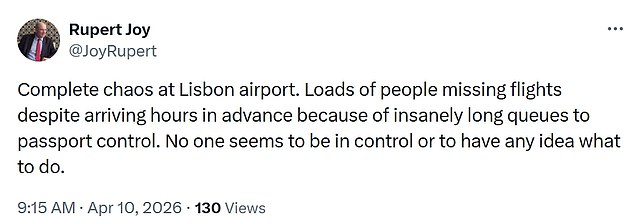
Two travellers at Lisbon Airport this morning were amongst those facing a long wait at passport control. Ex UK and EU diplomat Rupert Joy said the new system was in disarray in the Portuguese capital’s major transport hub.
He wrote on social media platform X: ‘Complete chaos at Lisbon airport. Loads of people missing flights despite arriving hours in advance because of insanely long queues to passport control. No one seems to be in control or to have any idea what to do.’
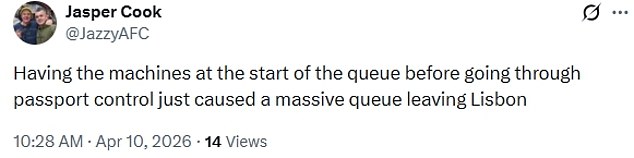
Another traveller said he’d experienced a similar scenario, writing: ‘Having the machines at the start of the queue before going through passport control just caused a massive queue leaving Lisbon.’
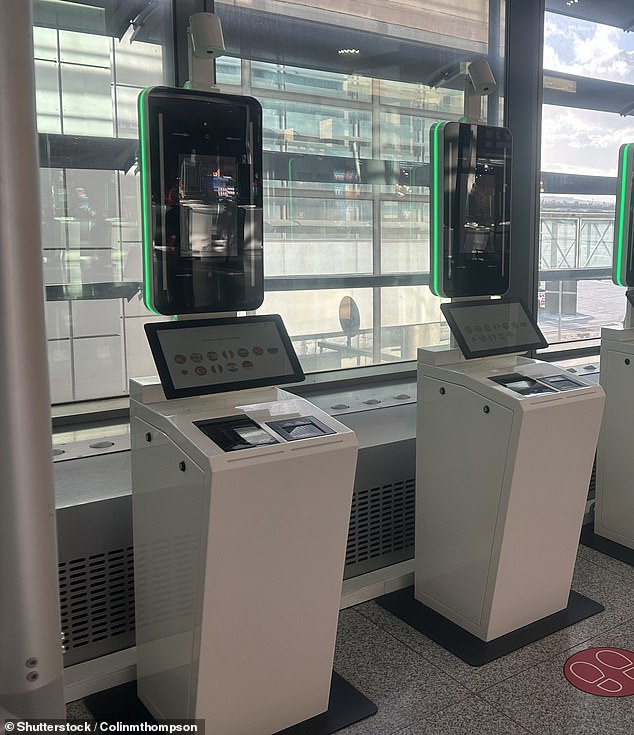
Today marks the official introduction of the EES digital border controls after a six-month roll-out…but travellers are reporting long waits at major airport, with one suggesting it was ‘complete chaos’ at Lisbon Airport
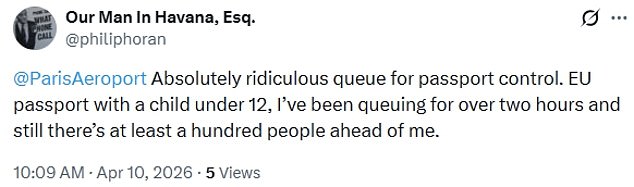
Over in Paris, a parent travelling with a child, believed to be at Charles de Gaulle airport wrote: ‘Absolutely ridiculous queue for passport control. EU passport with a child under 12, I’ve been queuing for over two hours and still there’s at least a hundred people ahead of me.’
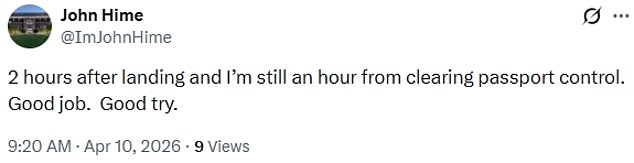
At Milan’s Malpensa Airport, it was a similar scenario. ‘Two hours after landing and I’m still an hour from clearing passport control. Good job. Good try,’ another delayed passenger fumed.
Under the new rules, any non-EU nationals, including UK citizens, who enter the Schengen Area are required to register biometric details, including fingerprints and photographs.
Under the new rules, any non-EU nationals, including UK citizens, who enter the Schengen Area are required to register biometric details, including fingerprints and photographs.
They will also need to provide proof of accommodation, sufficient funds, medical insurance and a return ticket.
With millions travelling as the Easter holidays continue, tourists are being warned to brace for a wait time of up to an additional two to three hours to get through passport control because of potential technical glitches.
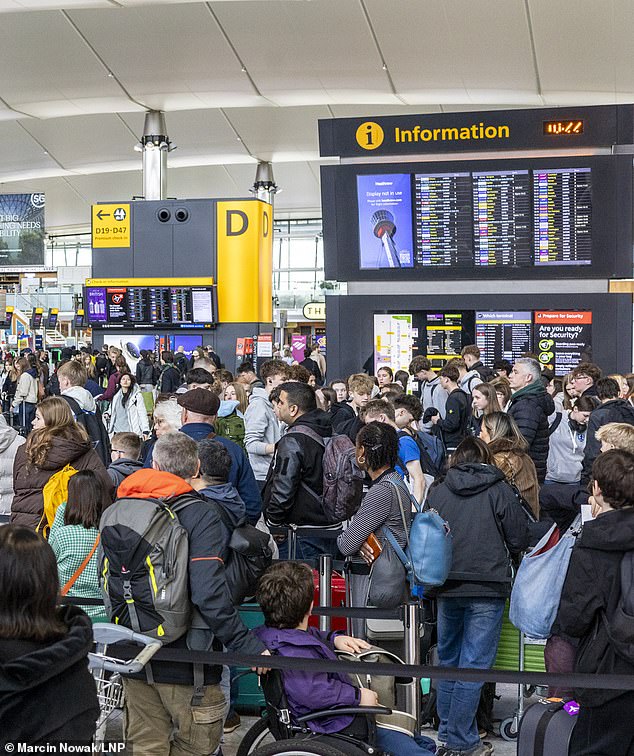
Passengers still face long queues at airports – despite the six-month roll-out of the EES digital border system – as airports across Europe struggle with the new technology (Pictured: queues at Heathrow Airport Terminal 2 pictured earlier this month)
Those travelling to Europe by ferry or Eurotunnel LeShuttle by car will see brand new EES machines in place, but are unlikely to be asked to use them this weekend – because computer systems in France are only partially able to use the technology. Coach passengers and lorry drivers will have to submit their data.
At London‘s St Pancras, Eurostar is still continuing to use traditional in-person passport control, with the new EES system not yet fully functioning.
Travel expert Simon Calder said of the current situation at the UK’s ports: ‘If you’re at the Eurostar terminal at London St Pancras you will see ranks of these fantastic entry exit system kiosks all lined up, all doing exactly nothing.
‘We were supposed to go to 100 per cent entry exit registration today. We are going to see nobody using any of those machines because the system isn’t working properly.
CEO of travel business network The Advantage Travel, Julia Lo Bue-Said, speaking to BBC Breakfast this morning, said despite having a six-month roll out, the EES has been blighted by problems since being unveiled in the autumn.
She told the programme: ‘The reality is through that period we’ve seen multiple IT failures, multiple issues, queues in some of the destinations.
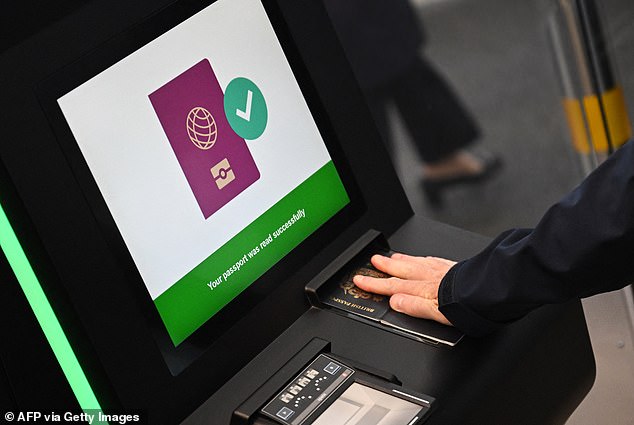
At ferry terminals, only coach passengers and lorry drivers are currently being asked to use the EES machines – because French computer systems aren’t yet completely ready
‘We’ve also seen some airports having to completely switch off the use of the kiosk because passengers have waited for hours and hours.’
While officials at individual airports have been able to make the decision to revert temporarily to the old-style checks during the roll-out, that soon won’t be an option – leaving experts warning summer travellers could face delays.
One British tourist, Jack Howes, told the Daily Mail how a recent trip to Spain was a ‘disaster’ as the EES hampered his travels through Almeria Airport.
He said: ‘There was an assistant who said, “It’s s**t but you have to keep trying.”‘
After getting rejected by the machine four times, Jack was told to go to a manual checkout instead – however there was no one working on the manual desk.
‘So in the end I just went to the gate and it let me through anyway,’ he said.
Another traveller shared their experience on X, and penned: ‘Holy c**p the new EES passport system is a nightmare.
‘Two hours at arrival at Krakow. 90 minutes on departure. Give yourself plenty of time if you’re travelling around Europe.’
Another on the social media platform said they were even reconsidering their plans because of the new process.
They wrote: ‘Rethinking my holiday/travel plans for this year and next, having been to Prague in Jan and Krakow this month.
‘The European entry/exit system (EES) was a nightmare – both going in and out. Despite the very best efforts of the excellent staff at both airports. Hours queuing.’
According to post-Brexit rules, Britons without the right to work or reside in the EU can only stay for 90 days in any 180-day period.
The EES will also automatically flag arrivals at risk of overstaying. It is due to be fully implemented at airports across Europe by April 10, with all third-country nationals required to register from today onwards.
Airports Council International said earlier this month that the latest data collected from airports across Europe shows a ‘continued deterioration in waiting times at border crossing points’ where ESS has been introduced.
Delays are ‘regularly reaching up to two hours at peak traffic times, with some airports reporting even longer queues’, it added.
The trade body previously warned that hubs in Germany, France, Iceland, Greece, Italy, Spain and Portugal were particularly impacted.
Last week, the boss of Ryanair accused the EU of punishing British holidaymakers over Brexit by subjecting them to hours long passport control queues.
Chief executive Michael O’Leary, who backed Remain in the referendum, claimed the bloc was ‘undoubtedly’ forcing Britons to endure longer waits at airports as payback for leaving the EU in 2020.

Ryanair CEO Michael O’Leary (above) has accused EU of punishing British holidaymakers over Brexit by subjecting them to hours-long passport control queues
Mr O’Leary said there had been ‘significant disruption’ at passport control since the new system was first introduced in October last year.
The system is being introduced in stages, with full operation expected from April 2026, but has already caused backlogs and increased waiting times for passengers.
‘We are beginning to see significant disruption. That’s the next big issue. And EES has just been a s*** show and a shambles,’ the Ryanair CEO told The Times.
He explained that any EU state can defer the implementation of EES for five months until the end of September, saying it would make ‘much more sense’ to do so to avoid the situation getting even worse during summer holidays.
‘There’s a bit of Brexit in this too. Here, you voted for Brexit – f*****g join the queue,’ he said.
Mr O’Leary added further delays were being caused by understaffed immigration kiosks, while passengers who had already registered under the new system were being put in the same queue as everyone else.
He warned that smaller airports, such as those in Seville, Alicante, Tenerife and Faro, were likely to be most affected by delays.