The Ukraine war should have prepared Germany for just these sorts of moments.
Four years ago, Russia’s invasion threw Europe’s energy supply into chaos. The price of natural gas increased 180%. Household energy costs went up by more than a third.
Politicians agreed: Lessons must be learned, steps taken. No longer could Germany be so dependent on fossil fuels imported from volatile regions of the world. Renewables were the “energy of freedom,” Germany’s finance minister said.
Why We Wrote This
Germany was supposed to have learned how to protect itself from energy shocks after the fallout from the Ukraine war. But the Iran war has shown that gaps still exist. What went wrong?
The crown jewel of this political awakening? A new law mandating that 65% of the fuel needed for new heating units come from renewable energy.
This month, the law was scrapped – ironically, just days before the Iran airstrikes began.
The law likely wouldn’t have done much to address the rising energy prices of the current crisis. It is not a quick fix. But if Germany wants to get off the energy roller coaster in the long term, it will need laws exactly like the one it just killed.
In that way, it is a parable of why, despite good intentions, big ideas falter and the global desire to leave behind fossil fuels is so difficult. Lurching from crisis to crisis doesn’t help, with Europe trying to navigate economic stagnation, the Ukraine war, tariffs, and the occasional American threat to invade Greenland. Political polarization makes the situation worse.
The result appears to be the loss of the ability to think and act long-term. Some countries like Norway have managed it, and the benefits are particularly obvious at moments like these. Nearly 100% of new cars sold in Norway, for example, are electric.
Europe’s challenge is how to commit to the reinvigoration that virtually all agree is dearly needed – in energy and beyond – when it feels it is hanging on by its fingertips.
Signs of progress
“During a crisis, lots of bold ideas are discussed. Once a crisis is over, it’s back to normal. Worse, we have this backtracking,” says Jan Rosenow, leader of the energy program at the University of Oxford’s Environmental Change Institute.
When it comes to making progress, he says, “We know what good looks like. We don’t know how to scale it yet.”

Indeed, signs of this progress are everywhere. In Germany, some 63% of electricity comes from renewable sources. In 2000, the number was 6%. Industries are better positioned to weather the current crisis because they are consuming one-fifth less energy per unit produced compared with the period of 2016 to 2019, according to global financial institution ING.
Technological breakthroughs are happening, too. In the chemical industry, which has particularly high energy usage, BASF opened a plant in 2024 in Germany that uses only renewable energy. “This outstanding joint project is a significant proof of how together we can develop ground-breaking technologies,” BASF and its partners said in a statement.
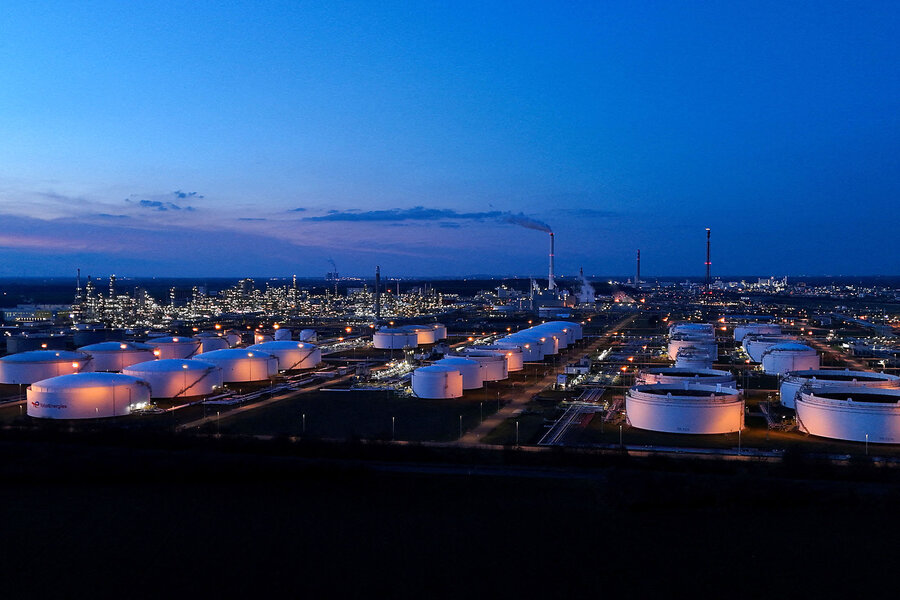
As a practical matter, Germany has significantly diversified where it gets its fossil fuels since 2022, when the Ukraine war broke out, so it is less dependent on any one source. This has cushioned the shock of the current crisis, which has raised energy prices substantially in Germany. Diesel, for example, is up about €0.30 to around €2.15 per liter ($9.44 per gallon).
Yet overall, the picture of dependence on fossil fuels has barely budged. Electricity makes up only 20% of energy usage. Heating and transportation make up 80%, “and we’ve done very little on that 80%,” says Dr. Rosenow.
That’s why Germany’s heating law was seen as significant. But with heating costs still high, the current government felt pressure to ease regulations. “Citizens once again have the freedom to decide how they heat their homes,” said Jens Spahn, a leading figure in the government coalition.

Marcus Brandt/dpa/Reuters
Cost of politicization
This is part of the challenge. The logic behind renewables is clear, but transitions cost money. “The high fuel prices are a strong argument to accelerate investment in renewables,” says Carsten Brzeski, an economist at ING. “But it is a question of money. Who is bearing the burden of the investment?”
Politics is another factor, with energy policy becoming entangled in the cultural debate over climate change.
“The reasons [for delay] are not technical or economic, but more cultural,” says Dr. Rosenow. “Politicization is not helping us. It’s making it so much harder for sensible decisions to be made.”
Yet some countries have set long-term plans and kept them comparatively insulated from politics. Norway changed course after the energy crisis of the 1970s. Now, in addition to building its electric car fleet, it also made it illegal to install heating systems that run on fossil fuels.
The results are some of the lowest household energy prices in Europe. Last May, for example, Norwegians paid €15.77 ($18.30) per kilowatt hour for electricity, compared with €35.23 in Germany, according to a Eurostat report.
Norway’s oil revenues have helped pay for its transition, but other Nordic countries without that advantage have followed a similar path and seen similar results. In some cases, these plans have been 50 years in the making.
Mr. Brzeski, the economist, understands the pressures facing Europe. But the needs remain and are only underscored by the Iran crisis.
“You still need to have a strategy,” he says. “The political establishment and the industrial establishment are still living in a kind of denial. Intellectually, they are seeing that something needs to change, but it comes at an economic cost first.”