At the start of this week, a four-day gathering of the World Trade Organization ended in deadlock over a disagreement between just two of its 166 member countries. The United States sought a 10-year extension to existing duty-free digital purchasing rules (for items such as software, music, and movies); Brazil would only agree to a two-year extension.
Nevertheless, working on the sidelines, 66 other members – from Asia, Europe, and the Americas – forged their own agreement on the issue.
The recent increase in such “minilateral” solutions to global obstacles signifies more than mere impatience with time-consuming multilateral processes. Rather, it highlights the impetus and realization among the world’s middle powers about their changing role – and responsibility – in shaping a world order amid major geopolitical shifts. Middle powers are seeking ways to lessen overdependence on the world’s two largest economies – the U.S. and China – while also crafting new interdependent relations with a wider range of partners.
“Middle powers have the potential to help stabilize global order and advance cooperation,” according to Stewart Patrick, senior fellow at the Carnegie Endowment for International Peace. “The range of potential issue areas for cooperation is vast, … [including] trade, climate action and energy security, digital technology, and support for the international rule of law.”
The European Union and Canada, both longtime allies that the U.S. has recently shunned, are at the forefront of this trend. In January, Canadian Prime Minister Mark Carney urged a move toward “building coalitions that work, issue by issue, with partners who share enough common ground to act together.” He dubbed this a policy of “variable geometry,” based on shared values and interests.
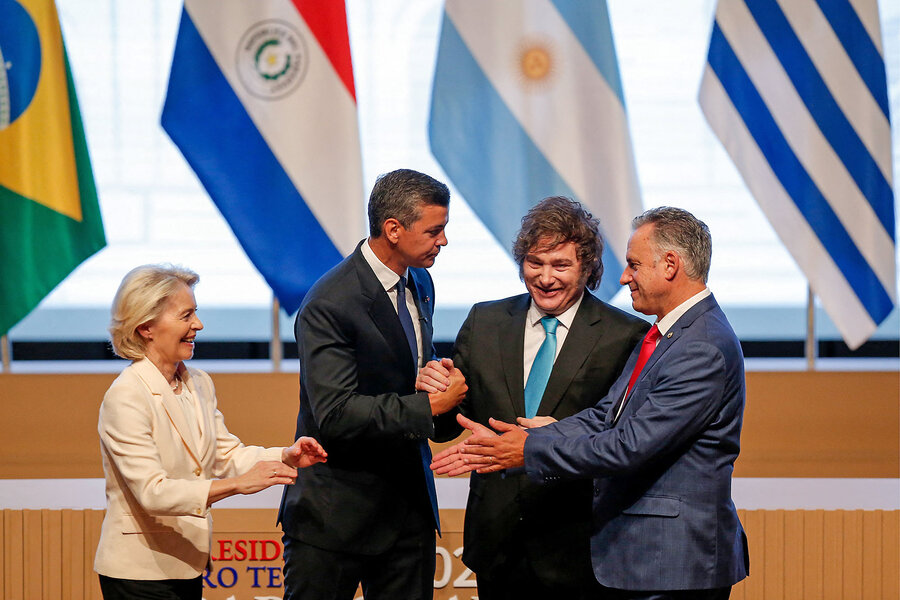
In the two months since his speech at the Davos World Economic Forum, Mr. Carney has traveled to Asia and Australia to hold trade talks. Ursula von der Leyen, president of the EU, has also logged many air miles. In the first three months of 2026, she helped conclude three significant free-trade negotiations – with the five-country Mercosur bloc in South America, and with India and Australia.
The Mercosur deal – in discussion for 25 years – “signals that the EU can still … deliver; even if slowly,” noted the Policy Center for the New South. For Mercosur nations, it is a “recognition of agency. Instead of choosing between China’s purchasing power and Washington’s attention, the bloc gains a third pillar: Europe’s market and political stability.” Both sides, the Morocco-based center said, benefit from “what the other can offer: balance, resources, stability.”
Referring to the U.S. retreat from a range of alliances and pacts, Dr. Patrick of Carnegie believes that emerging middle powers can “fill the leadership vacuum.” This is their opportunity, he wrote in January, “to defend what should be preserved, jettison what is obsolete, and renegotiate rules so that they work better for all.”