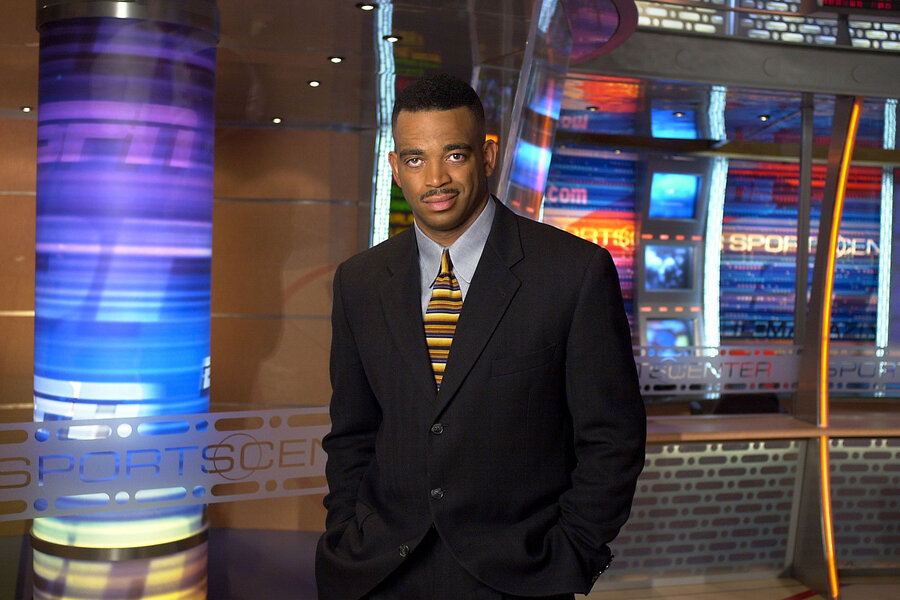
“Boo-yah!”
It’s at once a eureka moment and distinctive expression – a familiar exultation of the late ESPN host Stuart Scott, perhaps one of most important broadcasters of our time. On the network’s flagship “SportsCenter” program, he combined professionalism with hip-hop sensibilities for a populist appeal that millions of viewers embraced. His influence and inspiration are the topics of “Boo-Yah: A Portrait of Stuart Scott,” part of the “30 for 30” series, which airs Dec. 10 at 9 p.m ET on ESPN, the ESPN app, and Disney+. It will be available for streaming on the ESPN app.
When it comes to recognizing media luminaries, it takes one to know one. “He changed the game for me,” says Danyel Smith, an author and the former editor of Vibe and Billboard magazines. Ms. Smith is prominently involved in the documentary, both as an on-screen commentator and behind-the-scenes storyteller.
Why We Wrote This
For fans of ESPN’s “SportsCenter,” Stuart Scott was someone you had to listen to, even if you already knew the score. He infused every on-air moment with his own brand of dedication, enthusiasm, and personality.
The Monitor spoke with Ms. Smith by phone ahead of the documentary’s airdate. The interview has been edited for length and clarity.
How did you become involved with the documentary?
There are people on the producing side of the documentary and on the directing side who know very well how I feel about Stuart Scott’s impact on broadcasting. I have made a career of making sure that people receive the credit that they are due. You see that in “Shine Bright,” you see it in “Black Girl Songbook.” You see it as far back as when I was working at Vibe as editor-in-chief and when I was at Billboard. I like people to receive their flowers. It’s bittersweet that Stuart isn’t here to hear us and to feel our energy, but people know that I count up the credit.
Stuart is one of the most influential broadcasters of the last 50 and maybe 100 years. Without him, sports broadcasting would not look like what it looks like today. … It wouldn’t be as diverse, wouldn’t be as eloquent, wouldn’t be as full of energy as it is today if it wasn’t for Stuart Scott. Period.
Conversations about media and communications ultimately break down to language. What did Stuart Scott do for the sports and social mediums in that regard?
I think it’s so easy to take language for granted, to minimize its importance. Stuart Scott redefined language every day on one of the largest platforms in the world, and he talked like he talked.
I was taught as a journalist that there were rules and regulations, that there were terms and conditions. I learned to try to teach people in the most straightforward and, I hate to say it, boring way possible – in a way that was very homogenized and away from who I am as a person. I didn’t like it at all. I considered being a schoolteacher, as both my sister and my niece are, because I felt I could possibly be more myself in the classroom than in what I really wanted to do, which was to be a journalist.
But Stuart lifted me up. He lifted up my cohort, my age group, my Gen X journalism cohort. We didn’t know who we wanted to be or how we wanted to act. We weren’t sure that we were supposed to even be telling the stories that we wanted to tell, but Stuart confirmed us every day. And it wasn’t even just the hip-hop lyrics [he used], it was just the way he held himself.
He made us all feel like the best version of ourselves and that we could share that part of ourselves in our jobs. … It wasn’t just about who won and who lost. It was about the energy of the moment. It’s not that the field goal broke wide, but what was the expression on the face of the kicker? Because isn’t that what we wanna know? And we wanted to know from Stuart. It goes back to language. You could have your head down over your cornflakes, and you would look up because Stuart was speaking. Maybe you’d already heard who won from your partner or from somebody at work. That wasn’t the point. What did Stuart have to say about it?
Talking about Mr. Scott’s legacy often makes you emotional. Where does that spirit come from?
He’s gone too soon. He gave us 10 lifetimes worth of work and energy and influence. I see so many broadcasters – regardless of race, gender, or generation – and you see Stuart Scott alive in all these professionals. I know people had Howard Cosell, and Chick Hearn, but that’s the league Stuart Scott is in. A distinctive, unforgettable legend.
On the ESPN campus in Connecticut, you feel his spirit. There’s this big “Boo-yah!” sign that everybody wants to stand in front of and take a photo. He’s like an angel of the network.
I try to say in the documentary that we have to lift him up, and he must always be remembered because he’s not here to remind us of himself.