It is not unusual to find broken pieces of pottery in areas throughout the hometown of enslaved 19th-century potter and poet David Drake, affectionately known as Dave the Potter. Such pieces have been found on old plantations and near former kilns, and the glaze of those distinctive sherds – not shards – are reflective of unique craftsmanship. They also leave a trail for Drake’s descendants to learn about their 19th-century ancestor’s roots.
The broken pieces might also represent a fractured lineage – the near impossibility of determining ancestry because of the horrors of chattel slavery and an uncivil war that would devastate the South and its recordkeeping. Putting the pieces back together through genealogy and, at times, mythology, is not just Drake’s story, but a tale reflective of American history.
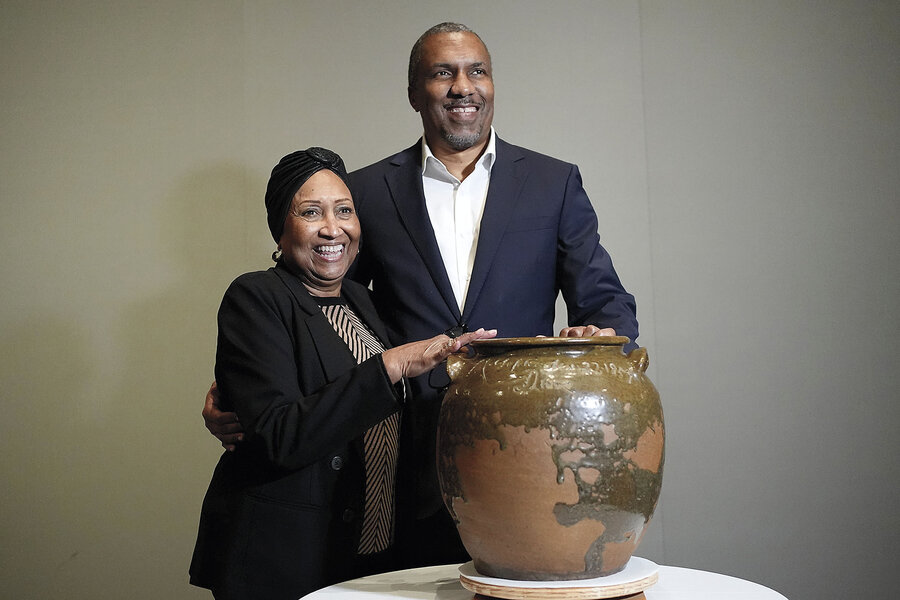
Last October, the Museum of Fine Arts, Boston did something unprecedented. It restored ownership of two of Drake’s pots to his descendants, marking the first time that such a claim had been resolved for a work of art crafted through the forced labor of Africans in America. Other museums and collectors own the pots, which today sell for hundreds of thousands of dollars.
Why We Wrote This
American history is full of overlooked stories, like that of David Drake, an enslaved potter in the 18th century, whose beautiful wares fetch hundreds of thousands of dollars today. Why the intense interest? In a time when literacy for Africans was illegal, Drake inscribed verses on the pots themselves. His phrases show a longing for family, and also a sense of humor.
Victoria Reed, the MFA’s chair of provenance, says in an interview that the museum’s relationship with Drake’s descendants dated back to 2022, when an exhibition featuring his pots, “Hear Me Now: The Black Potters of Old Edgefield, South Carolina,” was being planned.
“From my perspective, the most important thing was that we as an institution were upholding the criteria for restitution in a consistent way across departments,” she says. “We have dealt with claims for forcibly traded and coercively transferred property during the Holocaust. … I think we also have to ask these questions about forcible transfers in other [museum] departments as well. I would say it’s both unprecedented and we had something of a road map for it.”
Making pots as an “act of resistance”
Yaba Baker is a fifth-generation descendant of Drake and spokesman for the Dave the Potter Legacy Trust, the entity set up to honor him. “My uncle [John Williams] said you hear about [slavery], but once you have a direct connection to it, it feels different,” Mr. Baker says. “We understood the conditions [Dave] was working under, the heat and the toll, and how his family was sold from under him, which is why he wrote [the poem] about ‘all my relation.’”
“I wonder where is all my relation, friendship to all – and, every nation,” Drake wrote and molded into a pot dated Aug. 16, 1857. While his exact birth date isn’t known, it is believed that he was born in 1801 on a plantation in North Carolina owned by Harvey Drake, and was later transported to Edgefield to work for Drake’s business partner, Abner Landrum. It’s unclear how Drake learned to read and write, but South Carolina’s Negro Act of 1740 made literacy for enslaved Africans illegal.
In spite of those harsh realities, Drake made thousands of pots, which endeared him to the people of Edgefield and cemented his reputation. Mr. Baker calls Drake’s life and work an “act of resistance.”
“For us, he’s inspirational as a human. And then the work he did and the quality. Anything that lasts over the last 175 years is impressive,” Mr. Baker says. “We now have in our lineage someone who’s done something that changed the world.”

Celebrating “Dave Day”
The story of how Drake’s descendants learned about their ancestor can’t be told without the late April Hynes, a genealogist who was inspired by an artistic discovery made in her own family.
“April’s granddad was on this crew that was building a new school,” explains Wayne O’Bryant, a South Carolina-based historian. “They were digging a trench, and the shovel hit something hard. And so he dug around and pulled up this face jug.”
As it turned out, the jug was made in Edgefield County, and Ms. Hynes set out to learn more about the alkaline-glazed pottery method. What she found was the story of Dave the Potter, and then a question followed: Where are his descendants?
“It is important to note that prior to the 1870 census, slave ancestors had little records. If one was fortunate to have been listed in plantation records, or probate papers it was only by first name,” Ms. Hynes wrote on her blog, The Wanderer Project. “Enslaved families were rarely recorded by birth, death or marriage and African-Americans researching their slavery roots only have a few clues in which to reconnect their family history. To expect them to hold to the same standard of proof with other ethnic groups that held direct evidence and whose immigration was voluntary, tend to take this for granted.”
Ms. Hynes eventually made contact with Daisy Whitner, a fourth-generation descendant of Drake, and the aunt of Mr. Baker. Nearly 30 of Drake’s descendants made the trip from Maryland to Edgefield to celebrate the inaugural Dave Day celebration in 2016.
Almost a decade later, the revelation that landed in the family’s lap has manifested in an effort to tell Drake’s story and reclaim his glory.
“It was exhilarating to me, that in this environment that we live in today, that [the Museum of Fine Arts] would honor their promise of restitution,” Ms. Whitner says.
“The legacy that he left behind, I’m so inspired to encourage the family to do better,” adds Pauline Baker, Ms. Whitner’s sister and another fourth-generation descendant. “We have no excuse in this world because of [his] legacy. I am totally inspired by him.”
“He broke all the molds”
The landmark restitution between the MFA and Dave the Potter Legacy Trust centers around two of Drake’s pots. There’s also a pair of his pots on display almost 1,000 miles away at the Old Edgefield District Genealogical Society, which is also the current home of select wares from Old Edgefield Pottery.
While Drake’s legacy lives on in his descendants, there are other perspectives on his life and work. A likeness of his signed name is engraved on a unique edition of the book “Carolina Clay,” by Leonard Todd, one of the descendants of pottery businessman Lewis Miles, who enslaved Drake. It’s a deeply researched account that invariably becomes a topic of conversation whenever Drake’s name is mentioned. Justin and Tonya Guy, the current owners of Old Edgefield Pottery, light up when folks ask about the vessels, which they affectionately call “Dave” or “Daves” when talking about both pots.
Mrs. Guy spoke about Drake as being a figure who “stands out in not only Edgefield County history, but history in general.”
“Dave would’ve been right at the very beginnings of Edgefield pottery – the whole tradition. He would have been right there with Dr. Landrum and his brothers, who were the ones who kind of came up with the concept of visual pottery,” or showpieces that went beyond just utilitarian vessels, she says. “We believe it was Dr. Landrum who also employed Dave to work with him in the print shop, so he could learn to read and write.”
For Mr. Guy, a potter himself, there’s reverence and appreciation. “He was a true inspiration,” Mr. Guy says. “He did something truly amazing, and the character study of Dave himself will never get old. He broke all the molds.”
When asked about the partnership between the MFA and Drake’s descendants, however, the Guys expressed concerns about broken lineage and Ms. Hynes’ research.
“You’re doing [the descendants] a disservice by not doing your job as a genealogist and pinning their hopes on something that is not certainly true,” Mr. Guy says.
It is as uncertain a science as describing the dynamic between the enslaved and his enslaver, though Mrs. Guy has a compelling story about Drake and Lewis Miles: “There’s a pot with a handle on it which [reads]: ‘LM says this handle will [crack],’ which Dave inscribes. It didn’t break, which means Dave was right,” Mrs. Guy says. “But that tells you something about their relationship. Dave wasn’t just a slave. They had a more familial relationship for Dave to have such a voice.”
A legacy inscribed in clay
From Mr. Baker’s and the family’s viewpoint, there’s nothing else to prove about their lineage. “We went through a whole process,” Mr. Baker says. “MFA Boston … hired their own genealogist to confirm [the findings]. There wasn’t just one genealogist; there were several. To still ask the question of ‘How do we know?’ is insulting, in my opinion.”
It might be a fitting end – or beginning – to learning more about Dave the Potter, whose birth and death dates aren’t even known for certain. One thing that’s clear is that he was a deeply spiritual man whose works are still speaking for him decades later.