It’s time to rewrite the history textbooks – as a new study reveals that the biggest march in English history is a myth.
King Harold’s legendary 200–mile march to the Battle of Hastings in 1066 never happened, according to researchers from the University of East Anglia.
Instead, the journey was made largely by sea, they claim.
In their study, the experts reanalysed the Anglo–Saxon Chronicle – one of the earliest and most complete written records of English history.
Their analysis uncovered a ‘misunderstanding’ about Harold’s fleet, which was said to have ‘come home’.
While the Victorians interpreted this as meaning he dismissed his fleet before the Battle of Hastings, the experts now say this was not the case.
Professor Tom Licence, who led the study, said: ‘Harold’s campaign was not a desperate dash across England, it was a sophisticated land–sea operation.
‘The idea of a heroic march is a Victorian invention that has shaped our understanding, or misunderstanding, of 1066 for far too long.’
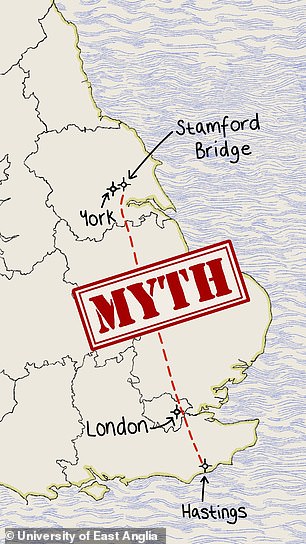
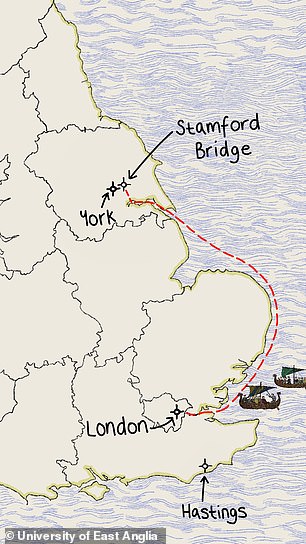
It’s time to rewrite the history textbooks – as a new study reveals that the biggest march in English history is a myth
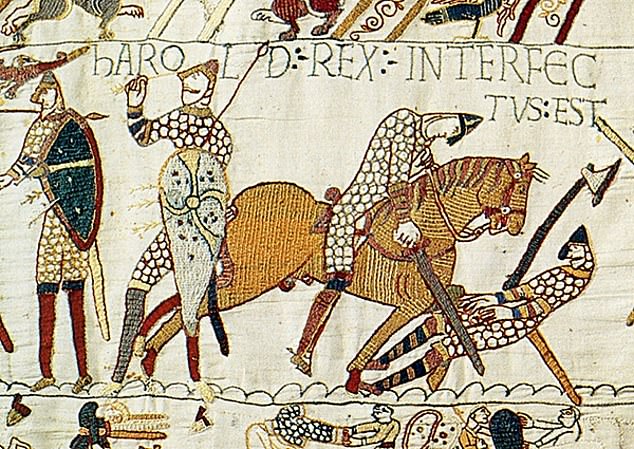
The Anglo–Saxon Chronicle was originally compiled around the late 9th century, with various anonymous scribes adding to it until the 12th century
The Anglo–Saxon Chronicle was originally compiled around the late 9th century, with various anonymous scribes adding to it until the 12th century.
It serves as a key record of early English history, documenting significant events from the arrival of the Saxons through to the Norman Conquest.
Until now, it has been widely believe that the Chronicle implies that Harold dismissed his fleet in early September 1066.
This is said to have left him no choice but to rush his troops south from Stamford Bridge in Yorkshire on foot.
The Chronicle says the ships ‘came home’, which Victorian historians interpreted as meaning Harold disbanded his navy.
However, the new study claims that this interpretation is wrong.
Instead, Professor Licence says the ships returned to their home base in London, and remained operational throughout the year.
‘I noticed multiple contemporary writers referring to Harold’s fleet, while modern historians were dismissing those references or trying to explain them away,’ Professor Licence explained.
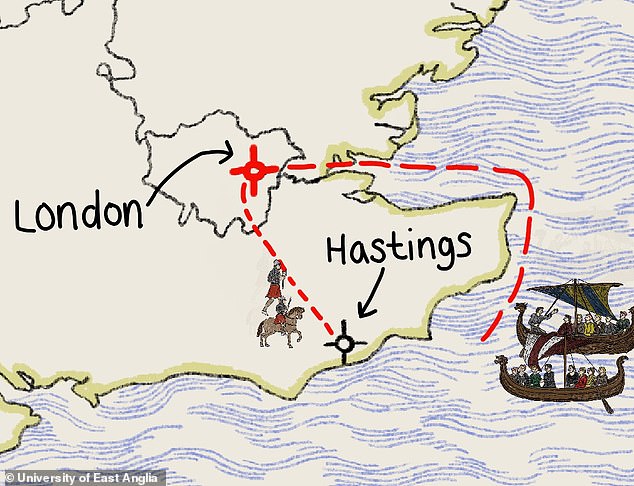
The new study claims that the Victorian interpretation is wrong. Instead, Professor Licence claims the ships returned to their home base in London, and remained operational throughout the year
‘I checked the evidence for him having sent the fleet home and found that it was just a misunderstanding.
‘I went looking in the sources for evidence of a forced march and found there wasn’t any.’
Contemporary sources describe Harold sending hundreds of ships to block Duke William after the Norman landing.
Until now, these references have caused confusion, since it was assumed Harold had no fleet left.
Professor Licence explained: ‘Harold’s “missing” fleet was used to defend the south coast, then to support his campaign against Harald Hardrada, and finally to rush back south after the Battle of Stamford Bridge ready to face Duke William of Normandy.’
Overall, the findings challenge one of the best–known narratives in English history.
‘Harold was not a reactive, exhausted commander, he was a strategist using England’s naval assets to wage a coordinated defence,’ Professor Licence said.
‘This reframes the events of 1066 and highlights a previously overlooked aspect of Anglo–Saxon maritime capability.’
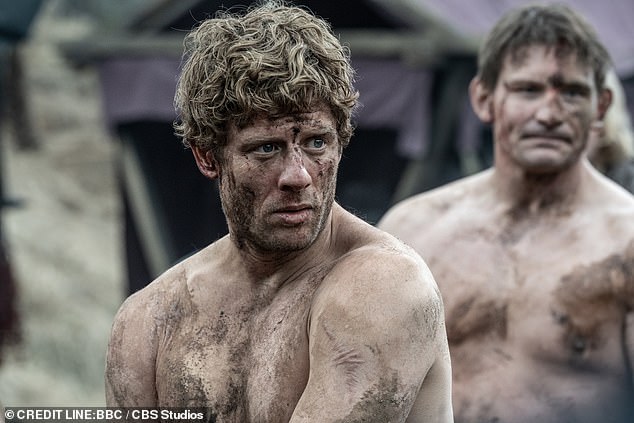
James Norton portrayed King Harold in the 2025 BBC series, King & Conquerer
Roy Porter, English Heritage Senior Curator of Properties, who oversees Battle Abbey and the Hastings battlefield, says the findings are ‘certain’ to spark debate among historians.
He said: ‘What we know about Harold’s previous military campaigns fits with the idea that he used naval forces to transport soldiers, and threaten William, and there are references in accounts of the Norman invasion which also lend weight to that possibility.
‘It’s exciting to consider that Harold’s response may have been far more sophisticated than previously understood, and William’s awareness of this may have informed when he chose to fight.’