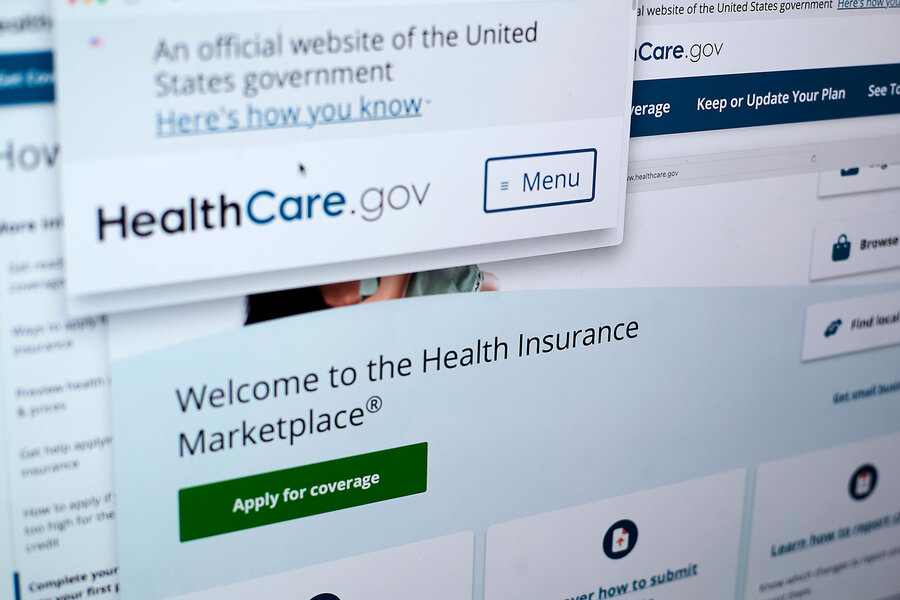
At the heart of what is now the longest U.S. government shutdown in history are federal subsidies that millions of Americans use to purchase health insurance on government-run marketplaces.
The shutdown began as Democrats dug in their heels to prevent these subsidies from expiring. And now, members of Congress are facing increasing pressure to end the shutdown – not just because of its effects on airports and federal programs like nutrition assistance, but also because of public concerns about rising insurance premiums.
These subsidies were greatly expanded in 2021 by Democrats who controlled Congress at the time. This led to a surge in enrollment on these marketplaces, which were created in 2010 under the Affordable Care Act (ACA), also known as Obamacare.
Why We Wrote This
The idea of federal subsidies to help more people afford health insurance was baked into the Affordable Care Act from the start. But they’ve grown – as has the strain of overall health care spending on federal budgets.
The expanded subsidies are set to expire next month, driving up premiums for many individuals and families who buy health insurance on Obamacare exchanges. For weeks, Democrats have called on Republicans to agree to extend the subsidies as a condition of reopening the government. Republicans have criticized the subsidies as wasteful and open to abuse, while arguing that the government must reopen first before Congress can discuss health insurance.
Dawn Schmidt doesn’t know yet how much her premiums will rise next year, but she’s worried about being able to afford her insurance plan. She retired from her job at Boeing in 2020 and lives in Pennsylvania, which administers its own ACA marketplace, known as Pennie. Administrators have warned her that premiums could rise by 82%. “It’s a lot. It adds up,” she says.
What are the expanded subsidies, and why are they expiring?
Subsidies were baked into Obamacare from the start. The idea was to assist individuals who didn’t have either employee-provided plans or access to Medicaid or Medicare, but couldn’t afford the market price of private insurance. Those with low incomes were required to pay between 2% and 10% of their income, with the government paying the rest.
The expanded subsidies were introduced by Democrats in 2021 during the COVID-19 pandemic, when access to health care was a pressing concern. Financial support was extended to Americans making more than four times the federal poverty level, now above $60,000 for an individual enrollee, while those with the lowest incomes no longer had to pay any premiums. Enrollment more than doubled, from around 12 million in 2021 to 24 million in 2024.
“We have more people in the system than we’ve ever had before, and that’s a good thing,” says Elena Marks, a health policy expert at Rice University’s Baker Institute for Public Policy. But, she adds, “the underlying costs continue to escalate … which is a bad thing.”
To pass the legislation, Democrats had to set an expiration date to satisfy congressional fiscal rules. This created an enrollment cliff that was already causing concern before the impasse on government spending that led to the Oct. 1 shutdown.
Tom Williams/CQ Roll Call/AP
Republican Rep. Mike Lawler (right) confronts House Minority Leader (and fellow New Yorker) Hakeem Jeffries about signing on to a bill that would extend Affordable Care Act tax credits, in the Capitol Visitor Center, Oct. 8, 2025.
How are Democrats and Republicans responding?
Democrats have tried to use the enrollment cliff as leverage to force an extension. Citing higher premiums in New York, Sen. Chuck Schumer has accused Republicans of ignoring a “healthcare crisis” that could see millions lose coverage if subsidies are slashed. “These devastating price hikes are entirely avoidable, but if Republicans keep stick[ing] their heads in the sand, New York families will be paying the price,” he said in a statement.
Most Republicans take a different view. They point to the fiscal burden of extending subsidies that, if made permanent, would cost around $350 billion over 10 years, according to estimates from the Congressional Budget Office. They question the design of Obamacare and its failure to curb rising health care costs, as well as the risk of waste and fraud. Some want to scrap the Affordable Care Act and replace it with an alternative approach.
What are the possible consequences of cutting subsidies for Obamacare?
Higher premiums could deter millions of Americans from enrolling in the 2026 program, which means more uninsured people. Those with middle incomes who didn’t benefit from the original subsidy program may decide to pay more out of pocket. Experts say far greater attrition is likely among low-income groups whose costs were almost entirely subsidized.
While critics have questioned why taxpayers are supporting middle-aged couples who took early retirement, such individuals are in the minority. Only 7% of enrollees in marketplaces had incomes over four times the federal poverty rate and, as a result, were eligible for the expanded subsidies. Of these, around half were between the ages of 50 and 64.
Ms. Schmidt falls into this category: She retired early because her husband is older, and they wanted to make the most of their retirement. He is now on Medicare, while she is too young to qualify and buys Obamacare insurance. She paid $211 a month this year for her plan, which has a $6,000 deductible, and is bracing to pay more if subsidies are eliminated.
“We’re probably going to have to cut back on things like vacations. We already cut back on spending on our grandchildren for Christmas and birthdays,” she says.
The participation of early retirees in Obamacare was woven into its design, says Ms. Marks at Rice. “Part of the reason behind the ACA marketplace was to allow people to not stay in jobs they didn’t want to stay in, to get health insurance,” she says.
Still, they aren’t the main beneficiaries of federal aid, she adds. “Most of the subsidy dollars go to the lowest-income people.”
Even with subsidies, the rising cost of premiums puts a strain on pocketbooks. Young people are generally more likely to forgo health insurance and risk having to pay out of pocket for medical care. This creates a quandary for insurers and regulators, since young people tend to use less health care compared with older people; insurance pools rely on serving a demographic mix.
This has long been the challenge hanging over Obamacare: If not enough young people pay into the system and the resulting pool skews less healthy, eventually it no longer becomes viable for private insurers. The individual mandate to buy health insurance was supposed to tackle this problem. Congress deactivated it during Mr. Trump’s first term.
Behind this difficulty lies a stark reality: Americans pay far more for health care than other countries, and most of the provisions in Obamacare that were designed to curb rising costs have been rescinded or have stalled. Tens of millions are still uninsured. And, while policy experts have proposed various solutions, so far neither political party has been willing to significantly cut rising expenditures on health insurance programs for an aging population.
A BARMAID said her evil boyfriend ruined her life after throwing her out of a 40ft tower block and telling police she jumped. Bobbie Goodman, 18, was pushed out of a fourth floor window by Jordan Herring in Solihull, West Midlands. Sign up for The…