This article is taken from the April 2026 issue of The Critic. To get the full magazine why not subscribe? Get five issues for just £5.
If the enduring appeal of some artists, such as the singer Madonna, can be attributed to their ability to reinvent themselves, the opposite is true of Tracey Emin. Contrary to her reputation as the most volatile artist of the YBA generation, cultivated by her pursuit of uncomfortably intimate subjects and the occasional public outburst, Emin has remained the same throughout her career.
Tracey Emin: A Second Life, a major exhibition at Tate Modern, is thus not so much a fresh start for the 62-year-old Emin as an opportunity to finally take her concerns in earnest.
Already, the earliest of Emin’s works included in the display — My Major Retrospective II consists of miniature photographic reproductions of her art school paintings from the 1980s, which she destroyed as inadequate — show the self-affirming, autobiographical obsession with which the artist became synonymous.
Yet a series of blanket-sized appliqués, like the 1993 Hotel International, whose title refers to the Margate property the artist’s parents managed, narrate Emin’s anxiety about her future and an obsession with making more of herself than her circumstances. These sentiments, and the way Emin would go on to voice them (in her interminable neon sloganeering, for example), are a profoundly English brand of platitude.
Indeed, this part of Emin’s oeuvre is a mixture of confidence and apprehension that characterised not only the artist’s early career but also much of British society in the final decades of the last millennium.
As the protective charm of the Union Flag waned (a feature in another fabric work), the momentum of the sexual revolution outran its course (the artist speaks of being called a “slag” by Margate boys in a video), and class and ethnic narratives became entangled (many handwritten confessional pieces dwell on prejudice), Emin, like many around her, turned to — and on — herself.
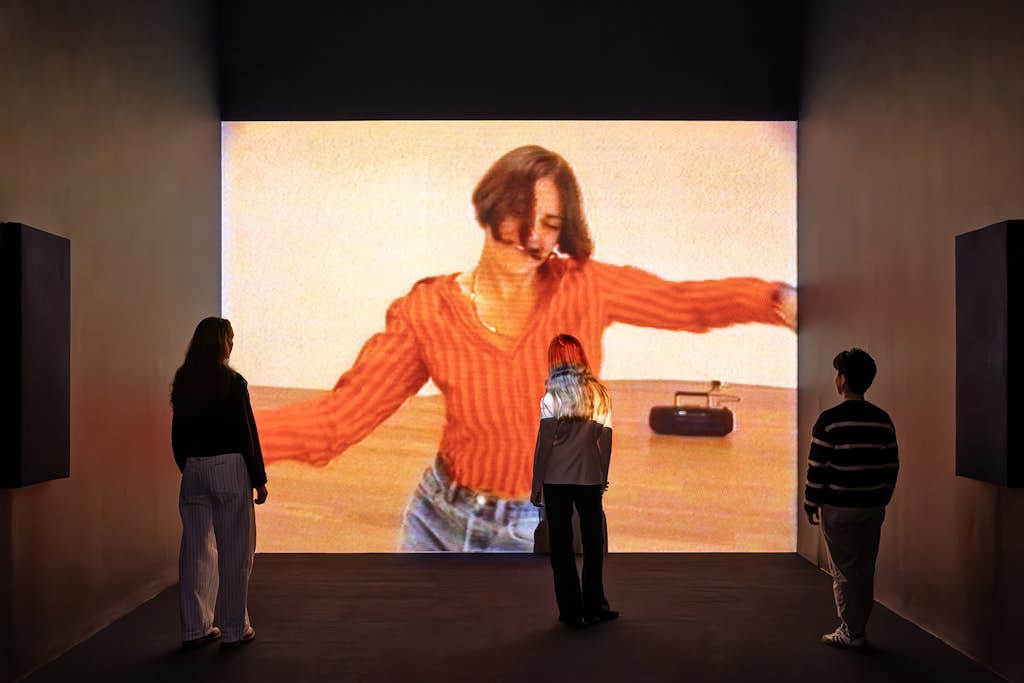
The exhibition unnervingly overlays the young, notorious Emin with the present, still notorious (albeit in a different meaning of the word) version of her. The 1996 video How it feels, in which the artist speaks about her first abortion, might have marked a watershed, were it not for the fact that this very piece, which is disturbing even today, brings the mixture of love and loss, alongside resolve and fear, to the forefront of all Emin’s other works.
One might understand this exposing piece to the camera, as well as Emin’s many monoprints and embroideries from this period, depicting the female body at the peak of its vulnerability, as part of a reckless turn in feminism. Contemporaneous critics accused the artist of emotional blackmail.
Yet her candour (she angrily admits that she terminated her pregnancy out of self-doubt) inspires the strongest protective, patriarchal feelings.
Emin has always been preoccupied with reality. A display of two series of photographic Self-portraits, arranged on the parallel walls of a narrow corridor, highlights her obsession with the body as the locus of experience.
Images from a 2001 sequence capture the artist posing seductively in her underwear for a handheld Polaroid camera. Opposite, in pictures from the 2020s, Emin unflinchingly shows off the effects of her bladder cancer surgery: blood and a double stoma. The juxtaposition is shocking; the later images dignify the sexy selfies, the earlier portraits invest the frail body with harrowing beauty.
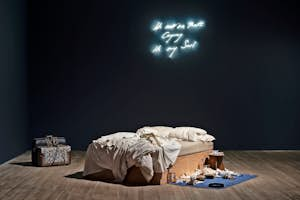
The corporeal continuity shown up by these images reframes even the infamous 1998 My Bed, which lies empty in the next gallery (although this artefact itself remains singularly unattractive).
High above it, Emin hung a 2024 bronze, Ascension, which renders a fragment of a body in imprecise, hand-modelled outlines. The torso is contorted; the perspective it imposes (not least on the artist, who may still be recumbent) is majestically reminiscent of the crucifix.
How should we understand these signs — the outrageous and the pious — in tandem? The bed, as the site of coitus, is the tangible, universal origin of all life and thought. The experience of death, whilst inevitable, is impossible to relate to fully first-hand, even in art.
Even more so, ascension is the rare preserve of the saintly. And Tracey, by her own admission, is no saint.
The synthesis of these ideas lies in Emin’s reflections on phantom pregnancies. Works such as Feeling Pregnant II (1999–00) are understated (and, again, Englishly corny) assemblies of text and readymades. Even in works that ostensibly do not relate to the topic — like the bronze Death Mask, which Emin made when she was only 39 — the confusion between beginnings and ends, in which we are all now living, is evident.
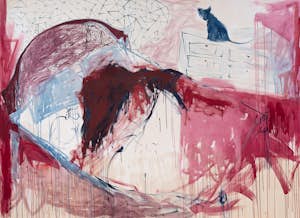
Is Emin’s refusal to move on an attempt to map some quasi-religious route to transcendence? Her latest paintings — many of them rendered in masterly, yet sketchy acrylics of blood reds and white, in a line reminiscent of Schiele — with titles such as I Followed you to the end (2024) gesture in this direction.
Yet surveying Emin’s lives is like witnessing someone experience ego death, over and again. Each work feeds off the artist’s corpus as though it were an autoimmune disease, always surprised that there is more Emin left. A Second Life is thus an uncanny mirror of the familiar mixture of unease, defiance and resignation of the society Emin was born into. Her work, once deemed distasteful, reminds us what we now cannot afford to lose.
Tracey Emin: A Second Life continues at Tate Modern until 31 August