A resurfaced poll from 1998 has highlighted Americans’ surprisingly prescient predictions of what would happen by 2025.
At the time of the survey, former president Bill Clinton was facing impeachment, Titanic had brought home 11 Oscars and Michael Jordan was leading the Chicago Bulls to victory.
Gallup and USA Today conducted the wide-ranging poll by calling 1,055 Americans over landlines.
They gave their forecasts on everything from politics to health and space travel, with most Americans accurately predicting several aspects of modern life.
Among those surveyed, 75 percent said a deadly new disease would emerge, an eerie foreshadowing of the Covid pandemic.
Almost three-quarters of Americans accurately predicted that gay marriages would be commonplace. Same-sex marriage was legalized nationally in 2015.
Meanwhile, 69 percent of respondents believed the country would elect its first black president, a statement which came true in 2008 with the election of President Barack Obama.
Other predictions hinted at developments that have taken place over the last two and a half decades, though they were not completely accurate.
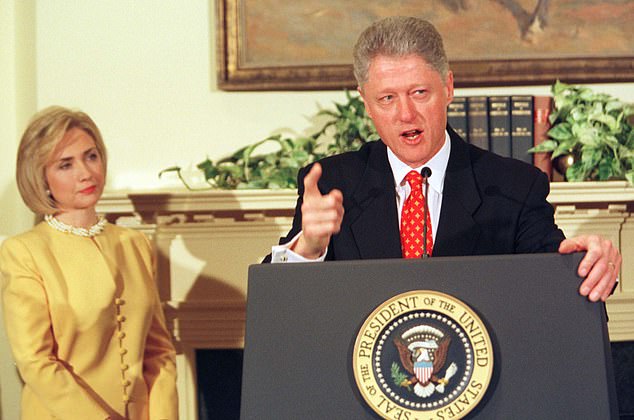
At the time of the survey, former president Bill Clinton was facing impeachment. He is pictured here addressing the Monica Lewinsky Scandal in 1998

Around three in four Americans predicted that a deadly new disease would emerge in eerie foreshadowing of the Covid pandemic
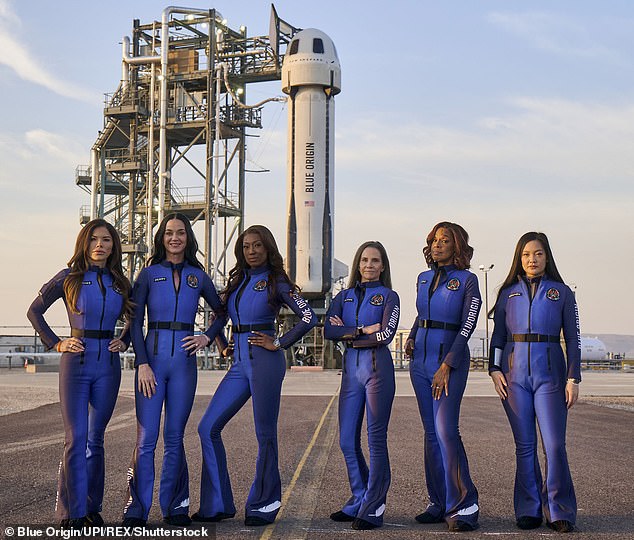
Americans also accurately predicted that space travel would not be commonplace for ordinary people. It remains limited to the famous and ultra-wealthy, such as Jeff Bezos’ wife (left) and Katy Perry (second to left), who were part of the all-women Blue Origin human spaceflight
Most Americans expected almost all stores would be wiped out by online shopping and that most people would work from home.
Trends have certainly moved in that direction. According to the latest census data, 13.8 percent of US workers usually worked from home in 2023, which was more than double the rate of 5.7 percent in 2019. But the vast majority are still working from offices.
Online shopping has also grown tremendously, with Amazon being the fifth largest company in the US by market capitalization, valued at an eye-watering $2.48trillion.
But brick-and-mortar businesses are still thriving. Walmart, the largest company by revenue in the US, still makes more than 80 percent of that revenue through its physical locations.
A majority of survey respondents also expected illicit drug use, such as marijuana and cocaine, to become commonplace.
According to the National Library of Medicine, the rate of marijuana use in the 1990s was about five percent, and that number nearly quadrupled by 2021, according to the CDC which said that 19 percent of Americans reported using the drug that year.
Just over half of Americans expected the US to be involved in a full scale war. That prediction became a reality just three years after the survey with the invasion of Afghanistan in 2001 and later Iraq in 2003.
Americans also made accurate predictions about what they did not expect to see by 2025.

In 1998, the year of the survey, Titanic brought home 11 Oscars and cemented Leonardo DiCaprio’s stardom

Among those surveyed for the poll, 69 percent said the country would elect its first black president. That prediction came true with the election of President Obama in 2008

The second largest majority of respondents – 74 percent – predicted that gay marriages would be commonplace
Most accurately believed that cars would not be replaced as the dominant form of transport and that human cloning would still be far outside the norm.
They predicted that space travel would remain unattainable for most people and did not believe that aliens would have made contact.
But for all the hits, there were also a few misses, particularly in the realm of healthcare.
Most survey respondents expected people to routinely live to be 100 years old and for AIDS and cancer to be cured.
Respondents also expected that the country would have elected its first woman president by now.
Those surveyed also made some more pessimistic predictions, with about 80 percent expecting Americans in the future to have less privacy and 57 percent expecting less personal freedom.
They also predicted higher crime rates, lower environmental quality and lower moral standards.
One of the biggest changes over the last 27 years has been Americans’ sense of satisfaction with their country.
In 1998, 60 percent said they were happy with the direction of the country and the way things were going. Today, less than a quarter still feel that way.