The Kennedy Center will be closed for renovations in July, and all of Washington’s culture vultures are in a tizzy. Thousands of self-styled sophisticates will be deprived of artistic offerings for two years, at least, and there’s no telling what the place will look like once President Donald Trump, whose name has been affixed to the marquee, is done.
Enjoy it while you can—the performances and the venue itself. “The Center for the Performing Arts named for Kennedy, an arts-loving statesman assassinated in 1963, opened in 1971,” Tom Sellar, the editor of Yale’s Theater magazine, wrote earlier this year. He continued,
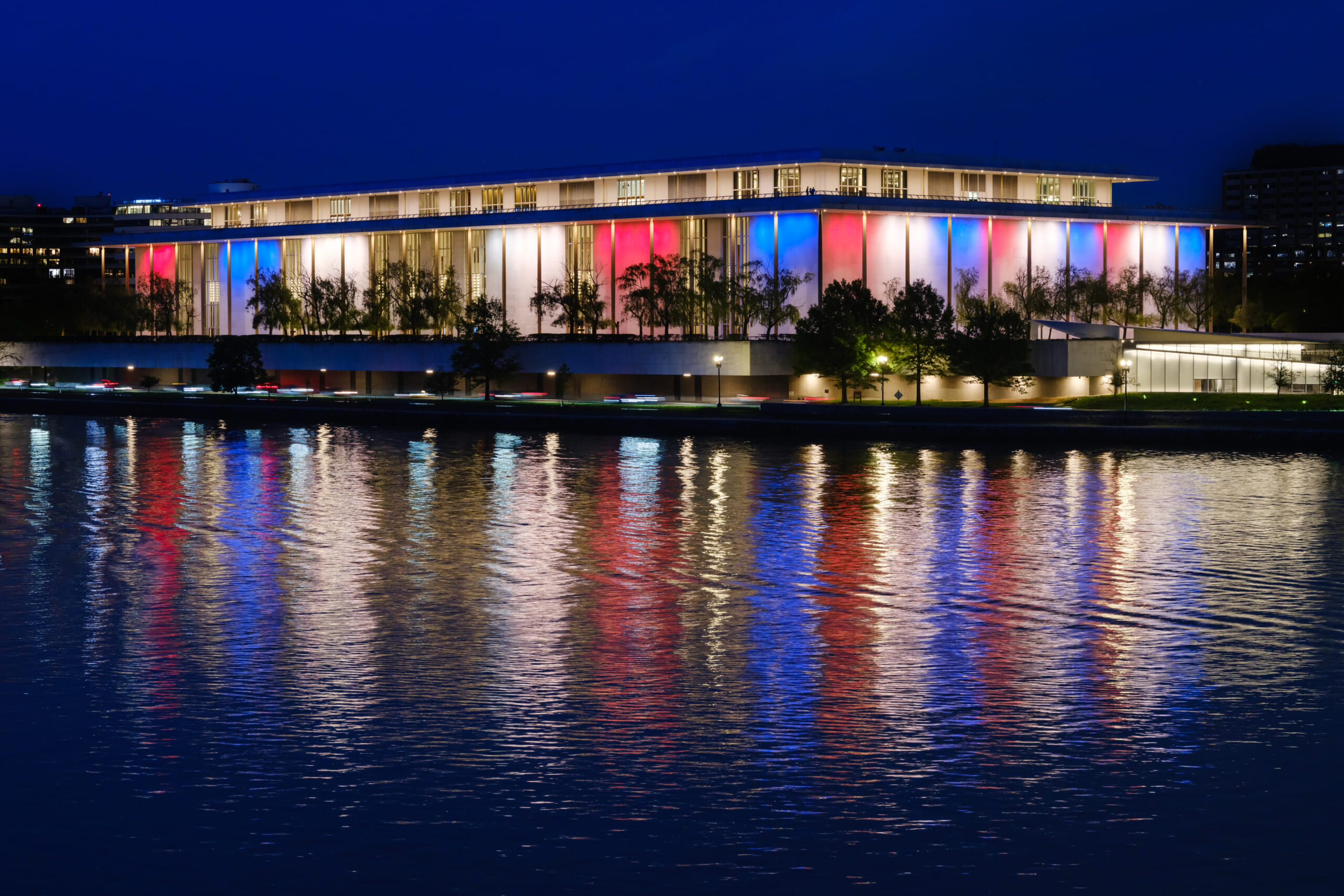
A white marble building with seven theaters perched along the Potomac River, it possesses sweeping views of the U.S. capital city. With striking crystal chandeliers and a regal red carpet leading visitors into the building, the land held a stateliness and glamor that memorialized the slain president while also honoring the performing arts. The institutional architecture might be dated, but when you walk into the building, you feel a little bit of Jackie Onassis glamour, the dignity of a bygone era.
It’s remarkable how much the place has improved in the past half century, considering that no significant improvements have been made. The Kennedy Center has been expanded, of course. Americans tend to make things bigger but not better, and that’s the case here as everywhere.
We also like to exaggerate the virtues of our heroes—especially ones no one can really remember—which is why JFK these days is regarded as not only as a great statesman, but a wit to rival Oscar Wilde and a connoisseur of the arts.
Mentions of Kennedy’s supposed love of literature, it has long since been revealed, was little more than a campaign ploy. Arthur M. Schlesinger Jr. urged JFK to position himself as a champion of “artistic and cultural achievement.” Even his “supposed addiction to James Bond,” Schlesinger said, was a “publicity gag.” Kennedy “seemed to enjoy the cool and the sex and the brutality” of Ian Fleming’s spy novels, Ben Bradlee said, but that was about it.
It’s remarkable, too, how the performance space named in JFK’s honor has, since Trump took office for the second time, become a beloved monument to high culture. That was never the case before. For decades, the Kennedy Center has been regarded as hopelessly middlebrow, if not actually embarrassing to the city’s true sophisticates.
It was certainly viewed as such when it opened. “The style of the Kennedy Center is Washington superscale, but just a little bit bigger,” Ada Louise Huxtable reported in the New York Times, when its doors first opened. “Albert Speer would have approved.”
Its 600-foot-long, 60-foot-high foyer—“the length of three New York City blockfronts,” made it “one of the biggest rooms in the world, into which the Hall of Mirrors at Versailles could be cozily nestled.” The Hall of States and Hall of Nations are “disquietingly reminiscent of the overscaled vacuity of Soviet places of culture. They would be great for drag racing.” The building itself “is a superbunker, 100 feet high, 630 feet long and 300 feet wide, on the Potomac. One more like this and the city will sink.”
The whole thing aimed for what its designers called “timelessness” and “produced meaninglessness.” What it has in size, “it lacks in distinction. Its character is aggrandized posh. It is an embarrassment to have it stand as a symbol of American artistic achievement before the nation and the world.”
With its “stupefying size” it’s “a familiar blend of theatrical glamor and showroom Castro Convertible.” It’s a “cross between a concrete candy box and a marble sarcophagus in which the art of architecture lies buried.”
What Trump will do can never be predicted with any kind of confidence and what he has in mind for the Kennedy Center, for his own ballroom and for the rest of the capital—considering the gold leaf he has plastered all around the White House—is not encouraging, of course. Jackie’s tastes were no doubt more refined than Melania’s, though it’s unlikely that our current First Lady will have much say in the plans, whatever that’s worth.
This is the edifice that establishment Washington now defends with such devotion, and echoes something else going on in political circles. This is from the same crowd, after all, that for decades has been telling us that the United States is a corrupt and racist plutocracy operating only for the benefit of rich people. Now they pledge to “save our democracy.” Go figure.
If you think health care is expensive now, just wait till you see what it costs when it’s free.
P.J. O’Rourke
Michael Tomasky of the New Republic wants to terminate the filibuster. Here he agrees with President Donald Trump, but for different reasons, of course. Trump wants to end the filibuster so he can get the SAVE America Act passed. Tomasky hates the SAVE Act but seems to think its passage would be a small price to pay for all the wonderful programs his likeminded liberals could enact once the filibuster was abolished.
The Democrats, “the party of government,” could “do a lot of things.” Good things, at that. They could “do what they came to Washington to do and pass laws that make people’s lives better.” Passing “bill after bill,” they could raise the minimum wage, make “vocational schools and community colleges free,” offer “subsidized childcare to working parents,” build “affordable housing units,” etc., etc., etc.—“done, done, done, done, and done.”
Americans would love it. “For the first time in ages,” Tomasky writes, they’d see their elected representatives, not wasting everyone’s time in “bickering and dysfunction.” Instead, they’d see “one party actually passing laws that make their lives a little better! They could, if they wished to, make FDR’s first 100 days look lackadaisical by comparison.”
But why stop there? The sky’s the limit. The agenda just laid out seems kind of miserly, if not mean-spirited, come to think of it.
C’mon, Michael. Loosen up, buddy! Use your imagination.
A study of the rise of rightwing populism in Europe and elsewhere by academics from universities in Salerno, Paris and Barcelona explores it as, in part, a backlash against globalization. Bankrolled by the National Research Fund of Luxembourg and the Brussels-based National Fund for Scientific Research, the report is generously decorated with the abstruse arithmetic equations now required of any and all serious contributions to political thought.
Left- as well as right-wing populism tends to spike after economic crises, the researchers find, and right-wing populism reached an “all-time high” during the decade ending 2019. Globalization is a factor, but immigration pressures play a role, too, and these can be expected to contribute to populist sentiments. Protectionist policies of trading partners, including the Trump administration’s tariffs, will also be a factor.
How impartial the researchers are might be inferred from how they frame the whole project. “Taken together,” they conclude, “our findings suggest that the blame for the rise of populism cannot be laid to globalization as a whole.”
Blame? Did you catch that?
Subscribe Today
Get daily emails in your inbox
Pete Hegseth’s firing of Army Chief of Staff Randy George—“the latest in a series of clashes between the Pentagon chief and the service’s leadership,” the Washington Post reports—calls to mind that great line from Stanley Kubrick’s Doctor Strangelove: “Gentlemen! Gentlemen! You can’t fight here. This is the war room!”