Britain is a ‘sitting duck’ in the face of drone attacks because Ed Miliband’s wind farms interfere with radar-based defensive domes, senior defence sources have claimed.
Ministers have been warned the UK lacks any equivalent to Israel‘s famous ‘Iron Dome’, which gives it the capability to intercept ballistic missiles at high altitude from 40 miles away.
Military chiefs have called for the Treasury to allocate the estimated £10billion required for the system – but have so far been promised only £1billion to scope out options.
Germany, in comparison, is spending £3.5 billion on the Arrow anti-missile system as part of an expanding pan-European air-defence network.
Part of the reason for the Government’s hesitation is said to be such a defence system would require the scaling back of Mr Miliband’s wind farm programme, which a source suggested ‘presents a major obstacle for anti-missile systems because of the impact they have on the radar needed to guide them’.
The Energy Secretary has vowed to double England’s onshore wind capacity to 29 gigawatts by 2030, and has dedicated £1.1billion a year for offshore wind developers as part of his aim to meet Net Zero targets.
The source added: ‘Wind farms are effectively giant chunks of metal that stand in the way of the tracking stations. It’s fair to say wind-farms and radar are not a great mix.
‘We are really lagging behind other countries on this. Ministers keep saying, “We have to be mindful of the cost implications, and there’s lots of competition for resources.”

Ed Miliband’s wind farm programme is proving an obstacle to the UK’s investment in air defence systems, a source has claimed

A billion pounds has been allocated to explore air defence options, but that is just a tenth of what ministers have called for. Pictured: The Israeli Iron Dome air defense system fires to intercept missiles during an Iranian attack over Tel Aviv, Israel, on June 18, 2025
‘Fine. But then what’s the cost of a missile landing in the middle of London, Manchester or Birmingham? We are sitting ducks.’
The RAF has also warned that the blades on Mr Miliband’s turbines reflect electromagnetic pulses pinged out by radar equipment to detect incoming aircraft and missiles.
This creates unhelpful background noise for system operators. Each blade on a turbine can generate a false return, meaning there is potential for disruption from several sites.
Another impediment has allegedly been that, while Israel leads the world in anti-drone technology, Sir Keir Starmer’s government has been reluctant to work closely with Tel Aviv given the strength of pro-Palestine feeling in the Labour Party.
The country’s Iron Dome is designed to intercept and destroy short-range rockets and artillery shells fired from distances of two to 43 miles.
And Air Chief Marshal Sir Richard Knighton last year suggested an Israel-style dome was needed to meet the Russian drone threat.
Sir Richard said: ‘We call it the integrated air and missile defence.
‘And we have, over 30 years, not really faced a threat from the air in that way. The threat has evolved. Russia’s capability and willingness to use ballistic and cruise missiles has become more apparent.’
He added that the UK would need to invest more in ‘radar capability, airborne air defence and our ability to shoot down drones and cruise missiles’. Sir Richard also acknowledged the UK was lagging far behind Israel and the US in developing such a defence, and said that it would include both aircraft and rocket launchers.
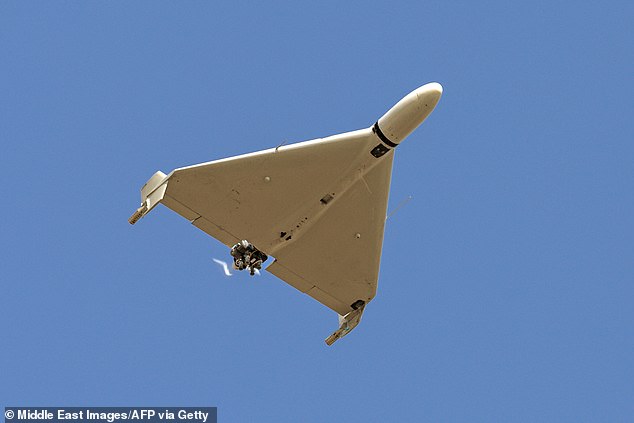
A pan-European air defence system is being developed in response to the increased threat of drone warfare. Pictured: An Iranian-made kamikaze Shahed drone
Labour is committed to switching to 95 per cent clean power sources by 2030 – a goal that will require a tripling of current wind capacity. It could lead to the relaxation of planning rules governing turbine construction.
MoD sources pointed out last night that wind turbine generation had to be done in a way that did not interfere with aviation and defence surveillance.
A spokesman said: ‘We recognise the vital importance of air and missile defence to UK national security and that is why we’re investing up to £1billion to improve air and missile defence.
‘As we build the next generation of large-scale offshore wind farms, we are looking at innovative ways to mitigate any impact on air defence and we have been able to mitigate the impacts of offshore wind farms with operational and technical solutions.’