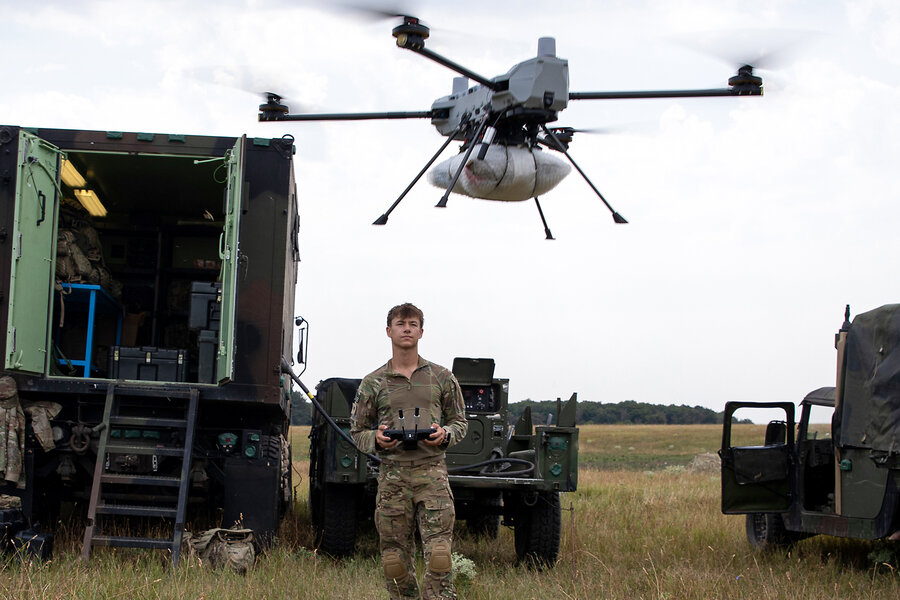
The U.S. Army is keeping a close eye on the battlefields of Ukraine and learning what many officers consider the war’s biggest lesson: how drones are changing the way American soldiers will fight.
So far, the military has been slow to acknowledge – and mobilize for – this revolution, top commanders say. Part of the delay is a result of the head-spinning pace at which drone technology has advanced, moving over the last a decade from basic aerial devices to complex machines with AI-powered navigation, long flight times, and advanced cameras.
“We’re behind – I’ll just be candid. I think we know we’re behind,” Lt. Gen. Charles Costanza, who leads U.S. forces deployed to Europe’s eastern flank, told an audience at an Army convention last month. “We aren’t moving fast enough.”
Why We Wrote This
America’s military leaders are having to think strategically about how to use drones and prepare soldiers for a new era that will require them to be creative, tech-savvy problem-solvers on the battlefield.
Small, inexpensive drones have become incredibly effective at taking out big, costly military equipment, lending urgency to the military’s efforts. Shortly after Russia’s 2022 invasion, for example, Ukrainian President Volodymyr Zelenskyy was pleading for U.S. tanks. He got some. Now, they’ve been essentially put out of commission by drones.
The U.S. Army’s plan now is to catch up by dramatically expanding its arsenal of drones and training its forces in the most effective ways to use them. The service will go from buying roughly 50,000 drones a year to more than 1 million annually by 2028, Army Secretary Daniel Driscoll said this month.
He and the Army’s top military officer, Gen. Randy George, visited Kyiv on Nov. 19, in part to discuss ways to end the war. But they also sought to check out Ukraine’s drone program, which Mr. Driscoll has called “an incredible treasure trove of information for future warfare” and a model for the U.S. military.
Russia and Ukraine each make roughly 4 million drones each year, and China likely produces triple that, defense officials say. The U.S., meanwhile, produces fewer than 100,000 drones – about half of those for military purposes – across some 500 American manufacturers, including Boeing and Northrop Grumman. The Army has also launched a public-private pilot program called SkyFoundry to speed up the creation of less-expensive flying robots for the military in part by turning existing Army depots into specialized manufacturing hubs where the service can more closely control costs and scale rather than relying on traditional contractors alone.
Commanders say American soldiers need more small, cheap drones to practice with, because they are often destroyed during training – through design flaws, human mistakes, or as part of war-game ambushes. But many current drone models cost thousands of dollars.
“Biggest battlefield innovation” in a generation
Defense Secretary Pete Hegseth called drones “the biggest battlefield innovation in a generation” in a memo ordering a reimagining of the way the U.S. military uses them.
The Pentagon’s goal now, he said, will be “unleashing the combined potential of American manufacturing and warfighter ingenuity.” By next year, unmanned systems will be part of all combat training, he added, “including force-on-force drone wars.”

Sgt. Juan Torres/U.S. Marine Corps
In the weeks after the July memo, the Army launched exercises to start getting more drones into the hands of soldiers in the field.
In the past, one big impediment to doing this has been the cost of drones that are highly likely to be destroyed during training. The price tag for each one ranged from $2,500 to $11,000.
That was “unacceptable for what we needed to do – that’s to throw a grenade on [the drone], put some C-4 [explosives] on it, teach people how to conduct an ambush,” said Brig. Gen. Travis McIntosh, deputy commander of the 101st Airborne Division.
After the defense secretary’s memo, “it was game on,” General McIntosh added at an Association of the U.S. Army Convention in October.
With the new focus on deploying faster, cheaper drones for the Army’s training exercises, the cost has since dropped to around $740 each. These “attritable” systems, as the Army likes to call them, can be made with cheaper materials than high-end reusable drones. They also tend to be more autonomous, reducing the need for complex control systems.
Now, during drills, defense contractors stand by to make tweaks to designs as soldiers break, fine-tune, and fix their drones, said Col. Donald Neal, commander of the 2nd Cavalry Regiment, at the same Army convention. “That’s the goal,” he says.
Teaching soldiers new skills
The Army is still working out just how to delegate its forces for drone operations since, at the moment, it involves “skill sets that maybe we don’t have throughout our force in a very formal way,” Colonel Neal said.
For now, the Army is creating new job specialties, courses, and exercises in which troops are learning how to integrate drones into military strategy – and where defense companies are learning how to weave troops’ tips into quick design tweaks as they go.
The aim is to better prepare soldiers for a new era that will require them to be creative – and in some cases, tech-savvy problem-solvers – on the battlefield.
“War does that,” General Costanza said. “It forces you to be innovative.”
The Army is also relying on troops who have “passion” and “a tenacity to learn,” he added. They watch YouTube videos and build their own drones; commanders support them by buying 3D printers, which create three-dimensional objects from digital files by layering and fusing materials.
To encourage and formalize this troop interest, the Army has also created a new military occupational specialty, or “MOS” in Pentagon parlance, just for drone operators. That means new schooling, including the Unmanned Advanced Lethality Course – a name that contains one of Mr. Hegseth’s favorite military words.
This three-week class includes 24 hours of combined simulator time for each student, as well as practice with first-person view (FPV) drones, now ubiquitous on Ukraine’s front lines.
So far, the course is teaching about 30 soldiers at a time. But the plan is for other units to build their own drone-training programs as well.
One of the Army’s biggest challenges remains the intense concentration and labor required to operate FPV drones in particular.
Troops need to be so focused as they maneuver them that it’s “don’t talk to that soldier, don’t nudge that soldier, don’t ask them to make a radio call – and they probably aren’t carrying a weapon,” General McIntosh said.
So, while it takes one person actually to operate the drone, it takes another to handle security, another to carry equipment, and one more to set up antennas – a four-soldiers-to-one-drone ratio, he said. “That’s the wrong math.”
For now, commanders like to stress the need for speed by frequently citing the “cookie test.” Some factories in Ukraine, as the story goes, put a fresh cookie in a drone off the assembly line. Once the baked good goes stale, the “drone isn’t capable anymore, because the technology has changed so quickly,” General Costanza said.
He admitted the story might be apocryphal. The point, he added, is that drone evolution “moves really, really fast” – and the U.S. Army must, too.