Iran isn’t winning the war being waged against it by the United States and Israel. But in the way it is responding militarily, it may be changing the rules of how wars are fought – and Ukraine might have the answers that the U.S. and its allies will need to respond.
Since the war began, Tehran has departed from its familiar playbook of tightly calibrated tit-for-tat escalation. Rather than concentrating firepower on a single, decisive target to overwhelm air defenses, its first retaliatory strikes were dispersed both in type and geography. The first drone and missile barrages hit airports, energy infrastructure, military bases, and hotels in the Gulf. Israeli cities and U.S. military and diplomatic assets in the region came next, followed by radar systems used to track incoming threats. Vessels transiting the Strait of Hormuz are in the crosshairs. The weekend saw attacks against docks, ports, and oil storage depots.
The shift in strategy has punctured the sense of security long cultivated by Gulf states, while inflicting psychological pressure on civilian populations across the region and rattling global markets and shipping lanes. It is also triggering a rethink of conventional air-defense math. Combined missile and drone attacks have become a defining feature of modern warfare. Cheap drones and relatively inexpensive missiles can compel defenders to expend far more costly interceptors, tilting the offense-defense balance toward attackers able to produce unmanned weapons at scale.
Why We Wrote This
Iran has shown they can do a lot of damage to United States and Israeli assets – and regional allies in the Gulf – via missile and drone attacks. But one country can offer its deep experience on how to counter such a blitz: Ukraine.
But such dynamics are already well understood in Ukraine, particularly in cities that spent years defending against waves of Iranian-designed drones launched by Russia. Kyiv has already begun sharing those lessons with U.S. partners in the Middle East. Teams of Ukrainian specialists have reportedly been dispatched to Gulf states and to Jordan to advise on counter-drone defenses and explore cooperation on battlefield technologies such as electronic warfare.
“They’ve basically got a Ph.D. in anti-drone warfare,” says Patrycja Bazylczyk, associate director and associate fellow with the Missile Defense Project at the Center for Strategic and International Studies. “They’ve really honed their craft of intercepting drones by many means.”
“Quality to quantity”
Since the start of Operation Roaring Lion, Iran has unleashed about 1,400 missiles and nearly 4,000 unmanned aerial vehicles across the region, striking Israel, the Gulf states, Iraq, Jordan, Oman, Turkey, Cyprus, and Azerbaijan, while Lebanon-based forces aimed more than 400 rockets toward Israel, according to a March 15 data summary compiled by The Institute for National Security Studies (INSS), an Israeli think tank.

“There is a quality to quantity,” says Grant Rumley, a senior fellow at The Washington Institute for Near East Policy and former Middle East policy adviser. “If you can cheaply produce large numbers of one-way attack drones, you can overwhelm an adversary’s air defenses and inflict damage that may not be as destructive as a missile strike, but can still have a major psychological and economic impact.”
The United Arab Emirates, for example, had spent vast sums over the past decade building a layered air-defense network centered on expensive Patriot and Terminal High Altitude Area Defense (THAAD) missile systems, which are extremely costly to operate. A single Patriot interceptor costs about $4 million, and a THAAD interceptor over $12 million. The systems themselves – batteries of roughly six truck-mounted launchers carrying dozens of missiles – run around $1 billion apiece.
Yet even those sophisticated defenses have been stretched thin as the UAE endures the largest volume of Iranian projectiles among Gulf states (309 missiles and 1,600 UAVs, according to INSS data as of March 15). Emirati Apache helicopters scrambled to shoot down Iranian drones midair last week. Earlier, in Riyadh, the Saudi capital, a suspected Iranian drone strike reportedly hit a CIA station. Iran also used drones to hit a French military base in Iraq, killing a soldier.
“Iran has been able to impose heavy costs on both Israel, the U.S., and the Gulf states by having this cost imposition strategy even if they are the weaker adversary,” says Ms. Bazylczyk. “They’re able to impose costs even as the U.S. is really raining [ordnance] down on them.”

For the Gulf states, the psychological impact may matter as much as the military one. “Iran might not be piercing the air defenses of Gulf states, but it is piercing the veneer of stability that is so crucial for the Gulf states and their theory of statecraft,” Mr. Rumley says. “For the Iranians, the ability to puncture that veneer is perhaps more valuable to them than actually defeating the air-defense systems.”
Ukraine’s defensive savvy
The experience of Israel and the Gulf states has been the lived reality for Ukrainians for years, says Ms. Bazylczyk. “Ukraine has been the world’s unwitting laboratory for drone warfare over the past four years, for better or for worse.” And it has inspired ingenuity that they can bring to defend against Iranian strikes – and benefit Ukraine by reducing the Middle East’s need for expensive air-defense missiles such as the U.S.-made Patriot interceptor, which Kyiv has been urgently requesting from Western allies for years.
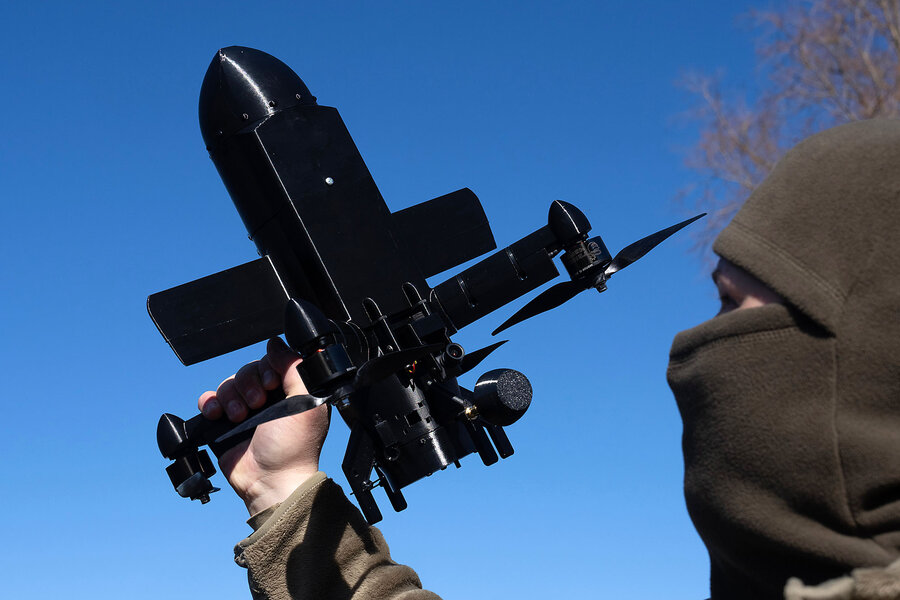
Key among Ukraine’s developments are interceptor drones: small, fast unmanned aircraft are piloted remotely by operators who steer them directly into incoming UAVs. Costing between a few hundred and a few thousand dollars, they provide a far cheaper way to stop weapons like Shaheds.
“Up to 35% of the Shaheds we destroy are destroyed by interceptor drones,” says Serhii “Flash” Beskrestnov, one of Ukraine’s best-known drone warfare specialists and an adviser to Ukraine’s Ministry of Defense. Most of the remaining Shaheds – almost 95% in total are destroyed, he says – are neutralized through a layered defense combining electronic warfare, interceptor drones, helicopters, ground fire, and traditional missile systems.

Scott Peterson/Getty Images/The Christian Science Monitor
For analysts, the drone arms race underscores the importance of developing a broad range of countermeasures. “People talk about the very costly missile interceptors that cost millions of dollars,” notes Ms. Bazylczyk. “And then they talk about really cheap drones, but there’s a myriad of solutions in between.”
Beyond jamming, she points to defensive nets and directed-energy weapons. The nets, a Ukraine innovation, have been deployed as canopies over roadways across the country, entangling Russian drones and preventing them from impacting Ukrainian targets. (Nets might be less suitable for a flatter, less war-torn environment like the Gulf, however.) As for directed-energy weapons, they use focused energy in the form of lasers or microwaves, rather than bullets or missiles, to take out targets. The key is for counter-drone defenders to feel comfortable with new technologies so that it is a tool in the toolkit they use.
“When a drone is approaching them, they need to feel confident reaching for that weapon and know that it will work,” Ms. Bazylczyk says.
Still, supply chains remain an issue. Ukraine’s wartime drone industry relies heavily on commercially available components that were cheap and readily available, many manufactured in China. U.S. defense planners are wary of building critical military systems around foreign-made parts, and are increasingly pushing to expand domestic manufacturing capacity, she notes.
The air-defense lessons of the current Gulf crisis and Ukraine conflict also matter beyond active war zones. Russian drone incursions are a reality in European countries, including Poland and the Baltic states. Whether dealing with cheap drones or high-end missiles, or with large windows for interception or short ones, successful air-defense strategies are governed by numbers.
It’s a bit like “a math equation,” says Mr. Rumley. “How do you defeat an air-defense system with eight interceptors? You shoot nine missiles at it.”