This article is taken from the November 2025 issue of The Critic. To get the full magazine why not subscribe? Get five issues for just £25.
In September, the NHS “Genomics Education Programme” published an article asking whether the UK government should ban first-cousin marriage.
Its answer was a confident no, even suggesting such unions might bring social benefits. The public outcry was immediate. So much so that the article vanished almost as quickly as it appeared.
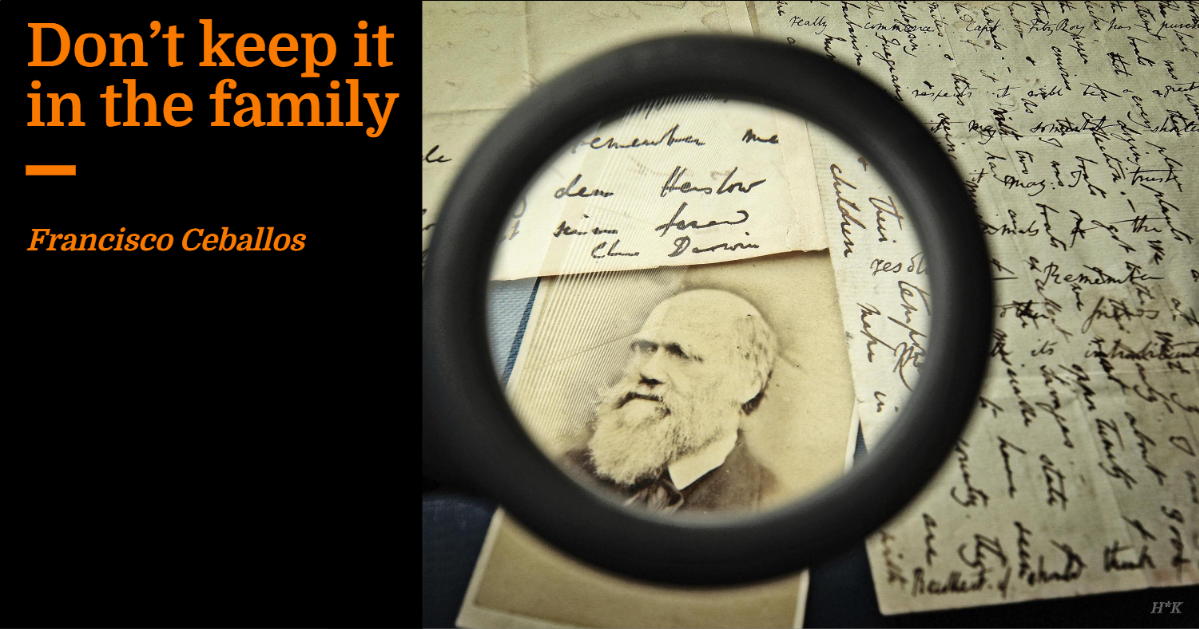
Yet this is hardly the first time Britain has wrestled with the question. First-cousin marriage was formally sanctioned by Henry VIII in the 16th century. More than three centuries later, Charles Darwin himself worried about its consequences. Married to his cousin Emma Wedgwood, Darwin fathered ten children, several of whom died young, suffered chronic illness or remained childless. His fears about inbreeding were not abstract: they were written into the pulse irregularities, digestive disorders and premature deaths of his own family.
Darwin’s anxieties drove him to study inbreeding systematically, beginning with plants. In The Effects of Cross- and Self-Fertilisation in the Vegetable Kingdom (1876), he demonstrated the harm of repeated close breeding. He even lobbied Parliament in 1871 to include a census question on cousin marriage, a request denied, perhaps unsurprisingly, since Queen Victoria had herself married her cousin Prince Albert.
His son George Darwin carried the investigation further, analysing marriage patterns amongst Britain’s sports elite and in mental asylums. He found cousin marriage more common amongst nobles than amongst workers, but no striking excess amongst asylum patients. Elite athletes, such as the Oxbridge boat-race crews, contained fewer inbred individuals than expected. The results were mixed, leading Darwin to soften his stance, but the question never disappeared.
Here we are again, with Parliament once more debating the risks of cousin marriage, in a motion tabled by Conservative MP Richard Holden last December. The science has advanced enormously since Darwin’s day, but the anxieties and the misunderstandings remain eerily similar.
More than a century after Darwin, in the age of genomics, the evidence for the risks of consanguineous unions is clear. Children of first cousins face a higher likelihood of inherited disorders, miscarriages and reduced fertility, not in every family, but at a population level significant enough to concern public health. Richard Holden brought these risks to Parliament, stressing the toll they place on families and on the NHS.
His remarks were countered by Labour MP Iqbal Hussain, who did not dispute the science directly but reframed the issue. He argued that cousin marriage was a long-established practice within parts of Britain’s Pakistani and Bangladeshi communities and that emphasising genetic risks risked stoking prejudice and social division. By shifting the debate from health outcomes to cultural sensitivity, Hussain deflected the focus from Holden’s concerns about congenital disorders and public costs.
Months later, that same reasoning appeared in an official context. The NHS “Genomics Education Programme” published an article that closely echoed Hussain’s arguments: downplaying the medical risks, casting them as exaggerated or poorly understood, and highlighting instead the supposed social benefits of cousin marriage, stronger family ties, cultural continuity, even economic support within extended kin networks.
Its conclusion, that there was no reason for restriction, read less like neutral medical advice than a political rejoinder transplanted into healthcare guidance. What had begun as a rebuttal in Westminster thus reemerged, almost unchanged, as NHS policy until public uproar forced the piece’s removal.
The NHS article contained inaccuracies and outright errors. One of the most misleading came through a citation of Professor Sam Oddie, a neonatologist in Bradford, who suggested that focusing on first-cousin marriage was an “oversimplification”, since the real issue was endogamy. That claim confuses two very different biological mechanisms that lead to inbreeding.
The first is consanguinity: when individuals deliberately marry close relatives, as in the case of first cousins. The second is genetic drift: what happens when a population is so small and isolated that, even without deliberate cousin marriage, individuals inevitably marry their relatives. Over time, random changes in such populations reduce genetic diversity and increase homozygosity, the genetic signature of inbreeding. Endogamy, as Oddie used the term, is closer to this second mechanism.
But in the British Muslim communities at the centre of this debate, the driving factor is not drift; it is consanguinity. A very large proportion of Britain’s Muslim population is Sunni, and in Sunni tradition cousin marriage has deep historical roots. The Prophet Mohammed himself married his cousin Ali to his daughter Fatima, establishing a model that still resonates culturally. First-cousin unions are not simply the by-product of small, closed populations; they are a conscious and longstanding practice.
The effects of first-cousin marriage are stark, and they have been well documented in Britain
From a geneticist’s point of view, the effects of first-cousin marriage are stark, and they have been well documented in Britain itself. Professor Oddie’s own research in Bradford found that children of cousin unions faced 181 per cent higher infant mortality than their peers. They required 39 per cent more primary care appointments, received 61 per cent more prescriptions, made 21 per cent more visits to A&E and had over twice as many outpatient hospital visits.
The educational impact was equally striking: an 89 per cent increase in learning difficulties, 63 per cent more problems with speech and language, children were 39 per cent less likely to achieve “good development” at school entry, showed lower phonics scores and were 38 per cent more likely to have special educational needs by the age of ten.
The biological logic behind these numbers is straightforward. Many genetic diseases are recessive: they only manifest when a child inherits two copies of the same faulty gene, one from each parent. In a randomly mating population, such cases are rare; the chance of two carriers meeting is low.
But in an inbred population the odds rise sharply. Basic population genetics tells us why: if an allele has a frequency of just one per cent, in the children of first cousins (whose inbreeding coefficient is 1/16), the risk of producing a child with the disease can be seven times higher than in the general population.
The problem is not confined to rare genetic disorders. Inbreeding also affects complex traits through a phenomenon known as inbreeding depression. This is the cumulative toll of many slightly harmful variants that, in unrelated pairings, usually remain hidden. In cousin marriages, those variants are more likely to combine, reducing overall health and fitness across a wide range of traits. The result is not just an increase in rare diseases, but a measurable decline in wellbeing, development and longevity.
In the age of instant information, and misinformation, the stakes of how we talk about genetics could not be higher. When complex risks are flattened into slogans or moral judgements, the result is stigma, blame and fear.
Yet genetics is not destiny: no one with a “risky” profile is condemned, and many who appear “low risk” still experience illness. Public health, more than any other field, must resist the temptation to speak in absolutes.
The Health Stigma and Discrimination Framework reminds us that health narratives ripple outward across levels: from institutions that shape policy, to communities where norms are forged, to individuals who may feel shame or concealment. When a medical government body like the NHS echoes a political rebuttal, rather than engaging rigorously with the science, it risks eroding trust.
The vacuum left by that lack of clarity is quickly filled by half-truths, sensationalism or conspiracy theories. In genetics, framing matters: how the story is told shapes not just what people believe, but how they act.
That is why clarity is not merely informative, it is protective. In a debate as entangled with identity, culture and history as cousin marriage, communication must be delivered with sensitivity, precision and humility. Genetics speaks in probabilities, not commandments; it points to risks, not verdicts. To acknowledge that honestly is not to stigmatise, but to empower.
When science is communicated with integrity, it equips families and communities to make informed choices without fear or coercion. When it is blurred by politics or softened into platitudes, it loses both accuracy and authority. In this debate, responsible communication is not an optional virtue, but an ethical necessity.