This article is taken from the February 2026 issue of The Critic. To get the full magazine why not subscribe? Get five issues for just £25.
Konrad Adenauer was born 150 years ago last month. The Federal Republic of Germany and European Christian Democracy are both largely his creation. Mayor of Cologne in 1917 when the Kaiser was still on the throne, he stayed in post throughout the Weimar Republic, was imprisoned during the Third Reich, was reinstated and dismissed by the Allies, yet became the first Federal Chancellor in 1949. Adenauer left office undefeated at the remarkable age of 87 in 1963.
Friedrich Merz, the present Bundeskanzler, was then nearly eight years old. Under his leadership, the Christian Democrats and their Bavarian partners won 28.5 per cent in last year’s federal election — their best showing for eight years. Under Adenauer, however, in 1957, the Christian Democrats had a vote share of more than 50 per cent.
That was the year I was born. Like most English families in the post-war era, mine regarded the Germans with a mixture of mockery and suspicion. My own interest in and lifelong love of German history and culture was a reaction against the prevailing contempt for the defeated foe. I still believe that we have much to learn from our North Sea neighbours.
Perhaps the only German my father knew well was a Jewish exile from the Nazis: the cartoonist Vicky (Victor Weisz). Vicky’s politics were in tune with the Bevanite leanings of my father’s magazine, the New Statesman, but far to the left of the Evening Standard and Spectator, for which he also drew. Vicky’s caricatures of Harold Macmillan (“Supermac”) and Charles de Gaulle evince genuine affection for his subjects, but he drew Adenauer less sympathetically: as a wizened old wizard, content to rebuild the Federal Republic and work his “economic miracle” with the help of former Nazis.
A Vicky cartoon of 1960 was prompted by a news story about West Germany seeking bases in Spain. It shows a (fictional) meeting of Adenauer and Franco. On the latter’s walls hang signed portraits from Mussolini and Hitler (plus, to remind readers of the Civil War, Picasso’s Guernica). The Spanish dictator asks: “What’s all the fuss about, Herr Doktor? I’m a Christian Democrat, too!”
Vicky’s jaundiced view of Germany’s Christian Democratic Union (CDU) as a bastion of reaction might seem absurd today, when British critics are more likely to caricature its luminaries such as Angela Merkel as unprincipled centrists and appeasers. In the decades after the war, however, it was hardly surprising that British Conservatives often treated their German counterparts as on probation. Margaret Thatcher’s allergic response to the opening of the Berlin Wall was by no means unusual for her generation.
Now, with the nationalist populists of the Alternative für Deutschland (AfD) snapping at the heels of the CDU in the polls, many Germans also shake their heads and worry about the long-term consequences of unification. Under Adenauer and Helmut Kohl, the Christian Democrats were a broad church, highly successful at integrating even the diehards of German politics.
These included the millions who had been expelled from Prussia, Silesia, the Sudetenland and other lost lands, and many more who had never accepted the Oder-Neisse line as Germany’s post-war eastern border. Adenauer and Helmut Kohl always kept Germans who saw themselves as victims on board. Only when unification finally came was Kohl forced to disappoint them.
A generation on, what Fritz Stern called “the politics of cultural despair” is rife across the eastern Länder. Western Germany, meanwhile, is gripped by mass border anxiety and the malaise of the Mittelstand, the small family businesses on which post-war prosperity was built.
As long as the CDU could deliver that prosperity and national prestige, such disappointments didn’t matter. But as the demographics turned against them, the German CDU quietly jettisoned their shibboleth that “Germany is not a land of immigration” and embraced multiculturalism. The Christian Democrats woke up to find that they were neither Christian nor democratic. Just as Marine Le Pen’s National Rally now dances on the grave of Gaullism in France and Nigel Farage’s Reform claims to have polished off the Conservative Party, so the Rechtsradikalen of Alice Weidel’s AfD proclaim the death of Christian Democracy in Germany.
How comparable, though, are the British Conservatives and the German Christian Democrats? Though the Tory party is much older — indeed, if you count it as a continuous entity, it is the oldest and most successful political party in the world — Christian Democrat Chancellors have held office for 51 of the 77 years that the Federal Republic has existed. Although the CDU has governed in coalitions of various complexions throughout its history, it has always been the dominant partner. Together with its sister party, the Bavarian Christian Social Union (CSU), it is often referred to as simply “the Union”.
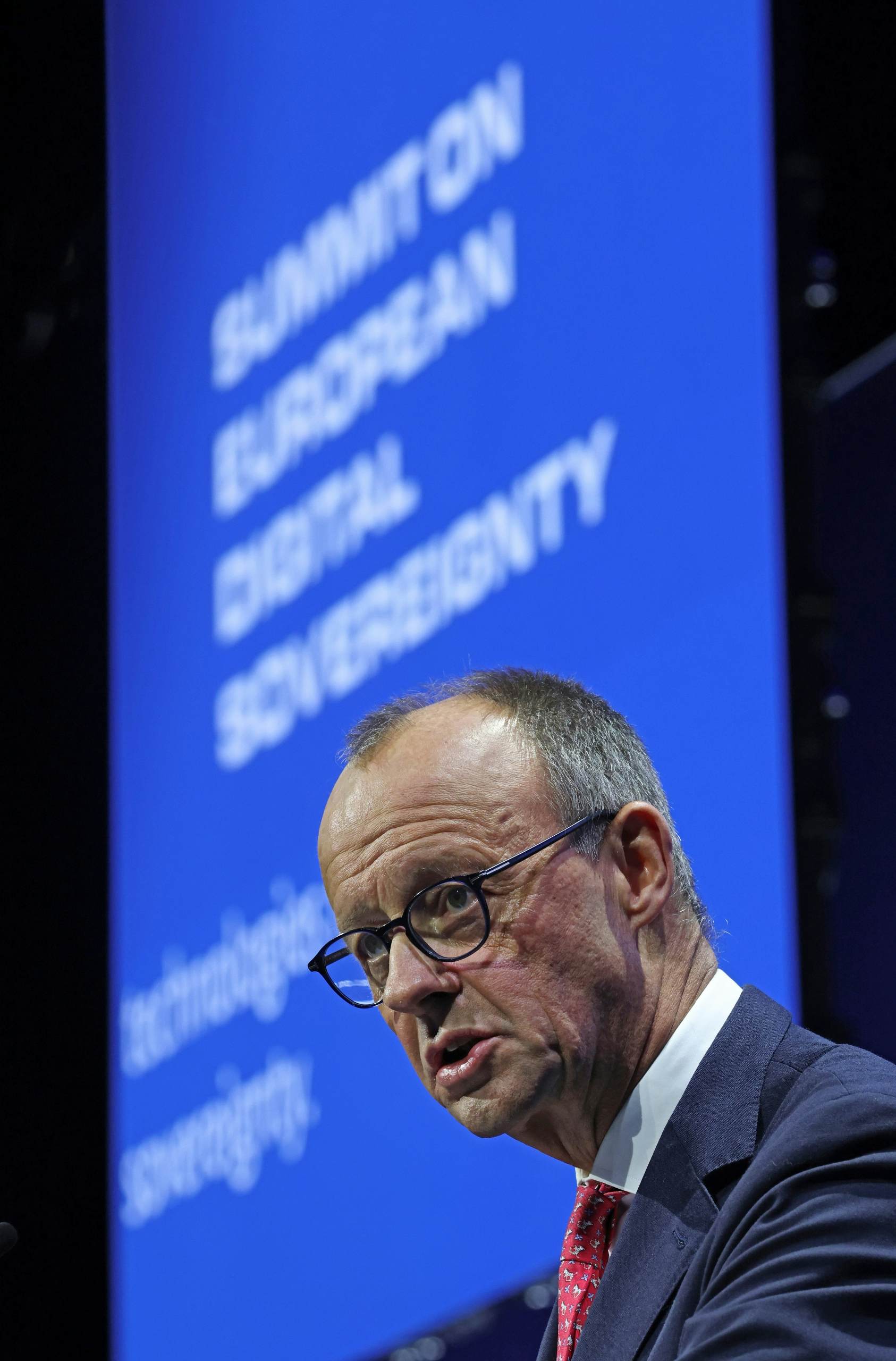
Friedrich Merz (credit: Sean Gallup/Getty Images)
Friedrich Merz is unusual amongst Christian Democrat leaders in one particular respect: his excellent command of English. Unlike the Social Democrat Chancellors Willy Brandt, Helmut Schmidt and Olaf Scholz, all of whom had good English, the Rhinelanders Adenauer and Kohl preferred French, whilst the East German Angela Merkel had Russian as her second language. The only exception was the Social Democrat Gerhard Schröder, whose English was so bad that he relied heavily on his Green Foreign Minister Joschka Fischer in dealing with leaders like Tony Blair and George W. Bush.
This linguistic contrast between left and right had consequences. Adenauer was dismissive of all his British counterparts, from Attlee to Macmillan. On a visit to Downing Street in 1953, he was appalled by Churchill’s physical and mental decline. In 1958 he told De Gaulle: “England is like a rich man who has lost his entire fortune but does not know it yet.”
Similarly, Helmut Kohl failed either to appreciate or to charm Mrs Thatcher, preferring to strike deals with François Mitterrand behind her back. Kohl got on better with Gorbachev than Reagan, whom he embarrassed by insisting that the President visit the Bitburg cemetery despite Waffen SS war graves.
Angela Merkel’s relationship with the British Conservative leaders she encountered ranged from tepid to icy. Euroscepticism was the objective reason for this lack of warmth, but the truth was that she never saw Britain as an important country for Germany. At a press conference at the Carlton Club in 2009, I saw how she publicly rebuked David Cameron for leaving the European People’s Party in Strasbourg — a striking discourtesy to her host. Mrs Merkel always cared more about demonstrating her own European credentials than about accommodating legitimate British concerns. She made little effort to prevent Brexit, and once it happened she was an enthusiastic advocate of blasting the British pour encourager les autres.
Friedrich Merz, by contrast, feels at home with the British. As a businessman, he respects the country that pioneered what Max Weber called “the Protestant work ethic and the spirit of capitalism” (even though he is a Catholic). Two decades ago he wrote a book, Mehr Kapitalismus wegen (“Dare more Capitalism”), which urged the Christian Democrats to break with the low-growth, high-welfare EU consensus, and return to the original principles of the German social market economy under Ludwig Erhard and Adenauer.
It is true that Merz, like Adenauer and Kohl, is a Francophile, descended on his mother’s side from the Savigny family. His grandfather, Josef Paul Savigny, was the mayor of Brion, a small town in the Hochsauerland region of North Rhine Westphalia. Like Adenauer, Savigny belonged to the Zentrum (Centre), the Catholic confessional party that had emerged during the 1870s in defiance of Bismarck’s campaign of persecution, known as the Kulturkampf (the original “culture war”).
In 1933, despite having voted in the Reichstag for Hitler’s Enabling Act, the Zentrum, like other parties, was abolished by the Nazis. Savigny did his best to ingratiate himself with the new regime (for example by renaming streets after Hitler and Goering), but was eventually replaced as mayor. He was a Mitläufer, a collaborator, rather than a fanatical Nazi and the family evidently suffered no major repercussions after 1945.
A Christian Democrat of Merz’s generation will have grown up in the shadow of Adenauer. Having founded what some nostalgically call the Bonn Republic, he set himself a triple task: to bind the Germans to the West with the Atlantic alliance, to end three centuries of Franco-German feuding, and to stop Stalin and Khrushchev from reuniting Germany as a neutral state.
Helmut Kohl accomplished reunification, but on his own terms: the communist German Democratic Republic was absorbed by the Federal Republic, which remained a key member of NATO and the European Union. Merz aspired to be Kohl’s heir, but the succession was usurped by Angela Merkel: first a protégé, then a pretender, finally a regicide.
Since 1945 the German Catholic Church had often resembled the Christian Democrats at prayer. Unlike her Catholic predecessors, however, Mrs Merkel was the daughter of a left-wing Lutheran pastor, known as “Red Kasner”, who chose to live and work in the East. As Chancellor she neglected die Westbindung, the network of Western alliances, economic and cultural connections on which the CDU’s pre-eminence had rested, and focused instead on cheap Russian energy. After Putin’s invasion of Ukraine, the scales fell from German eyes and Merz — by now a wealthy businessman — returned from his self-imposed exile to inherit a much-diminished party.
The comeback of this conquering hero has hardly been hailed as such. Indeed, his confirmation as Chancellor failed at the first parliamentary vote and required a second secret ballot: an unprecedented snub by malcontents in his own party. Merz’s determination to make the Bundeswehr once more the most powerful army in Europe has collided with the pro-Russian sentiments that still prevail across the political spectrum.
In such a climate, the Berlin establishment assumes that there could be no question of German troops joining the Anglo-French force promised to Ukraine to provide security guarantees against future Russian aggression.
Merz himself, however, is reluctant to countenance such excuses and evasion. He knows that German troops were last in Ukraine during the Second World War, where they and their collaborators killed some eight million Ukrainians (5.5 million of them civilians, including 1.6 million Jews). He knows that Putin’s propaganda depicts Zelenskyy’s government as neo-Nazis and that a German military presence in Ukraine would feed into this narrative. In the aftermath of Trump’s abduction of Nicolás Maduro, Putin’s attack dog Dmitri Medvedev suggested that the “neo-Nazi Merz” should also be kidnapped.
Yet precisely because Merz himself, like most Germans, counts Nazis amongst his forebears, he is determined that Germany should play a full part in helping Ukraine to defeat Putin’s genocidal invasion and occupation. The jury is out on whether Merz will succeed in rallying the German people (or even his own party) behind him in this endeavour.
Kohl and Adenauer could be confident the US would stand by them, but Merz cannot
It is hardly auspicious that at this critical juncture he must, like other European leaders, reckon with the possibility that the United States, the ally on whom they have placed most reliance, is not only seemingly siding with Russia, but threatening to annex Greenland, the sovereign territory of a NATO ally, Denmark.
Merz is being tested in ways that his heroes Adenauer and Kohl never were. Even though both had lived through dictatorship and war, defeat and occupation, they could be confident that America would stand by its allies in the defence of Western civilisation. Merz can have no such confidence.
In his masterpiece The Genesis of German Conservatism, the historian Klaus Epstein distinguished between three conservative archetypes: the defender of the status quo, the reformist and the reactionary. After the revolutionary and Napoleonic wars, Epstein argues, Metternich restored the status quo, sidelining both reformists and reactionaries. Today, CDU conservatives are also defending the status quo against radical reactionaries who really are offering eine Alternative für Deutschland — even if that alternative is a return to the 1950s or perhaps the 1930s.
In Britain, the Tories face a similar challenge from Reform. Kemi Badenoch has taken her stand on small-state, pro-market, reformist conservatism. Her response to nationalist populism has much in common with Friedrich Merz’s: both are classical liberals and moderate social conservatives but want radical restrictions on immigration. Merz is more explicit in his defence of Christian values, having voted consistently for pro-life positions, but Badenoch made her reputation in the culture wars and has encouraged a rearguard action against the assisted dying bill in the Lords.
British conservatism can learn from the politics, policies and predicament of Friedrich Merz. His brand of Christian Democracy, both catholic and Catholic, may seem remote from the Tories, who have enthusiastically embraced secularism. Yet as the late Maurice Cowling reminded us, the links between religion and public doctrine are innumerable and indissoluble.
It was St Boniface, our Anglo-Saxon apostle, who civilised the Germans. Nazi Germany and the GDR showed the world what a Germany shorn of that Christian civilisation would look like. Even the not-so-new atheists, from Richard Dawkins down, now fear what Britain minus cultural Christianity might become. Never have the Germans and the British needed one another more.