Donald Trump said today he was ‘not happy’ with the UK and ‘very surprised’ over its response to the Iran war in his latest attack on Keir Starmer.
In his latest broadside the president said Britain ‘should be involved enthusiastically’ with helping struggling US forces reopen the Straits of Hormuz to oil tankers and bring down global prices.
Trump suggested countries involved in protecting shipping in the Straits would face ‘very few shots’ from Iran, hours after the former head of the UK’s armed forces warned Royal Navy vessels could be sunk.
The president said that when he spoke to Starmer yesterday he admonished the Prime Minister for speaking to aides before making a decision on whether to send warships to the region.
Earlier today Sir Keir insisted the UK will not be drawn into a ‘wider war’ in the Middle East today as he knocked back the plea for warships in the Strait of Hormuz.
Giving a press conference in Downing Street, the PM insisted he wanted to see ‘an end to this war as quickly as possible’.
But facing the media this afternoon Trump said: ‘I was very surprised with the United Kingdom, because United Kingdom two weeks ago, I said, why don’t you send some ships over? And he (Starmer) really didn’t want to do it,’ Trump said.
‘I said, you don’t want to do it? We’ve been with you. You’re our oldest ally, and we spend a lot of money on, you know, Nato and all of these things to protect you.
‘We’re protecting them. We’re working with them on Ukraine. Ukraine’s thousands of miles away, separated by a vast ocean…
‘We don’t need to work with them in Ukraine, and then they tell us that we have a mine ship around and they don’t want to do it.’
He added: ‘I think it’s terrible. I was very surprised.’
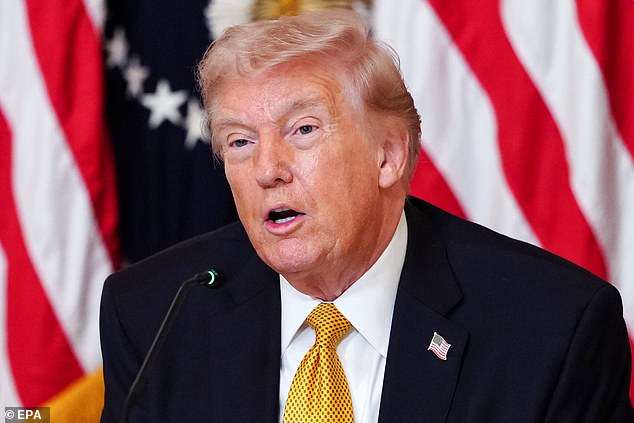
In his latest broadside at Keir Starmer the US president said Britain ‘should be involved enthusiastically’ with helping reopen the Straits of Hormuz to oil tankers.
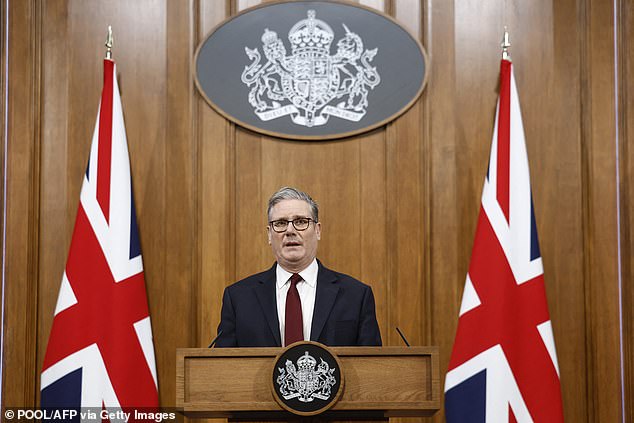
Giving a press conference in Downing Street, the PM insisted he wanted to see ‘an end to this war as quickly as possible’
Sir Keir said he was willing to be part of a ‘viable collective plan’ for the Strait, but said no decisions had been taken and suggested the UK is only looking at deploying anti-mine drones. ‘This is not easy. It’s not straight forward,’ he said.
The premier had a tense call with the president last night, in which he is believed to have signalled Britain will not deploy warships to the Strait. France, Canada, Germany and Australia have also dismissed the prospect.
Around a fifth of global oil supplies pass through the channel, but it has been effectively closed by Iran – sending prices soaring and raising fears of a worldwide recession.
Mr Trump upped the ante overnight by linking the response to his demand for ships in the Strait to the future of Nato and support for Ukraine.
Today he suggested countries involved in protecting shipping off Hormuz would face ‘very few shots’ from Iran.
Criticising nations that failed to support the US, he said: ‘The level of enthusiasm matters to me. We have some countries where we have 45,000 soldiers, great soldiers, protecting them from harm’s way. And we have done a great job.
‘And when we want to know ‘do you have any minesweepers?’, well ‘we’d rather not get involved, sir’.
‘You mean for 40 years we are protecting you and you don’t want to get involved in something that is very minor, very few shots are going to be taken because they don’t have many shots left.
‘But they said ‘we’d rather not get involved’.’
Today a former No10 expert warned that Trumps’ war could bring petrol rationing, medicine shortages and empty supermarket shelves to the UK within weeks, consumers were warned today.
Nick Butler said Tehran’s effective closure of the Strait of Hormuz to shipping meant there would be a global ‘shortage’ of oil in no time.
Prof Butler, who was an adviser to Gordon Brown and worked for BP for nearly three decades, insisted ministers must be ready to protect the ‘crucial sectors’ of the economy.
He told the BBC that it would mean ‘a form of rationing’, adding: ‘In the short-term, we have to look at what supply we have and look at the crucial sectors, the health service, food supply, hospitals, those are key elements that must be protected.
‘And beyond that, it is then for the Government to decide how to ration what is left if we get to that situation.’
But it came amid reports that hard-pressed families already struggling with the soaring cost of living may not get government assistance, with aid limited to benefit recipients and pensioners.
Officials are said to be examining whether to model aid on the current warm home discount scheme which gives six million people receiving pension credits or welfare cash £150 every winter.
The fighting between the US, Israel and Iran, now in its third week, has closed the Hormuz bottleneck that is used by supertankers leaving the Gulf oil production areas, since last week.
Trump has suggested the area has been mined and called for international help to protect shipping, though Sir Keir Starmer today said the UK would not be ‘drawn into a wider war’.
The PM vowed to force energy companies to pass on ‘every penny of the savings that we delivered at last year’s budget‘ to consumers, saying they would not be allowed to ‘make huge profits from the hardship of working people’.
He also insisted that switching the UK to reliance on green energy was the way to bring everyone’s bills down.
But if only benefit claimants and pensioners are eligible, millions of working households could miss out on support at a time of a general spike in the cost of living triggered by the US military action.
Domestic gas and electricity bills are covered by regulator Ofgem‘s price cap, which is fixed until June, but if the conflict continues and Iran maintains its stranglehold on shipping households could face dramatic hikes at that point.